Senior Legacy vs. Senior Legacy Life
 last updated on April 14, 2026
Here’s the Bottom Line:
• Senior Legacy and Senior Legacy Life are both lead generation companies
• You won’t see real quotes until an agent contacts you
• Your information gets shared with multiple agents after you apply
• Policies offered are standard burial insurance with possible waiting periods
• “No exam” marketing often hides higher costs and delayed payouts
• Not comparing carriers first is why many people overpay
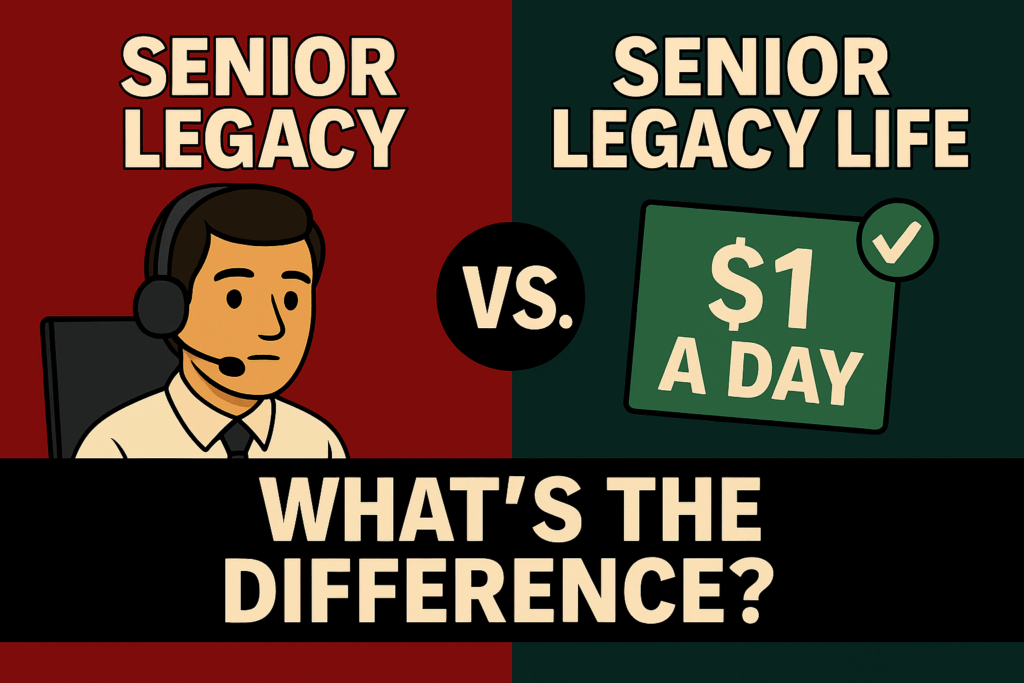
Senior Legacy vs Senior Legacy Life isn’t really a product comparison. Both are marketing platforms that collect your information and pass it to agents who then sell burial insurance or whole life insurance. The policies themselves come from outside insurance companies, not from Senior Legacy directly. That means pricing, coverage, and approval depend on who contacts you and what they offer. Without comparing multiple carriers upfront, it’s easy to get pushed into a higher-priced plan or one with a waiting period you didn’t expect.
Complete my quote request form on this page to compare real options fast and avoid mistakes.
PRICING AND VALUE COMPARISON
Policies sold through Senior Legacy Life often cost more than comparable first-day coverage sold by independent brokers.
Often, there’s no consistent rate sheet or single underwriting standard.
Here’s what a fair comparison looks like using average non-smoker rates for $10,000 in coverage at age 65:
The numbers speak for themselves.
First-day coverage with trusted carriers costs less and protects you immediately. The only reason people overpay is that they don’t know they have better options.
WAITING PERIODS AND REFUND POLICIES
Many of the promoted plans delay full payouts for 2 years, which surprises families when a death happens early.
When you’re told your coverage is “guaranteed,” it sounds reassuring. What you aren’t told is that those policies don’t pay out the full benefit during the first two years.
Let’s say you buy a $10,000 guaranteed issue policy through Senior Legacy Life. If you die from natural causes in the first two years, your family only gets back what you paid in premiums plus a little interest. That could mean receiving $600 back on a $10,000 policy.
After the two-year period ends, the full death benefit finally activates. That’s the moment the policy becomes what you thought you were buying from the start.
Simplified issue whole life 1st-day coverage works differently.
Once approved, the full benefit is active immediately. If you die the next day, your family gets the entire payout.
The difference between these two plans is massive, both in cost and in protection.
Many of the plans tied to Senior Legacy Life use guaranteed issue policies because they’re easier to approve in bulk. That might sound efficient, but it costs families real money when tragedy strikes early.
💡 The postcard that promised peace of mind
Robert, 68, received a Senior Legacy postcard that implied immediate whole life protection and led him to mail it back without asking questions.
He showed me the paperwork after his daughter asked why the policy mentioned “graded benefits” in small print. The card talked about guaranteed acceptance and lifetime coverage, but it never explained that natural death wasn’t fully covered for the first 24 months. Robert thought guaranteed meant paid out right away.
I walked him through the policy language line by line and explained how the waiting period worked and why it only refunded premiums early on. His health history showed no recent major issues, which meant the no-questions route wasn’t needed.
We replaced it with a simplified issue whole life policy for $15,000 that activates immediately and is intended to cover funeral costs and remaining medical bills the moment death occurs.
HOW THEIR PLANS ACTUALLY WORK
The insurance sold through this system usually comes from third-party carriers after a multi-step lead and sales process.
Coverage amounts usually range from $5,000 to $25,000.
There are two main types of policies you’ll often encounter through their network:
- Guaranteed issue life insurance: accepts everyone, no health questions. These plans always include a two-year waiting period for natural death. If you pass away during that period, your family will only receive a refund of premiums, plus a small amount of interest. They are often 40% to 100% more expensive than simplified issue plans.
- Simplified issue life insurance: includes a short health questionnaire. If you can answer those few questions honestly and aren’t terminally ill, you’ll often get first-day coverage with no waiting period and the lowest rates.
The problem is that many call-center agents automatically push you towards guaranteed issue plans because approval is automatic, but they cost up to 100% more and offer less protection than other, better plans and companies.
97% of the people I help qualify for 1st-day coverage. This means that protection starts the very first day your policy is active.
Yet many seniors are sold a plan with a waiting period because the agent wanted a sale that required no underwriting experience, rather than finding them the best fit.
⚠️ “State benefit” on a TV ad
Linda and Mark, both 72, called a number from a Senior Legacy Life television ad that suggested a state-regulated benefit tied to their eligibility.
The agent spoke quickly and focused on approval speed, not coverage timing. What wasn’t explained was that the plan relied on guaranteed issue underwriting, which delays full benefits for natural death. They assumed the wording meant oversight and protection similar to a public program.
I reviewed the application notes and clarified that the language was marketing, not a benefit category, and that nothing about the plan involved a state agency. Their health answers showed they could pass basic underwriting without trouble.
They ended up with a $20,000 first-day whole life policy designed to handle burial and final household expenses with the full payout available immediately.
WHAT IS SENIOR LEGACY?
Senior Legacy is a marketing operation that collects personal information and sells it to insurance agents instead of offering insurance itself.
It’s actually a marketing organization that generates and sells life insurance leads to call centers and agencies.
When you get a postcard, letter, or Facebook ad from “Senior Legacy,” it’s not a policy offer. It’s a data collection form designed to get your personal information.
Most of their ads talk about “state-regulated benefits” or “senior programs” that sound official. None of them is connected to any government office, the Social Security Administration, or Veterans Affairs.
Once you fill out one of these mailers, your name, age, and phone number are sold to multiple agents who start calling you within hours.
What makes this confusing is that “Senior Legacy” presents itself as if it’s a carrier. It isn’t. It’s a lead vendor.
The insurance itself comes from whichever company a call-center agent happens to represent that week. You’re not getting a quote directly from a carrier. You’re entering a marketing funnel.
When families think they’re applying for life insurance, they’re actually just approving themselves to be solicited repeatedly by multiple companies and salespeople. That’s why some people get five to ten calls each day for months after mailing a card back.
WHAT IS SENIOR LEGACY LIFE?
Senior Legacy Life is a licensed insurance agency that sells policies from other insurance companies rather than issuing its own.
The agency is legitimate in the sense that it’s licensed to sell life insurance. The problem is that its marketing often looks identical to the unlicensed “Senior Legacy” mailers.
This overlap leads many people to believe the two are one and the same, or that Senior Legacy Life is an insurance carrier. It’s not.
It’s an agency that markets policies from other companies, usually higher-priced insurance carriers such as American Amicable, Americo, and others.
Many agents under the Senior Legacy Life umbrella work as independent contractors. That means they might use the brand name but actually represent themselves or small marketing groups. This creates inconsistent sales experiences and makes it hard to know who you’re really dealing with.
To be fair, some Senior Legacy Life agents do help clients find suitable coverage. The issue is that consumers rarely understand who’s handling their policy: the marketer, the agency, or the carrier.
HOW SENIOR LEGACY & SENIOR LIFE ARE CONNECTED
Senior Legacy gathers leads and passes them to Senior Legacy Life agents who then try to sell insurance policies.
Here’s how the process works in many cases.
You get a mailer or see an ad labeled “Senior Legacy.” It asks for your age, phone number, and whether you already have life insurance. Once you respond, your information is sold to a call center or a licensed agent working under Senior Legacy Life. That agent then contacts you and tries to sell you a small whole life or final expense policy from another insurance company.
This creates confusion because the handoff happens behind the scenes.
Most people think they’re dealing with one company from start to finish. They don’t realize their private and personal data was passed through several hands before reaching the person who calls.
It’s not illegal, but it’s far from transparent. You deserve to know who you’re talking to, who’s getting paid, and which company is actually responsible for your policy.
WHY THE CONFUSION EXIST
The confusion comes from intentionally similar branding and marketing that makes private companies look official or government-related.
“Senior Legacy” sounds trustworthy, patriotic, and familiar. It’s the kind of phrase seniors associate with dignity and family values. Marketing companies use names like that on purpose, hoping it builds instant trust.
Then they take it further by designing mailers that look like government forms or official state notices.
Many use bold letters such as “FINAL EXPENSE BENEFIT INFORMATION” or “STATE REGULATED PROGRAM.” Some even add fake reference codes and official-looking seals to make it appear legitimate.
What people don’t see is that these mailers are printed by private marketing firms that sell the responses. They are not from any state agency or life insurance carrier. The company collecting the cards isn’t the same one issuing the policy.
The Federal Trade Commission (FTC) has warned consumers for years about these deceptive “state benefit” mailers, which prey on seniors trying to protect their families.
🔍 Five calls after one form
Angela, 59, filled out an online Senior Legacy form after seeing a social media ad and believed she was requesting a direct quote from an insurance company.
Within hours, multiple agents called, each claiming to help her finish the process. None clearly explained who issued the policy, and one suggested she accept a fast approval option without reviewing health details. The missing piece was that her information had been passed around before any coverage discussion started.
I traced the source of the form, explained the lead handoff, and reviewed her actual health profile. She didn’t need an underwriting shortcut, and skipping questions would’ve limited her early protection.
She secured a $10,000 whole life policy with immediate coverage meant to pay for cremation services and outstanding final bills as soon as the policy takes effect.
COMMON COMPLAINTS AND CONCERNS
Most complaints stem from aggressive follow-up calls, unclear company identities, and mismatched expectations about coverage.
Almost every time, it started with a “Senior Legacy” postcard, letter, or form.
The most common complaints include:
- Repeated phone calls at all hours
- Agents refusing to say which company they represent
- Confusing paperwork that doesn’t match the name on the mailer
- Rates that change between the first call and the policy offer
The Better Business Bureau (BBB) shows consumer complaints tied to misleading marketing and excessive solicitation. The National Association of Insurance Commissioners (NAIC) receives similar reports, noting that people often mistake lead vendors for real insurers.
When customers discover that “Senior Legacy” isn’t an insurance company, frustration sets in. They thought they were getting coverage. Instead, they got added to a sales list that could be sold again and again.
The problem isn’t that every agent under the Senior Legacy Life brand is dishonest. The problem is that when your personal information is treated like a commodity, trust disappears fast.
COMPANY REPUTATION AND FINANCIAL STRENGTH
Neither Senior Legacy nor Senior Legacy Life has financial ratings because they don’t issue or pay insurance claims.
When people look up Senior Legacy or Senior Legacy Life, they expect to see ratings from places like A.M. Best or the National Association of Insurance Commissioners (NAIC).
You won’t find any, though.
That’s because neither Senior Legacy nor Senior Legacy Life is an insurance carrier. They don’t issue or pay out policies, so they aren’t rated.
The real insurance company behind your policy is what matters.
It’s the carrier your agent places you with, such as American Amicable, Americo, or others. Those companies are rated and regulated by financial authorities.
Senior Legacy and its related entities operate as middlemen, connecting you to those carriers but taking a commission cut in the process.
The Better Business Bureau (BBB) lists multiple consumer complaints about misleading marketing, repeated calls, and unclear policy ownership. The confusion usually comes from not knowing which company is actually responsible for your insurance.
Always check the carrier’s financial strength rating before signing. A company with an A or A+ rating from A.M. Best has proven financial stability and a long history of paying claims. If a salesperson refuses to tell you which insurer will back your policy, stop the conversation.
WHO SENIOR LEGACY LIFE IS BEST FOR
These plans mainly fit people with serious health issues who can’t qualify for lower-cost first-day coverage elsewhere.
These plans may help people who have serious health conditions, such as advanced diabetes, recent cancer treatment, or heart failure (albeit at a much higher cost).
If every other company has declined you, a guaranteed issue plan might be your last resort.
But for most seniors, that’s not the case.
If you can answer a few simple health questions, you can qualify for first-day coverage through an independent broker at a lower price. Paying more for a two-year waiting period doesn’t make sense when you could be approved immediately elsewhere.
Many consumers are convinced that Senior Legacy Life’s business model focuses on volume, not personal service. That’s why most customers get routed through call centers. You might speak to one agent today and someone completely different next week. There’s little long-term relationship or follow-up after the sale.
That setup works fine for telemarketing companies. It doesn’t work for families who want honest guidance and a single person they can call for help later.
HOW TO VERIFY YOUR POLICY AND AGENT
You protect yourself by confirming the agent’s license, the issuing carrier, and the policy details before paying anything.
Here’s how to protect yourself:
- Ask for the agent’s full legal name and license number. Every legitimate agent has one.
- Look up their license using your state’s Department of Insurance website. Every state has a free public lookup tool.
- Ask which company will issue the policy. Write down the insurer’s full name and policy type.
- Check the insurer’s A.M. Best rating to make sure it’s at least a B+ or higher.
- Confirm your first payment method is made directly to the insurer, not the agent or marketing company.
If the person you’re talking to gets defensive when you ask these questions, walk away. Honest agents appreciate informed clients.
The only people who dislike these questions are the ones trying to hide something.
BETTER ALTERNATIVES FOR SENIORS
Independent brokers can compare multiple carriers and often place seniors in lower-cost plans with immediate coverage.
Independent brokers like me at the Final Expense Guy work directly with A-rated carriers, including Mutual of Omaha, Family Benefit, Trinity Life, and Aetna Accendo.
These companies offer simplified-issue whole life policies that pay the full death benefit immediately upon approval.
The application process is simple. You answer a few short health questions with no medical exams, no waiting. The goal is to match your health profile with the carrier most likely to approve you for first-day coverage at the best rate.
Because independent brokers like me aren’t tied to one company, we can compare multiple carriers at once and show you the real cost difference. That’s how families save hundreds every year and avoid the two-year waiting period that most call-center agents push.
For example, a 70-year-old non-smoker can often get $10,000 in first-day coverage from Mutual of Omaha for around $53 per month, while a guaranteed issue plan from a call center might cost $87 or more for the same amount. The difference is massive, and the costs add up quickly.
WHO OWNS SENIOR LEGACY AND SENIOR LEGACY LIFE?
Senior Legacy operates through loosely connected marketing entities, while Senior Legacy Life is a registered insurance agency with state licensing.
Senior Legacy Life, on the other hand, is a licensed agency registered with the National Association of Insurance Commissioners (NAIC).
You can verify their active license and the states they’re approved to sell in by checking your state’s Department of Insurance license lookup tool.
The key distinction is this:
- Senior Legacy sells personal information submitted via letters and forms.
- Senior Legacy Life sells life insurance policies.
When a company’s ownership is unclear or hidden behind multiple DBAs (doing business as names), it should be a red flag to consumers.
Real insurers like Mutual of Omaha or Royal Neighbors have transparent corporate structures, published financial ratings from A.M. Best, and regulatory filings with the NAIC. You won’t find that kind of documentation for “Senior Legacy.
HOW TO REPORT MISLEADING INSURANCE MARKETING
Misleading mailers and ads can be reported to federal and state regulators that track consumer fraud.
If you’ve received a postcard or ad that looks like a government notice but mentions “Senior Legacy,” don’t ignore it. You have the right to report deceptive advertising. Doing so helps regulators track which companies are using misleading mailers or robocalls to target seniors.
Here’s how to take action:
- File a complaint with the Federal Trade Commission (FTC). Use the online portal at reportfraud.ftc.gov. Attach photos of the mailer and the envelope it came in.
- Contact your State Department of Insurance. Every state regulator tracks unauthorized marketing activity. They can confirm whether the sender is licensed or just selling data.
- Report fake government-looking mailers to the U.S. Postal Inspection Service. This group investigates mail fraud and deceptive solicitations.
- Tell your family members. Scammers rely on silence. Talking about what you received protects others from the same trap.
Regulators take these complaints seriously, especially when the material appears to be an official government document. The more information you include such as postmarks, sender name, and images, the faster they can investigate.
FINAL VERDICT: SHOULD YOU TRUST SENIOR LEGACY OR SENIOR LEGACY LIFE?
Both operate legally, but their marketing model adds confusion and cost compared to more transparent options.
One collects leads. The other sells policies. Neither is an insurance company.
Suppose you’re comfortable being routed through multiple layers of sales calls and possibly paying more for a plan with a waiting period. In that case, Senior Legacy Life can still issue you a valid policy.
But if you value honesty, transparency, and getting the most for your money, there are better ways to buy coverage, like through the Final Expense Guy.
Independent brokers like me work directly with the top-rated insurers and help you qualify for immediate protection. This guarantees your family is protected from day one. You should never have to guess who holds your policy or whether you’re covered right away.
Call 888-862-9456 or visit FEXGUY.com to get a quote from a licensed professional, not a marketing middleman. I’ll help you compare your best options and find real first-day coverage you can trust.
FREQUENTLY ASKED QUESTIONS: SENIOR LEGACY & SENIOR LEGACY LIFE
What is a Senior Legacy Life plan?
Senior Legacy operates as a sales agency that markets life insurance policies from other companies.
It’s not a separate insurer – it’s a sales agency.
How does Senior Legacy Life Insurance work?
Senior Legacy Life sells small whole-life policies meant to cover burial costs.
Premiums never change, but many of their advertised “instant approval” plans have a two-year waiting period before full benefits apply.
Who is eligible for Senior Legacy Life?
Most people ages 40-85 can apply for coverage through Senior Legacy Life.
Health plays a big role in whether you qualify for first-day coverage or a modified plan with a waiting period.
What are the benefits of Senior Legacy Life?
Simplified issue underwriting makes it easier to get coverage without a medical exam.
The downside is higher cost per thousand in coverage
How much does Senior Legacy Life cost?
Senior Legacy Life pricing often runs higher than similar coverage from other carriers.
Many plans start around $60 per month for $10,000 at age 70, while competitors offer first-day coverage for $45 or less.
Is Senior Legacy Life worth it for seniors?
Senior Legacy Life usually isn’t the best value compared to other final expense options.
You can find stronger financial ratings, faster claims, and lower premiums elsewhere.
