AARP Burial Insurance Review
Here’s the Bottom Line:
• AARP burial insurance is easy to get but often overpriced
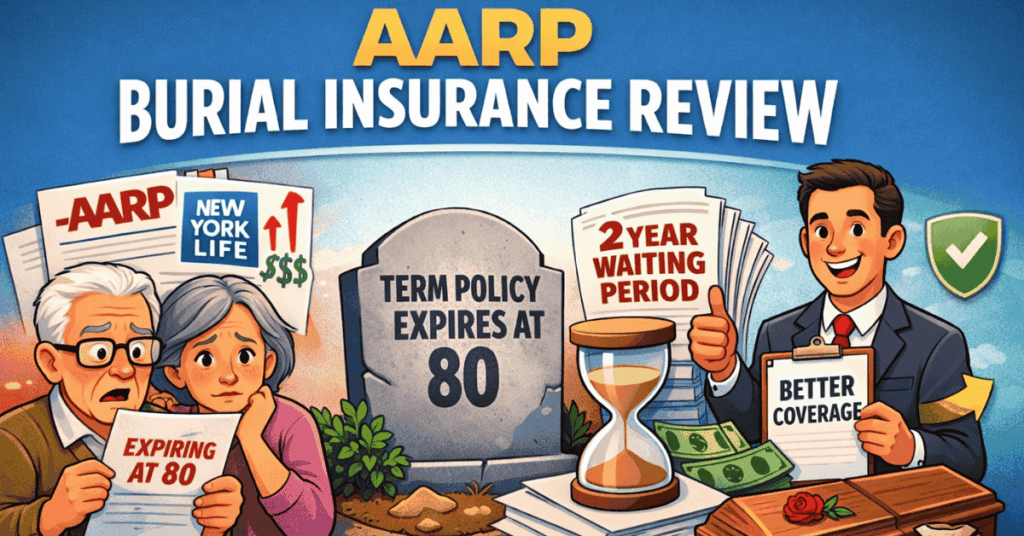
• Guaranteed acceptance plans come with a 2-year waiting period
• Coverage is limited, usually maxing out around $25,000 to $30,000
• Term policies can expire at age 80 with no payout
• You’re only getting one company’s pricing, not true comparison shopping
AARP burial insurance is marketed as simple and safe, but it comes with tradeoffs most people miss. It’s actually a group policy through New York Life, not AARP itself, and you must be a member to qualify. The guaranteed acceptance option has no health questions, but it includes a limited benefit for the first 2 years and caps coverage around $30,000. Term options can also expire at age 80, which creates a real risk of paying for years and getting nothing. AARP burial insurance works best as a last resort, not a first choice, especially if you can qualify for better coverage elsewhere.
Get a quote on this page by completing my quote request form now.
AARP Burial Insurance Basics
Most seniors get easy approval for better insurance companies than AARP through my simple process that handles the hard work for your family.
AARP life insurance isn’t sold by AARP itself. It’s a branded program underwritten and managed by New York Life Insurance Company, with New York Life paying royalties to AARP for use of the name. This is a high-volume direct marketing operation that relies on brand trust rather than competitive pricing.
Because these policies are structured as group coverage held in a trust, they are not individually owned contracts. This structure can limit your customization and allows the company to make plan changes without your individual consent.
You must be an AARP member to buy these policies, and that membership has a cost that adds to your total annual expenses. While New York Life is a financially strong “Field-Underwritten Carrier,” the products they funnel through AARP are often more restrictive and expensive than the individual policies I can find for you on the open market.
AARP AARP Underwriting & Eligibility
AARP uses simplified and guaranteed underwriting to determine applicant eligibility.
The company offers three main paths: Term, Permanent, and Guaranteed Acceptance.
For the first two, they use a simplified underwriting method that checks the Medical Information Bureau (MIB) and prescription databases to assess actual health risk. However, if you don’t fit their narrow “healthy” window, they push you toward the Guaranteed Acceptance plan.
The Guaranteed Acceptance plan does not check your health history. Because they accept applicants with the most serious health problems, they must treat everyone as high risk. That approval criteria forces all policyholders into higher prices and a two-year waiting period, even when someone is otherwise stable.
Honestly, it just doesn’t make sense to subsidize the risk of the sickest people if you are in reasonable health.
AARP Policy Types & Waiting Periods
No waiting periods for 1st-day coverage policies offset high mortality risks, so you get lower rates, whereas waiting periods apply to guaranteed-issue policies to offset the risk of high mortality.
AARP offers “Level Benefit” term and permanent plans that pay out immediately, but the term life coverage ends completely at age 80. If you are still alive on your 81st birthday, your family gets nothing. The Guaranteed Acceptance plan is a “Modified” benefit, meaning that if you die from natural causes within the first 24 months, your family receives only a return of premiums plus 10% interest.
Understanding AARP Policy Types
Carriers offer different plan categories based on an applicant’s health conditions and short- and long-term health stability.
- Level: Level burial insurance offers 1st-day coverage and pays the full death benefit from day one. (AARP Term and Whole Life).
- Graded: Graded burial insurance limits benefits during the 12 to 24 months for health or medical-related causes of death.
- Guaranteed Issue: Guaranteed issue burial insurance requires no health questions but includes a 2-year waiting period before it pays out for causes of death related to health or medical conditions. (AARP Guaranteed Acceptance – NEVER recommended).
AARP Policy Payout Comparison
| Year | Level/Permanent (Natural) | Guaranteed Acceptance (Natural) | Accidental Death (All Plans) |
|---|---|---|---|
| Year 1 | 100% Payout | Premiums + 10% | 100% Payout |
| Year 2 | 100% Payout | Premiums + 10% | 100% Payout |
| Year 3+ | 100% Payout | 100% Payout | 100% Payout |
AARP Rate Analysis
Limited underwriting results in better pricing for healthy seniors, but a lack of underwriting results in much higher monthly premiums for everyone else.
AARP rates vary widely by age and health status. Their term life is generally cheaper at younger ages, but because those premiums increase every 5 years, they can become unaffordable exactly when you need them most. If you buy a $10,000 policy at 65, don’t be surprised when the price jumps significantly at age 70 and 75.
AARP Monthly Rates for $10,000 Coverage
| Age | Term Life (Increases) | Permanent Whole Life (Fixed) | Guaranteed Acceptance (Fixed) |
|---|---|---|---|
| 60 | $28.00 | $46.00 | $64.00 |
| 65 | $39.00 | $62.00 | $88.00 |
| 70 | $58.00 | $84.00 | $124.00 |
The long-term value of first-day coverage is far stronger when you qualify. If your premium is $50 lower than a guaranteed issue plan, you save $600 per year and $6,000 over time. On a $10,000 policy, that difference alone can cover most of the benefit instead of wasting it on unnecessary premiums. A common misunderstanding is that “level benefit” means fixed rates for term; in reality, those term premiums increase with age, and the policy terminates at 80.
Financial Strength & Consumer Trust
NAIC complaint data reflects consumer experience rather than financial solvency.
AARP policies are backed by New York Life, which holds an A++ (Superior) rating from A.M. Best. They have an incredible ability to pay claims. However, consumer experience with the AARP-branded products can be mixed. Their NAIC Complaint Index for individual life is typically below 1.0 (national average), which is good, but many complaints stem from seniors being shocked when their term insurance expires at age 80 or when rates jump every five years.
Better Alternatives to AARP
Medically underwritten burial insurance provides lower rates and immediate coverage for qualified applicants.
Final Expense Guy companies like Family Benefit Life, Trinity Life, Aflac, or CICA provide “Day 1” coverage for conditions that AARP may force into higher rates or a 2-year wait. For example, some health issues that AARP declines under its “Level” plan can be covered immediately elsewhere at a much lower price.
Comparison: AARP vs. Standard Level Benefit
| Feature | AARP Permanent Life | Standard Level Carrier (e.g. Trinity) |
|---|---|---|
| Rate Increases | None | None |
| Ownership | Group Trust | Individual Contract |
| Membership Required | Yes (Fee) | No |
| Wait Period | 0 Months | 0 Months |
Pros and Cons – AARP
Comparing AARP advantages and limitations helps seniors make informed decisions.
- PRO: Financial Backing from New York Life, which is one of the strongest companies in the world.
- PRO: Fast Approval with no medical exams required for any of their products.
- PRO: Brand Familiarity, which provides peace of mind for seniors who don’t want to shop around.
- CONS: Much Higher Pricing for many seniors who could get a better rate with an individual policy elsewhere.
- CONS: Expiration at 80 for term policies, making them a poor choice for final expenses.
- CONS: Group Structure means you don’t own an individual contract, which limits your control.
AARP is best for members who are already healthy enough to pass their questions but want the absolute simplest “no-exam” process, regardless of the extra cost.
Frequently Asked Questions: AARP Burial Insurance Review
Is AARP burial insurance a permanent policy?
AARP offers both permanent whole life and term life insurance options to its members. The “Permanent Life” and “Guaranteed Acceptance” plans are designed to last for your entire lifetime, provided you continue to pay the premiums. However, the “Level Benefit Term Life” plan is temporary and expires in full on your 80th birthday, making it not a permanent solution for those who live into their 80s and beyond.
Does AARP life insurance have a waiting period?
The AARP Guaranteed Acceptance plan includes a mandatory two-year waiting period for all natural deaths. Because this specific policy requires no medical exam and asks zero health questions, the company limits its risk by only paying the full benefit after you have held the policy for at least 24 months. If you pass away from an illness during this timeframe, your family receives a refund of your premiums plus 10% interest, though accidental deaths are covered for the full amount from day one.
How do AARP life insurance rates increase over time?
AARP term life insurance premiums jump into a higher price bracket every five years. These rate increases occur as you enter each new “age band” (e.g., 60, 65, 70, and 75), which can double or triple the monthly cost over the life of the policy. In contrast, AARP’s whole life and guaranteed acceptance products feature “locked-in” rates that stay the same for as long as you own the coverage.
Can I get AARP burial insurance without a medical exam?
AARP provides life insurance coverage without requiring a physical medical exam or blood work. For their “Level Benefit” term and permanent plans, you must answer a brief health questionnaire and allow the company to check your prescription history. The “Guaranteed Acceptance” plan skips the health questions entirely, ensuring that any AARP member aged 50 to 80 is approved regardless of their current medical condition.
What happens to AARP term life insurance at age 80?
AARP term life insurance coverage terminates automatically once the insured person reaches age 80. Unlike whole life insurance, which is intended to pay a death benefit no matter when you pass away, this term plan simply ends, and the company is no longer obligated to pay your beneficiaries. While you may have the option to convert the term plan into a permanent policy before age 80, the new premiums will be based on your older age and can be significantly more expensive.
Who is eligible for AARP guaranteed acceptance life insurance?
AARP members aged 50 to 80 are eligible for guaranteed approval in most states. Spouses of members are also eligible to apply if they fall within the age range of 45 to 80. Because there are no health qualifications, this plan is specifically designed for seniors who have been turned down elsewhere due to serious conditions like terminal cancer, active dialysis, or recent organ transplants.
Can I borrow money from my AARP whole life policy?
AARP permanent life insurance policies accumulate cash value that you can access through a policy loan. After you have paid premiums for several years, a small portion of that money becomes available for you to use for emergencies or bills. It is important to remember that any unpaid loan balance, plus interest, will be deducted from the final check sent to your family upon your passing.
Is AARP burial insurance more expensive than other companies?
AARP rates are often higher than those of independent insurers that use personalized underwriting. Because AARP uses a “group trust” model and accepts a wide range of health risks, healthy seniors end up paying more to offset the costs of insuring sicker members. By shopping for an individual policy, a senior in relatively good health can often find 1st-day coverage for a lower monthly price than the AARP group rate.
Why is AARP insurance underwritten by New York Life?
AARP partners with New York Life to provide the financial backing and administrative support for its insurance program. AARP is not an insurance company itself; it acts as a marketing brand that receives royalty fees for endorsing New York Life’s products. This partnership allows AARP to offer products to its massive membership base while leaving the specialized task of managing claims and investments to one of the world’s largest insurance carriers.
