Quick Answer
Getting burial insurance with a heart murmur depends on what’s causing it. Most insurance companies view a heart murmur as a minor health issue. If tests show it’s “innocent,” you can often qualify with normal rates, and immediate first-day coverage is widely available for people with heart murmurs. If the murmur is tied to valve problems or other heart issues, your options narrow and costs go up.
Key Points
- Most heart murmurs don’t affect approval if they’re harmless and stable
- Serious murmurs tied to heart disease can raise rates or cause denials
- Many agents overreact and push expensive plans you don’t need
- Recent diagnosis without testing can delay approval or increase pricing
- Not knowing the cause of your murmur can hurt your application
GET MY QUOTEor call 888-862-9456
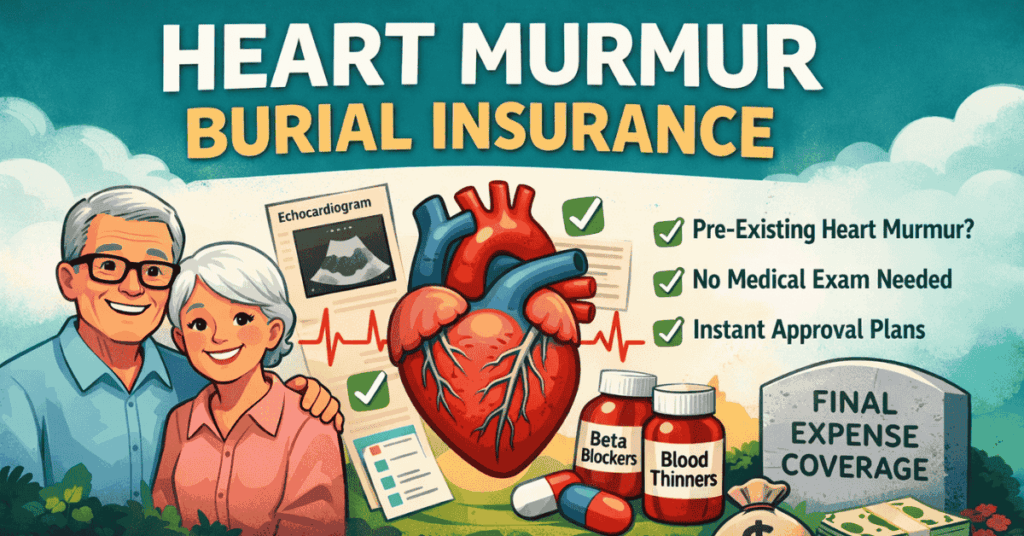
Heart murmur burial insurance key insights
- Murmurs are rarely a dealbreaker: Most insurance companies view a heart murmur as a minor health issue since many people have lived with them since childhood without any problems.
- Underwriters prioritize underlying causes: Carriers care more about whether a leaky valve or a structural defect causes the sound rather than the murmur itself.
- Stability indicates lower risk: Insurance companies offer the best rates when your medical records show no new symptoms or changes in heart medications for several years.
- Pending tests cause delays: Please ensure all heart scans or cardiology checkups are complete, as active testing will pause your application during the review process.
- Comorbidities drive the final price: Having a murmur alongside serious issues like congestive heart failure or COPD will impact your eligibility more than the heart sound alone.
I’m always on the lookout for more insurance companies that will offer affordable protection for heart murmurs. As a result, most people I help will have no trouble qualifying for and affording an instant-approval policy.
Heart murmur medical definition & health risks
Underwriters determine the risk level of a heart murmur by assessing whether the sound is “functional,” meaning it is harmless and doesn’t affect health, or whether it is linked to structural heart disease. Because a heart murmur is an extra sound produced by blood flow within the heart, insurance companies review medical records to ensure there are no underlying valve issues or chamber abnormalities. While many heart murmurs are harmless, some indicate that a valve is not closing properly or that blood is flowing through a narrow opening. If a murmur is a sign of a serious valve problem and goes untreated, it can eventually lead to heart failure or blood clots.
Life insurance companies ask these heart murmur questions
Different life insurance companies ask different questions to decide which heart murmur applicants they may approve.
- Aetna Decline – Have you ever been diagnosed with, received, or been advised to receive treatment or medication for congestive heart failure, pulmonary fibrosis, any terminal condition, or end-stage disease?
- Aetna Decline – Have you ever been diagnosed with, received, or been advised to receive treatment or medication for cerebral palsy, cystic fibrosis, muscular dystrophy, or un-operated heart defects?
- Aetna Modified – Within the past year, have you been diagnosed with, received, or been advised to receive treatment for angina (chest pain), heart attack, cardiomyopathy, or any type of heart or circulatory procedure or surgery?
- Aetna Level – Within the past 2 years, have you been diagnosed with, received, or been advised to receive treatment for angina (chest pain), heart attack, cardiomyopathy, or any type of heart or circulatory procedure or surgery?
- Aflac Decline – Have you ever been diagnosed with, received, or been advised to receive treatment or medication for congestive heart failure, pulmonary fibrosis, any terminal condition, or end-stage disease?
- Aflac Decline – Have you ever been diagnosed with, received, or been advised to receive treatment or medication for cerebral palsy, cystic fibrosis, muscular dystrophy, or un-operated heart defects?
- Aflac Modified – Within the past year, have you been diagnosed with, received, or been advised to receive treatment for angina (chest pain), heart attack, cardiomyopathy, or any type of heart or circulatory procedure or surgery?
- Aflac Standard – Within the past 2 years, have you been diagnosed with, received, or been advised to receive treatment for angina (chest pain), heart attack, cardiomyopathy, or any type of heart or circulatory procedure or surgery?
- Family Benefit Life Decline – Have you ever been diagnosed by a medical professional with a terminal illness, end-stage disease, congestive heart failure, or cardiomyopathy?
- Family Benefit Life Decline – Within the past 12 months, have you been diagnosed by a medical professional for, or hospitalized for, a heart attack, stroke, transient ischemic attack (TIA), angina, aneurysm, or had cardiac or circulatory surgery of any kind to improve circulation to the heart or brain?
- Family Benefit Life Level – During the past 24 months, have you been diagnosed, treated, tested positive for, or given medical advice by a medical professional for a heart attack, stroke, transient ischemic attack (TIA), angina, aneurysm, or had cardiac or circulatory surgery of any kind such as a pacemaker, heart valve replacement, bypass, angioplasty, or stent implant to improve circulation to the heart or brain?
- Liberty Bankers Life Decline – Have you, the Proposed Insured, ever been diagnosed, treated, tested positive for, or been given medical advice by a member of the medical profession for; congestive heart failure (CHF), cardiomyopathy, memory loss, Alzheimer’s, senile dementia, dementia, heart defibrillator implant, 2 or more instances of internal cancer(s), or terminal illness (“terminal illness” means a disease or illness that is expected to result in death within 24 months)?
- Liberty Bankers Life Modified – Within the past 2 years have you, the Proposed Insured, been diagnosed, treated, tested positive for, or been given medical advice by a member of the medical profession for; angina (chest pain), any type of heart or circulatory surgery or disease, heart valve disorder, heart attack, or received a pacemaker or stent?
- Liberty Bankers Life Preferred – Have you, the Proposed Insured, by a member of the medical profession, ever been diagnosed with, or received, or been advised to receive treatment or medication for Chronic Obstructive Pulmonary Disease (COPD), chronic bronchitis, emphysema, irregular heartbeat, atrial fibrillation, peripheral vascular disease or peripheral artery disease?
- Mutual of Omaha Decline – Has the Proposed Insured ever been diagnosed by a licensed medical professional with, received treatment by a licensed medical professional for, or been advised to seek treatment by a licensed medical professional for; Alzheimer’s Disease, Dementia, Huntington’s Disease, Sickle Cell Anemia, Myelodysplastic Syndrome (MDS), Lou Gehrig’s Disease (ALS), Hydrocephalus, Muscular Dystrophy, Quadriplegia, Paraplegia, Down Syndrome, Intellectual Developmental Disorder, Congestive Heart Failure, Cirrhosis, Metastatic Cancer or recurrent Cancer of the same type?
- Mutual of Omaha Decline – In the past 12 months, has the Proposed Insured been diagnosed by a licensed medical professional as having heart disease or heart surgery of any kind?
- Mutual of Omaha Level – In the past 2 years, has the Proposed Insured been diagnosed by a licensed medical professional with, received treatment by a licensed medical professional for, or been advised to seek treatment by a licensed medical professional for; Coronary Artery Disease, Heart Attack, Coronary Artery Bypass Surgery, Angioplasty, Cardiomyopathy, irregular heart rhythm, Pacemaker or Valvular Heart Disease with surgical repair or replacement?
- Trinity Life Decline – Have you ever been diagnosed by a medical professional with a terminal illness, end-stage disease, congestive heart failure, or cardiomyopathy?
- Trinity Life Decline – Within the past 12 months, have you been diagnosed by a medical professional for, or hospitalized for, a heart attack, stroke, transient ischemic attack (TIA), angina, aneurysm, or had cardiac or circulatory surgery of any kind to improve circulation to the heart or brain?
- Trinity Life Level – During the past 24 months, have you been diagnosed, treated, tested positive for, or given medical advice by a medical professional for a heart attack, stroke, transient ischemic attack (TIA), angina, aneurysm, or had cardiac or circulatory surgery of any kind such as a pacemaker, heart valve replacement, bypass, angioplasty, or stent implant to improve circulation to the heart or brain?
Heart murmur underwriting basics
Insurers evaluate your heart health by reviewing recent echocardiogram results to determine whether your heart structure is normal.
- Testing & Test Results: Carriers look for “normal” ultrasound findings and an ejection fraction between 55% and 70%.
The correct use of medications over time should reduce your mortality risk, allowing the insurance companies to offer you better coverage options.
- Why it Matters: Your test results determine your risk class by showing whether your heart is pumping blood efficiently or struggling under pressure.
Heart murmur prescription medication classes
Insurance companies review your prescriptions to see if you take drugs that suggest a more serious heart rhythm or valve issue.
- Beta-Blockers: Metoprolol or Atenolol are used to manage heart rate and blood pressure.
- Statins: Atorvastatin (Lipitor) is used to manage cholesterol and protect the heart.
- Blood Thinners: Aspirin or Plavix are used to prevent clots if a valve issue is present.
Heart murmur with comorbidities
When multiple health conditions occur simultaneously, insurance companies view the combined profile as higher risk, which often leads to higher monthly premiums. A heart murmur paired with diabetes or lung disease requires underwriters to perform a more detailed review of your cardiovascular health to determine how these conditions interact and affect your long-term stability. If you also have congestive heart failure, most carriers will move you toward a plan with a waiting period. Chronic lung issues like COPD increase risk because they put extra strain on a heart that already has an irregular flow sound.
In my experience, a controlled heart murmur qualifies people for immediate level burial insurance coverage, even with secondary health issues.
Other common health issues with heart murmur
A heart murmur reflects abnormal blood flow through the heart caused by valve changes or structural defects, which can affect pumping efficiency and circulation and may affect underwriting and policy selection when these related issues are present.
- Valve disease – Leaking or narrowed valves reduce blood flow efficiency and limit stamina.
- Shortness of breath – Impaired circulation increases breathing difficulty during activity or exertion.
- Fatigue – Reduced cardiac efficiency lowers energy and work capacity.
- Heart enlargement – Chronic valve strain forces the heart to work harder and weakens the muscle over time.
- Arrhythmias – Structural changes disrupt electrical signals andhttps://fexguy.com/burial-insurance/valvular-heart-disease/ cause palpitations or dizziness.
- Heart failure risk – Progressive valve dysfunction can lead to fluid buildup and reduced organ perfusion.
- Infection risk – Certain murmurs increase susceptibility to endocarditis.
- Exercise intolerance – Physical exertion triggers symptoms due to a limited blood flow response.
- Need for monitoring or surgery – Worsening murmurs often require imaging, procedures, or valve repair.
- Reduced work reliability – Symptoms, follow-up care, and activity limits affect consistency and endurance.
Understanding heart murmur policy types
Carriers offer different plan categories based on an applicant’s Heart Murmur and long-term health stability.
- Level: Level burial insurance offers 1st-day coverage and pays the full death benefit from day one. My recommended companies are Family Benefit Life, Trinity Life, and Aflac.
- Graded: Graded burial insurance limits benefits during the 12 to 24 months for health or medical-related causes of death. My recommended company is Guaranteed Trust Life.
- Guaranteed Issue: Guaranteed issue burial insurance requires no health questions but includes a 2-year waiting period before it pays out for causes of death related to health or medical conditions. My recommended company is Gerber Life.
Sample heart murmur rate snapshot for $10,000 coverage
Monthly burial insurance costs increase as you get older because your statistical life expectancy decreases, making you a higher risk for the insurer. Rates also vary by gender because women statistically live longer than men, allowing insurance companies to offer them lower monthly premiums.
Here are some preferred rates, but your rates can vary based on which A-rated carrier is best for your situation.
Trinity Life & Family Benefit insurance rates age 50–85
| AGE | $10,000 | $15,000 | $20,000 | $25,000 |
|---|---|---|---|---|
| 50 | F: $21 M: $27 | F: $31 M: $39 | F: $40 M: $52 | F: $50 M: $64 |
| 55 | F: $26 M: $32 | F: $38 M: $47 | F: $49 M: $62 | F: $61 M: $78 |
| 60 | F: $32 M: $41 | F: $47 M: $61 | F: $62 M: $80 | F: $77 M: $100 |
| 65 | F: $41 M: $53 | F: $60 M: $79 | F: $79 M: $104 | F: $99 M: $130 |
| 70 | F: $52 M: $69 | F: $76 M: $102 | F: $101 M: $135 | F: $126 M: $169 |
| 75 | F: $71 M: $96 | F: $106 M: $143 | F: $140 M: $190 | F: $175 M: $237 |
| 80 | F: $104 M: $145 | F: $155 M: $217 | F: $207 M: $288 | F: $258 M: $360 |
| 85 | F: $155 M: $192 | F: $231 M: $287 | F: $307 M: $382 | F: $384 M: $477 |
Rates may vary based on age, gender, health, and state.
Heart murmur underwriting & medication history
Prescription history provides a record of medical stability that underwriters use to verify the current status of your heart health. Insurance companies prefer to see a consistent history of the same medication because it demonstrates that your condition is well-managed and not progressing. If your doctor has not changed your heart meds in over two years, you are a very strong candidate for first-day coverage. Most carriers also view it as a positive sign if you have avoided the emergency room for any heart-related symptoms.
Your prescription history is how the insurance carriers verify medical stability. Recent hospitalizations for crises trigger postponement rather than permanent decline.
| Health Profile | Coverage Type | Wait Period |
|---|---|---|
| Innocent Murmur | Level | None |
| Valve Regurgitation | Level / Graded | 0 to 24 Months |
| Severe Valve Issues | Guaranteed Issue | 2 Years |
Real life heart murmur success stories
Real-world examples illustrate how people with Heart Murmur can get day-one protection with anywhere from $5,000 to $25,000 for any of the following: burial, cremation, funeral expenses, final expenses, leave money for loved ones, pay off last bills, or a combination of these.
Robert’s story
Robert was 66 years old and had lived with a heart murmur since he was a teenager. He was worried that he would have to pay high rates or wait two years for his coverage to start. I helped him apply with Family Benefit Life because they are very understanding of stable heart conditions. Robert qualified for a $15,000 first-day coverage plan with a very low monthly payment. He used the extra money he saved to take his grandkids to dinner every month.
Linda’s story
Linda had a murmur that her doctor recently started treating with a mild beta-blocker to keep her heart rate steady. She wanted a $10,000 policy to cover her cremation costs so her children wouldn’t have to worry about the bill. We worked with Trinity Life to show the underwriters that her condition was stable and her tests were clear. Linda received instant approval for a level benefit plan with no waiting period. She now has peace of mind knowing her final expenses are fully funded.
Heart murmur financial ratings & stability
Financial ratings verify a carrier’s ability to pay out death claims to your family. Grades from A.M. Best act as a financial report card, proving that an insurance company maintains the necessary cash reserves and investment stability to fulfill its long-term promises when you pass away. The BBB tracks whether a company handles customer complaints well or treats beneficiaries poorly. Choosing a company with an A rating helps make sure your family will receive their check quickly after you pass away.
Insurance carrier ratings & comparisons
| Carrier | A.M. Best | BBB | NAIC Complaints |
|---|---|---|---|
| Aflac | A+ (Superior) | A+ | Low |
| CICA | B++ (Good) | A+ | Low |
| Colonial Penn | A (Excellent) | A+ | High (300% Above Avg) |
| Family Benefit Life | A+ (Superior) | A+ | Low |
| Guarantee Trust Life | A (Excellent) | A+ | Low |
| Senior Life | Not Rated | A+ | High (300% Above Avg) |
| Trinity Life | A+ (Superior) | A+ | Low |
Frequently asked questions: heart murmur burial insurance
Can you get burial insurance if you have a heart murmur?
Specialized burial insurance companies approve applicants with heart murmurs every single day because most underwriters view a murmur as a minor sound rather than a life-threatening disease. I have sat with thousands of seniors who were terrified that a simple heart sound would make them uninsurable, but honestly, it just does not make sense to worry. If your doctor has told you the murmur is “innocent” or asymptomatic, you will likely qualify for the lowest rates on the market without any medical exam. Even if your murmur stems from a minor valve issue, I can match you with a carrier that sees you as a standard risk. You do not have to settle for an overpriced plan just because your heart makes a little extra noise.
Is day one burial insurance coverage available for heart murmur patients?
Immediate first-day coverage is widely available for people with heart murmurs because many carriers do not even ask about murmurs on their health questionnaires. Since many murmurs do not require surgery or heavy medication, carriers like Family Benefit Life and Trinity Life typically approve these applications for full benefits starting on the very first day. This means your beneficiaries receive the full death benefit from the moment your first premium is paid. You should never accept a 2-year waiting period for a simple heart murmur. I run a quick background check on your prescriptions to ensure we place you with a company that provides full protection today.
Does a heart murmur count as a heart condition for burial insurance?
Insurance underwriters typically view a heart murmur as a symptom or a physical finding rather than a formal diagnosis of heart disease. If your medical records show that you do not have structural problems like valve stenosis or regurgitation, the insurance company will likely treat the murmur as a non-issue. But here is the part they do not tell you in the TV commercials: you must still be honest if an application asks about valve disorders or heart sounds. I help you navigate the wording on these applications so your policy is valid and your family gets the check without a fight.
What is the cash value of a small burial insurance policy?
Burial insurance is a form of whole life insurance, which means it builds a small amount of cash value that you can access if you ever face a financial emergency. While the policy’s primary purpose is to pay for your funeral, the cash value grows the longer you keep the plan. You can eventually borrow against this money to pay a bill or cover an unexpected expense, but doing so will reduce the final payout to your family. Honestly, it just does not make sense to buy a policy that leaves you with nothing when you can have one that builds value and lasts forever.
Can you be denied burial insurance for a heart murmur?
It is almost impossible to be denied burial insurance solely because of a heart murmur unless the murmur is a sign of an untreated, much larger problem like congestive heart failure. If a major carrier declines your application, it is usually due to a secondary issue, such as fluid in the lungs or a recent hospitalization. Even in those extreme cases, I can still get you a guaranteed issue policy that asks no health questions at all. This ensures your family is never left with the $15,000 burden of a funeral. I shop your case across multiple companies to find the one that welcomes your history.
Is burial insurance worth buying for seniors with a heart murmur?
Burial insurance is a smart investment for seniors who do not want to leave their children or spouse with a 10,000 to 20,000 dollar debt for funeral and cremation costs. It provides immediate peace of mind, allowing your family to focus on grieving rather than scrambling for cash. The rates you get today are locked in for life, so the price will never go up even as you get older or if your health changes. Honestly, it just does not make sense to gamble with your family’s financial future when you can lock in a low rate now. Every dollar you spend on a premium is a dollar that protects your loved ones later.
Why is whole life burial insurance better than term for a heart murmur?
Whole life burial insurance is a better deal than term insurance because it provides a permanent guarantee that your coverage will never expire. Term insurance is a gamble that you will pass away before the clock runs out; if you outlive the policy, you are left with nothing and will find it nearly impossible to get a new plan at an older age. A burial policy is yours for life. It ensures that a check is waiting for your family no matter how long you live, and your monthly price will stay exactly the same until the day you pass. You should own your insurance, not rent it.
How do medications for a murmur affect my burial insurance rates?
If you take a mild blood pressure medication or a beta-blocker to manage your heart rhythm, you can still qualify for the lowest preferred rates and first-day coverage. Underwriters look for stability in your prescription history to confirm that your heart condition is not getting worse. If you are not taking any medication for your murmur, the company views you as even lower risk. I run a quick background check on your prescriptions to determine which carriers will offer the best deal for your specific meds. This keeps more money in your fixed-income household while providing your family with the highest level of protection.