Cerebral Palsy Burial Insurance
Cerebral Palsy doesn’t automatically disqualify you from burial insurance, but applying the wrong way can cost your family thousands. These cerebral palsy-approved policies I help people with pay out quickly to cover burial or cremation costs, or provide a tax-free legacy for your loved ones.
Cerebral Palsy Burial Insurance Key Insights
- Mobility tools like canes or wheelchairs serve as the primary factor underwriters use to determine your qualification status for first-day coverage.
- Picking carriers with inconsistent underwriting practices often results in unnecessary flags for neurological conditions, even when you handle daily tasks alone.
- Guarantee Trust Life approves early to mid-stage cases at high rates, provided you do not require assistance with eating or bathing.
- Gerber Life offers a guaranteed safety net for those who have progressed to needing significant help with daily living activities.
- Early approval remains essential because this condition moves slowly, and your plan options shrink as physical mobility decreases over time.
More carriers expanded immediate-coverage options for people with well-controlled Cerebral Palsy. Most people will have no trouble qualifying for and affording an instant-approval policy.
Cerebral Palsy Medical Definition & Health Risks
Insurers classify the risk level of cerebral palsy by reviewing your medical history and specific mobility milestones. Because this neurological impairment affects muscle tone and movement, underwriters use your ability to walk or perform daily tasks independently to determine which policy tier you qualify for. While it is not a fast-moving disease, it creates a domino effect on your physical health as you age.
If you lose the ability to care for yourself or start using a wheelchair, insurance companies see a much higher risk for falls and secondary infections.
Life Insurance Companies Ask These Cerebral Palsy Health Questions
Different life insurance companies ask different questions to decide which applicants with cerebral palsy they may approve.
- Aetna Decline – Have you ever been diagnosed with, received, or been advised to receive treatment or medication for cerebral palsy, cystic fibrosis, muscular dystrophy, or un-operated heart defects?
- Aflac Decline – Have you ever been diagnosed with, received, or been advised to receive treatment or medication for cerebral palsy, cystic fibrosis, muscular dystrophy, or un-operated heart defects?
- Family Benefit Life Decline – Have you ever been diagnosed by a medical professional for, or taken medication for, dementia, Alzheimer’s disease, mental incapacity, Down syndrome, Huntington’s disease, Lou Gehrig’s disease (ALS), cystic fibrosis, cerebral palsy, muscular dystrophy, or sickle cell anemia?
- Trinity Life Decline – Have you ever been diagnosed by a medical professional for, or taken medication for, dementia, Alzheimer’s disease, mental incapacity, Down syndrome, Huntington’s disease, Lou Gehrig’s disease (ALS), cystic fibrosis, cerebral palsy, muscular dystrophy, or sickle cell anemia?
Cerebral Palsy Underwriting Basics
Insurance companies evaluate physical mobility to determine policy eligibility.
- Testing & Test Results: Carriers check the date of your diagnosis and any pending procedures. They look for stability, meaning your symptoms have not worsened over the last 12 to 24 months.
Not all companies view medications negatively. Using the right medications actually reduces the insurance company’s mortality risk.
- Why it Matters: Your test results and prescription history control the price you pay. If your condition is stable, I can usually find you a plan that skips the 2-year waiting period.
Cerebral Palsy Prescription Medication Classes
Prescription history identifies the medical management of your condition.
- Muscle Relaxants: Baclofen or Dantrolene are used to manage muscle stiffness and spasms.
- Anticonvulsants: Keppra or Dilantin are used if the condition causes seizure activity.
- Benzodiazepines: Valium or similar drugs are used for severe muscle tension.
Cerebral Palsy with Comorbidities
Insurers evaluate how multiple health issues occurring together determine your total insurance risk profile. Because cerebral palsy often leads to secondary issues like diabetes or heart failure as the body wears down over decades, underwriters must look at how these overlapping risks affect your long-term stability. Underwriters look at your total health picture to see how these risks overlap.
If you have multiple health struggles, I can still find the specific carriers that won’t punish you with high rates for things you cannot control.
Controlled Cerebral Palsy qualifies most people for immediate level burial insurance coverage, even with secondary health issues.
Other Health Issues With Cerebral Palsy
Cerebral palsy affects brain control of movement and muscle coordination, leading to lifelong motor limitations and related neurological and orthopedic complications that can affect underwriting decisions and policy selection when these conditions are present.
- Muscle stiffness and spasticity – Abnormal muscle tone causes tightness, pain, and restricted movement.
- Mobility limitations – Difficulty walking or transferring reduces independence and physical work capacity.
- Joint and bone problems – Muscle imbalance leads to contractures, hip displacement, and scoliosis.
- Chronic pain – Muscle tension and joint stress cause ongoing discomfort and fatigue.
- Fine motor difficulties – Impaired hand control affects writing, dressing, and task precision.
- Speech and communication challenges – Muscle control issues affect speech clarity and expressive language.
- Swallowing and feeding difficulties – Poor muscle coordination increases choking risk and nutritional problems.
- Seizure disorders – Epilepsy occurs more often and adds ongoing medical risk.
- Respiratory complications – Weak trunk and swallowing muscles raise pneumonia risk.
- Fatigue and reduced stamina – Increased effort for basic movement leads to early exhaustion and lower endurance.
Understanding Cerebral Palsy Policy Types
Carriers offer different plan categories based on an applicant’s Cerebral Palsy and long & short-term health stability.
- Level: Level burial insurance offers 1st-day coverage and pays the full death benefit from day one.
- Graded: Graded burial insurance limits benefits during the 12 to 24 months for health or medical-related causes of death.
- Guaranteed Issue: Guaranteed issue burial insurance requires no health questions but includes a 2-year waiting period before it pays out for causes of death related to health or medical conditions.
Sample Cerebral Palsy Rate Snapshot for $10,000 Coverage
Insurers use age and gender as the primary factors to determine the direct cost of your burial insurance premiums. Because women have a longer statistical life expectancy, they typically qualify for lower monthly rates compared to men of the same age. This means ladies usually pay a bit less for the same amount of protection.
Here are some preferred rates, but your rates can vary based on which A-rated carrier is best for your situation.
GUARANTEE TRUST LIFE INSURANCE RATES AGE 50–85
| AGE | $10,000 | $15,000 | $20,000 |
|---|---|---|---|
| 50 | F: $43 M: $62 | F: $63 M: $90.75 | F: $82 M: $119 |
| 55 | F: $52 M: $68 | F: $77 M: $100 | F: $101 M: $132 |
| 60 | F: $61 M: $77 | F: $89 M: $114 | F: $117 M: $151 |
| 65 | F: $72 M: $97 | F: $107 M: $143 | F: $141 M: $189 |
| 70 | F: $87 M: $115 | F: $129 M: $170 | F: $171 M: $226 |
| 75 | F: $125 M: $157 | F: $185 M: $234 | F: $246 M: $311 |
| 80 | F: $191 M: $250 | F: $285 M: $373 | F: $379 M: $496 |
| 85 | F: $224 M: $321 | F: $334 M: $480 | F: $444 M: $639 |
Rates may vary based on age, gender, health, and state. Click the form on this page for the lowest rates from the best carriers.
Cerebral Palsy Underwriting & Medication History
Insurers use your prescription history to verify your medical stability and determine your mortality risk. You should be cautious of companies that offer first-day coverage while using inconsistent or complicated underwriting methods. Even if you walk just fine, their computers might flag your CP and force a 2-year wait.
I avoid these mistakes by doing a quick background check on your prescriptions first to make sure we pick a friendly carrier. Just remember that your prescription history is how the insurance carriers verify medical stability.
Recent hospitalizations for medical crises can trigger a postponement rather than a permanent decline.
| Health Profile | Coverage Type | Wait Period |
|---|---|---|
| Mild CP / No Mobility Aids | Level | None |
| Cane Use / Stable | Graded | Partial |
| Wheelchair / ADL Needs | Guaranteed Issue | 2 Years |
Real Life Cerebral Palsy Success Stories
Real-world examples illustrate how people with Cerebral Palsy secure day-one protection, ranging from $5,000 to $25,000, to cover their final expenses.
Kevin’s Story
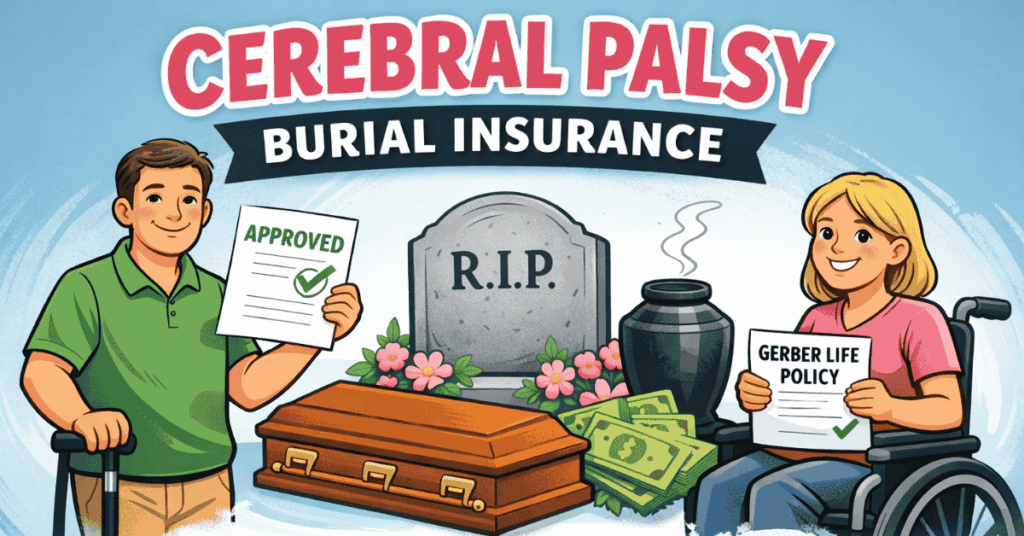
Kevin has lived with Cerebral Palsy his whole life and uses a cane for balance. He was worried that his mobility aid would automatically trigger a 2-year waiting period. I helped Kevin apply with Guarantee Trust Life because his condition was stable and he didn’t need any help with daily activities. Kevin was approved for a $12,000 policy that gave him peace of mind. Now Kevin knows his funeral costs are taken care of without his family having to struggle.
Sarah’s Story
Sarah’s Cerebral Palsy had progressed to the point where she was in a wheelchair and needed some help with dressing. Sarah thought she couldn’t get any insurance at all. I set up a Gerber Life policy for Sarah because they don’t ask any health or mobility questions. Sarah secured $10,000 for final expenses and got the 2-year waiting period started right away. It was the best move for her future, and it saved her family from a huge financial burden.
Cerebral Palsy Financial Ratings & Stability
Insurers use financial ratings to verify a carrier’s ability to pay death claims to your beneficiaries. I prioritize companies with top-tier financial strength to guarantee they have the capital necessary to pay your claim when your family needs it most. Solvency ratings from A.M. Best and service scores from the BBB help me find companies that are both rich and reliable.
Insurance Carrier Ratings & Comparisons
| Carrier | A.M. Best | BBB | NAIC Complaints |
|---|---|---|---|
| Aflac | A+ (Superior) | A+ | Low |
| CICA | B++ (Good) | A+ | Low |
| Colonial Penn | A (Excellent) | A+ | High (300% Above Avg) |
| Family Benefit Life | A+ (Superior) | A+ | Low |
| Guarantee Trust Life | A (Excellent) | A+ | Low |
| Senior Life | Not Rated | A+ | High (300% Above Avg) |
| Trinity Life | A+ (Superior) | A+ | Low |
Frequently Asked Questions: Cerebral Palsy Burial Insurance
Can you get burial insurance if you have cerebral palsy?
Some insurance companies approve permanent life insurance policies for people with cerebral palsy, regardless of their health. Many folks mistakenly believe that a disability makes them uninsurable for the rest of their lives. Honestly, it just does not make sense to go without protection when most carriers only care about your independence today. If you can perform your daily activities and manage your own home, you can qualify for a policy in minutes. Your family gets the cash they need for final expenses without you ever having to visit a doctor for a medical exam.
Is Day One burial insurance coverage available for people with cerebral palsy?
People with mild cases of cerebral palsy often qualify for first-day coverage by demonstrating a stable health history to the insurance underwriter. You can absolutely qualify for full benefits from the very first day of the policy. If you work or live independently, the insurance company can offer a plan that pays your family the full check immediately. Proper planning ensures your family stays protected from the moment you make that first premium payment.
Does using a wheelchair for cerebral palsy disqualify me from burial insurance?
Wheelchair use never prevents an applicant from getting a permanent insurance policy, though it may influence the specific plan tier available. A wheelchair is not a deal-breaker for most state-regulated policies. If you use a mobility aid because of cerebral palsy and not a progressive disease, many companies offer standard rates. Some simplified issue companies remain very friendly about mobility issues. If your mobility is very limited, a guaranteed issue plan accepts everyone regardless of how they get around.
Will having seizures alongside cerebral palsy affect my burial insurance options?
Insurance companies typically require a two-year waiting period if a seizure episode has occurred within the last 24 months. If your cerebral palsy comes with seizures, the insurance company looks closely at the calendar. Most carriers use a 24-month look-back period to determine the risk level for these episodes. If you have stayed seizure-free for 2 years, you can still qualify for first-day coverage. If episodes are more recent, you might have to take a plan with a waiting period, but at least your family has a safety net in place.
How does the severity of cerebral palsy impact burial insurance premiums?
Functional independence determines your monthly rate for standard plans, while guaranteed issue policies provide a fixed price regardless of your condition. For plans that ask no health questions, the severity of your cerebral palsy does not change the price at all. You pay age-based pricing according to your gender. If your condition is mild, you pay the same standard rates as anyone else on your block. Selecting the plan that fits your physical needs ensures you do not pay a convenience tax to the insurance company that you do not actually owe.
Is there a waiting period for burial insurance with cerebral palsy?
The specific insurance plan you qualify for determines whether your beneficiaries have a two-year waiting period or 1st-day coverage with the full death benefit. Whether you wait depends on how much help you need with daily life. A plan with first-day coverage has no waiting period. If you require 24-hour care, the company will likely offer a guaranteed issue plan with a mandatory two-year waiting period. Determining your qualification level early prevents your kids from being left with a funeral bill they cannot pay.
Does taking muscle relaxants like Baclofen impact my burial insurance eligibility?
Insurance companies view maintenance medications like muscle relaxants as proof that you are managing your health consistently under a doctor’s care. A quick background check on your prescriptions will help the insurance company determine your overall health stability. Drugs like Baclofen or Dantrolene are totally normal for cerebral palsy and do not act as red flags for underwriters. These medications do not stop the approval of your policy. As long as you do not take heavy meds for terminal illnesses, the company will see your prescription history as a sign of a stable lifestyle.
Can I get burial insurance if I am on Social Security Disability (SSDI) for Cerebral Palsy?
Social Security Disability benefits do not prevent you from purchasing a permanent life insurance policy to cover your final arrangements. Many carriers specialize in serving folks who live in fixed-income households. Being on SSDI is very common for burial insurance applicants. Many insurance companies do not even ask if you receive disability payments. They only care about your actual health and your ability to pay the monthly premium. Keeping your rate within your budget lets you save more for your daily life.
What happens if an applicant with Cerebral Palsy cannot sign the burial insurance application?
Alternative signature methods like voice recordings or electronic clicks allow everyone to apply for burial insurance coverage regardless of physical limitations. If you understand the policy but cannot hold a pen, you can use a voice signature or a simple electronic click to finish the process. It is a very easy process for any applicant. If a client cannot make their own legal decisions, a Power of Attorney can sign the documents on their behalf. Handling the red tape correctly allows your family to have peace of mind.
Why is whole life insurance better than term insurance for someone with CP?
Whole life insurance provides permanent protection that never expires as long as you pay the premium, while term insurance would not be available with this health condition. Even if you did qualify for term life insurance, it just does not make sense to buy a policy that might expire when you need it most. A burial policy locks in your rate forever, so your kids always have a check waiting for them.
