Endocarditis Heart Infection Burial Insurance
Heart infection endocarditis doesn’t automatically disqualify you from burial insurance, but applying the wrong way can cost your family thousands. These endocarditis heart infection-approved policies I help people with pay out quickly to cover burial or cremation costs, or provide a tax-free legacy for your loved ones.
Endocarditis Heart Infection Key Insights
- Current infections require complete resolution: Because every insurance company asks about pending tests or active medical procedures, you must finish your antibiotic course and show a clean bill of health before you can qualify for the best rates.
- The twelve-month recovery mark is a major milestone: Carriers typically postpone applications during the first year of recovery, so reaching the one-year anniversary of your successful treatment is the key to moving from high-cost plans to standard pricing.
- Prosthetic valves increase recurrence risk: Insurance companies view artificial heart tissue as a higher risk for future bacterial attachment, which often leads to modified plan offers even if you feel perfectly healthy now.
- Documented heart function proves stability: Having current echocardiogram results that show a strong pump and stable valves allows underwriters to offer you first-day coverage instead of making you wait.
- Cardiology follow-ups reduce insurance worry: Consistent checkups with your specialist provide the medical evidence needed to show that the infection caused no permanent damage to your heart muscle.
More carriers expanded immediate-coverage options for people with controlled heart infection (endocarditis). Most people will have no trouble qualifying for and affording an instant-approval policy.
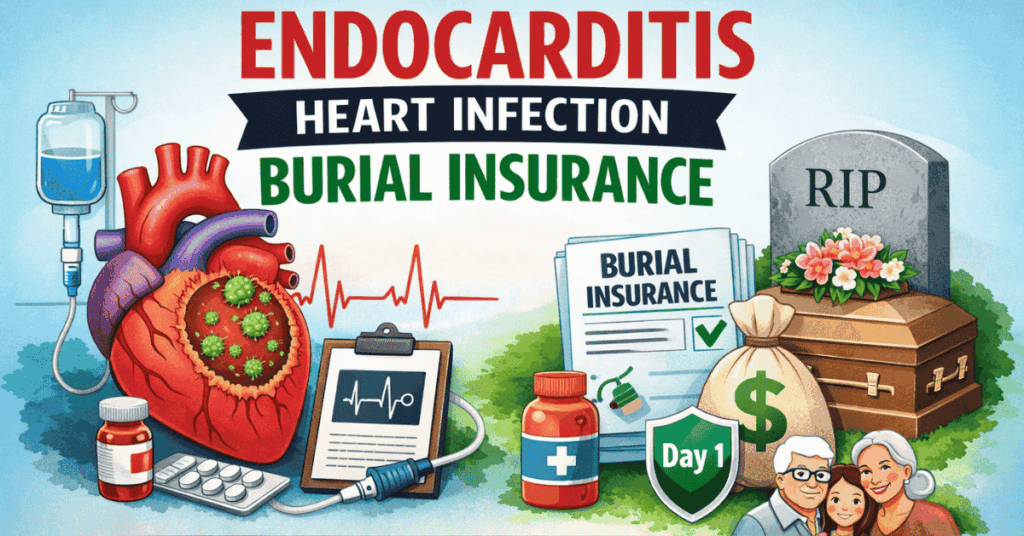
Endocarditis Heart Infection Medical Definition & Health Risks
Insurance underwriters determine your risk level for heart infection endocarditis by reviewing the dates of your last hospital stay and surgical history. Endocarditis is a serious inflammation of the inner lining of your heart and your heart valves. It occurs when bacteria enter your bloodstream and adhere to damaged areas of the heart muscle. If you do not treat it with strong medicine or surgery, it can destroy your valves and lead to sudden heart failure or a stroke.
Heart Infection Endocarditis Underwriting Basics
- Testing & Test Results: Carriers, check your Echocardiogram to see your Ejection Fraction score. A score of 55% to 70% is considered healthy, while a score below 40% indicates a higher risk of heart failure.
The sensible use of medications over time should reduce your mortality risk, allowing the insurance companies to offer you better coverage options.
- Why it Matters: Your test results control your risk class and determine if you get a plan that pays out on day one or one that makes you wait.
Heart Infection Endocarditis Prescription Medication Classes
- IV Antibiotics: Vancomycin or Gentamicin are used to treat infections while you are in the hospital.
- Oral Antibiotics: Amoxicillin is used as a preventive before your teeth are cleaned to keep germs from reaching your heart.
- Blood Thinners: Warfarin or Eliquis are prescribed to prevent clots if the infection damaged your valves.
Heart Infection Endocarditis with Comorbidities
Multiple health issues occurring at the same time increase the total risk for the life insurance company. Endocarditis often affects people who already have heart valve disease or other chronic health problems. Insurers watch for diabetes or kidney disease because these issues make it much harder for your body to fight off a second infection. Having a history of a stroke or a pacemaker also makes the insurance company view you as a higher risk.
In my experience, controlled heart infection endocarditis qualifies people for immediate level burial insurance coverage even with secondary health issues.
Other Common Health Issues With Endocarditis Heart Infection
Endocarditis, a heart infection, can damage heart valves and surrounding tissue through bacterial or fungal invasion, disrupting blood flow and cardiac function, and affecting underwriting and policy selection when these complications are present.
- Valve damage – Infected valves don’t seal properly, reducing cardiac efficiency and stamina.
- Heart failure – Valve destruction and weakened pumping cause shortness of breath, swelling, and fatigue.
- Stroke risk – Infected clots can break loose and travel to the brain, causing sudden neurological injury.
- Persistent fever and fatigue – Ongoing infection drains energy and limits daily function.
- Arrhythmias – Inflammation and scarring disrupt electrical signals, causing palpitations or dizziness.
- Embolic events – Septic debris can block blood flow to organs, causing pain and organ damage.
- Kidney injury – Immune complexes and emboli impair filtration and fluid balance.
- Need for surgery – Severe valve damage often requires valve repair or replacement with long recovery.
- Recurrent infection risk: Prior endocarditis increases the risk of future infections.
- Reduced work capacity – Fatigue, cardiac limits, and prolonged treatment affect reliability and endurance.
Understanding Endocarditis Heart Infection Policy Types
Carriers offer different plan categories based on an applicant’s heart infection, endocarditis, and long-term and short-term health stability.
- Level: Level burial insurance offers 1st-day coverage and pays the full death benefit from day one through companies like Family Benefit Life and Trinity Life.
- Graded: Graded burial insurance limits benefits during the 12 to 24 months for health or medical-related causes of death and is often provided by Guarantee Trust Life.
- Guaranteed Issue: Guaranteed issue burial insurance requires no health questions but includes a 2-year waiting period before it pays out for health or medical-related causes of death through carriers like Gerber Life.
Sample Endocarditis Heart Infection Rate Snapshot for $10,000 Coverage
Monthly premiums for burial insurance policies will increase as you get older and your health risks grow each year you don’t get this insurance. Women pay lower rates than men because they statistically live longer lives. Here are some preferred rates, but your rates can vary based on which A-rated carrier is best for your situation.
TRINITY LIFE & FAMILY BENEFIT INSURANCE RATES AGE 50–85
| AGE | $10,000 | $15,000 | $20,000 | $25,000 |
|---|---|---|---|---|
| 50 | F: $21 M: $27 | F: $31 M: $39 | F: $40 M: $52 | F: $50 M: $64 |
| 55 | F: $26 M: $32 | F: $38 M: $47 | F: $49 M: $62 | F: $61 M: $78 |
| 60 | F: $32 M: $41 | F: $47 M: $61 | F: $62 M: $80 | F: $77 M: $100 |
| 65 | F: $41 M: $53 | F: $60 M: $79 | F: $79 M: $104 | F: $99 M: $130 |
| 70 | F: $52 M: $69 | F: $76 M: $102 | F: $101 M: $135 | F: $126 M: $169 |
| 75 | F: $71 M: $96 | F: $106 M: $143 | F: $140 M: $190 | F: $175 M: $237 |
| 80 | F: $104 M: $145 | F: $155 M: $217 | F: $207 M: $288 | F: $258 M: $360 |
| 85 | F: $155 M: $192 | F: $231 M: $287 | F: $307 M: $382 | F: $384 M: $477 |
Rates may vary based on age, gender, health, and state. Click the form on this page for the lowest rates from the best carriers.
Heart Infection Endocarditis Underwriting & Medication History
Insurance carriers use your prescription history to confirm that you have finished your treatment and remain stable. Underwriters look for a clean gap between your last IV antibiotic dose and today to prove the infection is gone. Taking your maintenance heart meds exactly as the doctor says is a “positive sign” to the insurance company. If you stay compliant with your blood thinners or blood pressure pills, you show the insurer that you are a low-risk client.
Your prescription history is how the insurance carriers verify medical stability. Recent hospitalizations for crises trigger postponement rather than permanent decline.
| Health Profile | Coverage Type | Wait Period |
|---|---|---|
| Recovered (12+ Mos) | Level | None |
| Recent Treatment (6 Mos) | Graded | 24 Months |
| Active Infection | Guaranteed Issue | 2 Years |
Real Life Endocarditis Heart Infection Success Stories
Real-world examples illustrate how people with heart infection endocarditis can get day-one protection with anywhere from $5,000 to $25,000 for burial, cremation, funeral expenses, final expenses, leave money for loved ones, pay off last bills, or a combination of these.
Robert’s Story
Robert finished his treatment for a heart infection about eighteen months ago and feared he would only qualify for a waiting-period plan. He had some minor valve leakage, but his latest echo showed that his heart was still pumping strong. I helped him apply with Family Benefit Life because they offer great rates for people who have recovered from heart infections. He got a $12,000 policy with full first-day coverage. This plan allowed him to pay for his final expenses while saving 30% compared to other quotes.
Mary’s Story
Mary had a heart infection that resulted in a valve replacement surgery just over one year ago. Many agents told her she was a high-risk decline because of the surgery and the infection history. I found her a plan with Trinity Life that focused on her stability since the operation. She was approved for $15,000 in immediate coverage to pay off her last medical bills and burial costs. Mary was happy that her family would have the money the very day it was needed.
Endocarditis Heart Infection Financial Ratings & Stability
Financial ratings identify why financial ratings verify a carrier’s ability to pay death claims.
Companies with high ratings from A.M. Best have the money needed to pay your claim within just a few days of your passing. A good BBB rating shows that the company treats its customers with respect and has very few complaints. You want a company that is strong and stable so your family doesn’t have to worry during a difficult time.
Insurance Carrier Ratings & Comparisons
| Carrier | A.M. Best | BBB | NAIC Complaints |
|---|---|---|---|
| Aflac | A+ (Superior) | A+ | Low |
| CICA | B++ (Good) | A+ | Low |
| Colonial Penn | A (Excellent) | A+ | High (300% Above Avg) |
| Family Benefit Life | A+ (Superior) | A+ | Low |
| Guarantee Trust Life | A (Excellent) | A+ | Low |
| Senior Life | Not Rated | A+ | High (300% Above Avg) |
| Trinity Life | A+ (Superior) | A+ | Low |
Frequently Asked Questions: Endocarditis Heart Infection Burial Insurance
Can you get burial insurance after a heart infection (endocarditis)?
Insurance companies approve permanent burial insurance for endocarditis survivors because final expense carriers in 2026 primarily focus on your recovery time and current heart stability. You are not “uninsurable” just because you survived a serious heart infection. Honestly, it just does not make sense to assume the door is closed when most carriers are perfectly comfortable with your history once the infection is fully resolved. If you have been out of the hospital for at least 24 months, you can often qualify for a standard “Level” plan with the lowest rates. Even if your recovery was more recent, a guaranteed-issue plan ensures your family is protected regardless of your medical records.
Is Day One burial insurance coverage available for endocarditis survivors?
Immediate first-day coverage is available for survivors who have met the insurance carrier’s look-back period, typically a two-year window of stable health. You do not have to wait if you have completed all IV antibiotics and your cardiologist has confirmed your heart valves are stable. If you have passed the 24-month mark without a relapse, companies such as Family Benefit Life or Trinity Life can offer you immediate protection. This means your family receives the full death benefit from the very first day you pay your premium. It is a much better deal than the “waiting room” plans you see advertised on late-night TV.
How does a heart valve replacement from endocarditis affect burial insurance?
A heart valve replacement influences the type of plan you qualify for, but it does not stop you from getting a permanent whole-life policy to cover your funeral costs. Most insurance underwriters want to see at least 12 to 24 months of successful recovery after a major heart surgery before they offer you their best rates. If your surgery was years ago and your heart function scores remain in a healthy range, you can qualify for the same low prices as anyone else. But if the surgery was recent, you might start with a graded plan that seasons over time. Framing your surgery as a successful repair helps the company see you as a stable risk rather than a walking crisis.
What is the waiting period for burial insurance with active endocarditis?
If you currently have an active heart infection or are undergoing IV antibiotic treatment, you must use a guaranteed-issue policy, which always includes a mandatory two-year waiting period. Here is the part they do not tell you in the flashy commercials: insurance companies will not give you immediate coverage while you are still fighting an active infection. If you pass away from natural causes during the first 24 months of a guaranteed-issue plan, the company simply refunds your premiums plus about 10% interest. However, accidental death is covered for the full 100% starting on day one. It is better to start this clock now so your family is fully protected sooner rather than later.
Will prophylactic antibiotics for endocarditis raise my burial insurance premiums?
Taking preventative antibiotics before dental work or minor surgery does not raise your premiums because underwriters view this as responsible medical management rather than an active illness. Insurance companies do not penalize you for following a doctor’s orders to protect your heart valves; they only flag “active” infections that require high-dose IV therapy or long-term hospitalization. Following your preventative care plan actually proves to the company that you are a “boring” and stable risk. This responsible behavior allows me to argue for the lowest possible rates for your family, saving you a “convenience tax” on your monthly bill.
What heart function scores do burial insurance companies check?
If you apply for a plan that asks health questions, underwriters may review your Ejection Fraction (EF) score to determine if the endocarditis caused any permanent muscle damage. The insurance company wants to see a “math of the heart” that shows you are healthy enough to live a long life. An EF score between 55% and 70% is considered ideal and helps you land the best rates. If your score has dropped below 40% due to complications, you may be directed toward a graded or guaranteed plan. Knowing these numbers before you apply prevents you from being surprised by a higher rate or a longer waiting period.
Does burial insurance cover death from heart failure caused by endocarditis?
Burial insurance covers death from any cause, including long-term complications like heart failure, once you have owned the policy for at least 24 months. Once you satisfy the initial waiting period, the insurance company is legally bound to pay the full death benefit to your family. It does not matter if the cause of death stems from a prior heart infection or a completely unrelated issue. This permanent protection ensures your spouse has the cash needed to pay the funeral director without having to dip into their own savings or social security check.
Can I get burial insurance if I have endocarditis and a Pacemaker?
You can qualify for a permanent whole-life policy even if you have a pacemaker and a history of endocarditis because many “impaired risk” carriers specialize in these cases. Having a pacemaker is actually very common among heart survivors, and it shows the company that your heart rhythm is being managed by modern technology. As long as the device was not installed in the last 12 months for an “unstable” emergency, it typically won’t prevent you from getting coverage. You get a targeted benefit that handles your final bills while the company takes on the risk of your heart health.
What medications for heart infections trigger an insurance waiting period?
High-dose IV antibiotics like Vancomycin or Gentamicin act as “red flags” that indicate an active infection and will trigger a two-year waiting period on your application. Underwriters perform a quick background check on your prescriptions to see what you have taken in the last 12 months. If these heavy-duty meds pop up, the company assumes you are currently in a medical crisis. Once you transition back to standard maintenance pills or no medication at all, your chances for immediate, day-one coverage go up significantly. Waiting until you are off the “crisis meds” can save your family a lot of money in the long run.
Why is burial insurance better than a funeral plan for heart survivors?
Burial insurance is a much better deal than a pre-paid funeral plan because it provides your family with tax-free cash that can be used at any funeral home in any state. Pre-paid plans are often “bad deals” that lock your money into one specific location, which is useless if your family moves or if that business closes down. Burial insurance is a permanent asset that travels with you. If your health changes or you need to move closer to family, your policy stays in force at the same locked-in rate. It gives your loved ones total flexibility to handle your final wishes exactly as they see fit.
