Quick Answer
Burial insurance with multiple sclerosis is still possible, but it depends on how your condition is managed and how recently symptoms have progressed. Insurers look closely at flare-ups, mobility, medications, and hospital history. If your MS is stable, some whole life burial insurance plans can offer full coverage from day one. If not, you’ll likely be placed into a policy with a waiting period that delays the payout, and needing another person’s help with bathing, dressing, eating, toileting or transferring means a guaranteed acceptance plan with a two-year waiting period for natural death.
Key Points
- Multiple sclerosis can limit your options and raise your monthly cost
- Recent flare-ups or disabilities usually trigger waiting period plans
- Some companies decline you while others still offer the same-day coverage
- Applying wrong can lock you into higher prices or delayed benefits
- Guaranteed issue plans accept you, but delay full payout for 2 years
- Stable MS cases can still qualify for full coverage with the right company
GET MY QUOTEor call 888-862-9456
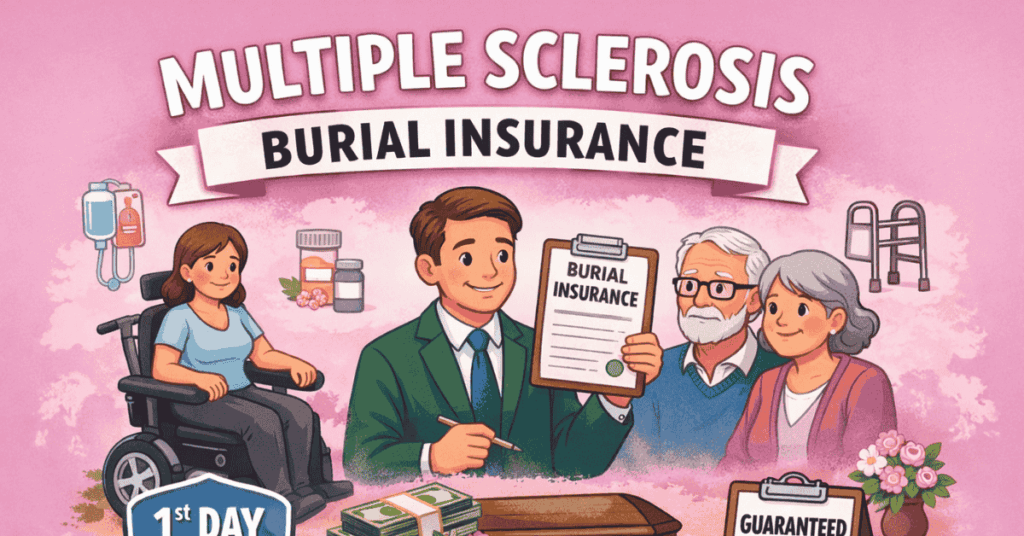
Multiple sclerosis burial insurance key insights
- Aflac is the Top Choice for MS: Aflac is uniquely forgiving of Multiple Sclerosis. They often provide first-day coverage even for moderate cases, allowing your family to be fully protected from the very first premium payment.
- Mobility Tools Define Your Options: Underwriters focus on your physical independence. If you still walk on your own or with a cane, you have a high chance of immediate approval. Transitioning to a motorized scooter or wheelchair may shift you toward specialized or graded plans.
- Lock in Rates Early: Because MS is a progressive condition, it is vital to secure a policy while your symptoms are manageable. Applying now “grandfathers” you into a rate and plan that might be unavailable if your mobility decreases later.
- Independence with ADLs is Crucial: Needing assistance with activities of daily living (ADLs), such as bathing, dressing, or eating, is the primary trigger for a waiting-period plan. Maintaining your independence is the key to qualifying for the lowest possible market rates.
- Medication Stability is a Green Light: Using standard disease-modifying therapies like Copaxone or Gilenya proves you are under a doctor’s care. Underwriters view a consistent, long-term medication routine as a sign of medical stability rather than a reason for denial.
More carriers expanded immediate-coverage options for people with controlled Multiple Sclerosis. Most people will have no trouble qualifying for and affording an instant-approval policy if they do not have major limitations in their daily lives.
Multiple sclerosis medical definition & health risks
Underwriters evaluate the severity of Multiple Sclerosis by reviewing your diagnosis date, the frequency of relapses, and your level of physical mobility. Multiple Sclerosis is a chronic disease where the immune system attacks the nerves, and insurers use your recent medical history to determine how effectively your treatment is preventing new symptoms or disability. This condition causes a domino effect of issues like trouble swallowing, motorized scooter use, and frequent falls.
Because it is a progressive condition, insurance companies look closely at how long ago you were diagnosed and if you have any pending tests or flare-ups. Poor control of the condition leads to rapid disability and a loss of independence.
Life insurance companies ask these multiple sclerosis health questions
Different life insurance companies ask different questions to decide which applicants with multiple sclerosis they may approve.
- Aetna Standard Level – Have you ever been diagnosed with, received, or been advised to receive treatment or medication for parkinson’s disease, multiple sclerosis, or systemic lupus erythematosus (SLE)?
- Aflac Standard Level – Have you ever been diagnosed with, received, or been advised to receive treatment or medication for parkinson’s disease, multiple sclerosis, or systemic lupus erythematosus (SLE)?
- Family Benefit Life Level – Have you ever been diagnosed as having multiple sclerosis, epilepsy, schizophrenia, Parkinson’s disease, nephropathy, neuropathy, retinopathy, chronic kidney disease or failure, systemic lupus, hepatitis B or C, cirrhosis of the liver, liver disease, liver failure, or lung impairments including chronic obstructive pulmonary disease (COPD), chronic asthma, chronic bronchitis, emphysema, or fibrosis?
- Liberty Bankers Life Modified – Within the past 2 years have you, the Proposed Insured, been diagnosed, treated, tested positive for, or been given medical advice by a member of the medical profession for multiple sclerosis, Parkinson’s disease, or required the use of a walker, wheelchair, or electric scooter due to chronic illness or disease?
- Mutual of Omaha Level – In the past 4 years, has the Proposed Insured been diagnosed by a licensed medical professional with, received treatment by a licensed medical professional for, or been advised to seek treatment by a licensed medical professional for Bipolar Depression, Schizophrenia, Parkinson’s Disease or Multiple Sclerosis?
- Trinity Life Level – Have you ever been diagnosed as having multiple sclerosis, epilepsy, schizophrenia, Parkinson’s disease, nephropathy, neuropathy, retinopathy, chronic kidney disease or failure, systemic lupus, hepatitis B or C, cirrhosis of the liver, liver disease, liver failure, or lung impairments including chronic obstructive pulmonary disease (COPD), chronic asthma, chronic bronchitis, emphysema, or fibrosis?
Multiple sclerosis underwriting basics
Insurance companies evaluate neurological stability to determine policy eligibility.
- Testing & Test Results: Underwriters check for recent flare-ups and any pending procedures or neurological tests that do not have final results yet. They categorize “controlled” as having no new lesions on scans for 12 months, while “uncontrolled” means you have active symptoms or new medical findings.
Medication stability over time reduces the insurance company’s perceived mortality risk, often allowing you to qualify for better coverage.
- Why it Matters: Test results and drug history tell the insurer if the disease is moving slowly or if it is causing rapid health decline. Your specific “risk class” determines if you pay the lowest rate or a higher price for the same death benefit.
Multiple sclerosis prescription medication classes
Prescription history identifies the medical management of your condition.
- Disease-Modifying Therapies: Copaxone, Gilenya, or Aubagio are used to slow disease progression.
- Steroids: High-dose Prednisone or infusions used during a flare-up to reduce nerve inflammation.
- Muscle Relaxants: Baclofen or Zanaflex are used to treat the stiffness or spasms that often come with Multiple Sclerosis MS.
Multiple sclerosis with comorbidities
Insurers evaluate overlapping health profiles to determine how the interaction between Multiple Sclerosis and other chronic conditions increases your overall insurance risk. Because MS often pairs with secondary issues like high blood pressure, heart disease, or lung problems, underwriters carefully review how these conditions stack up, as the presence of multiple health challenges can complicate your treatment and increase the likelihood of future claims. If you have multiple health problems, I use your total health picture to find the best carrier for your unique needs. It is like trying to bake a cake with the wrong ingredients: if one health issue is bad, the whole “recipe” for your insurance approval could fail.
Getting this insurance now is the only way to avoid higher costs later. As your body wears down, the price of a policy only goes up. You are essentially buying peace of mind for your kids so they aren’t passing the hat when you pass away.
Controlled Multiple Sclerosis qualifies most people for immediate level burial insurance coverage, even with secondary health issues.
Other common health issues with multiple sclerosis (MS)
Multiple sclerosis causes immune-mediated damage to the central nervous system, disrupting nerve signal transmission and leading to physical, sensory, and cognitive impairments that can affect underwriting decisions and policy selection when these related issues are present.
- Mobility impairment – Muscle weakness, spasticity, and poor coordination limit walking and physical endurance.
- Chronic fatigue – Neurological fatigue reduces stamina and consistency with daily activities and work.
- Sensory disturbances – Numbness, tingling, and pain interfere with balance and fine motor tasks.
- Vision problems – Optic neuritis and blurred vision affect reading, driving, and safety.
- Cognitive impairment – Slowed processing, memory issues, and attention problems impact decision-making.
- Bladder and bowel dysfunction – Urgency, incontinence, and constipation disrupt daily routines.
- Spasticity and muscle stiffness – Muscle tightness causes pain and limits range of motion.
- Depression and anxiety – Mood disorders are common due to neurological changes and disease uncertainty.
- Heat sensitivity – Elevated temperature worsens symptoms and reduces functional capacity.
- Progressive disability – Accumulating nerve damage increases long-term dependence and care needs.
Understanding multiple sclerosis policy types
Carriers offer different plan categories based on an applicant’s Multiple Sclerosis and long & short-term health stability.
- Level: Level burial insurance offers 1st-day coverage and pays the full death benefit from day one. Aflac is a top choice here as they accept even moderate cases for their first-day coverage plan.
- Graded: Graded burial insurance limits benefits during the 12 to 24 months for health or medical-related causes of death. Guarantee Trust Life is a very solid option if your Multiple Sclerosis has caused some minor complications.
- Guaranteed Issue: Guaranteed issue burial insurance requires no health questions but includes a 2-year waiting period before it pays out for causes of death related to health or medical conditions. Gerber Life is the best choice if you need help with activities like eating, bathing, or transferring.
Sample rate snapshot for $10,000 coverage
Insurers use age and gender as primary factors in determining premiums, as both directly impact statistical life expectancy. Rates vary by these markers because women generally have a longer life expectancy than men, allowing carriers to offer them lower monthly costs. This is just the “math of the heart” at work: women get a better deal because they stick around longer. Here are some preferred rates, but your rates can vary based on which A-rated carrier is best for your situation.
Aflac standard life insurance rates age 50–80
| AGE | $10,000 | $15,000 | $20,000 | $25,000 |
|---|---|---|---|---|
| 50 | F: $35 M: $44 | F: $51 M: $64 | F: $67 M: $84 | F: $83 M: $104 |
| 55 | F: $38 M: $49 | F: $55 M: $72 | F: $72 M: $95 | F: $89 M: $118 |
| 60 | F: $43 M: $59 | F: $63 M: $86 | F: $83 M: $114 | F: $103 M: $141 |
| 65 | F: $57 M: $75 | F: $83 M: $111 | F: $110 M: $147 | F: $137 M: $183 |
| 70 | F: $75 M: $101 | F: $111 M: $150 | F: $147 M: $199 | F: $183 M: $248 |
| 75 | F: $107 M: $142 | F: $159 M: $211 | F: $210 M: $280 | F: $262 M: $349 |
| 80 | F: $172 M: $222 | F: $256 M: $331 | F: $340 M: $440 | F: $424 M: $549 |
Rates may vary based on age, gender, health, and state.
Multiple sclerosis underwriting & medication history
Insurers use your prescription history to confirm that your medical condition is stable and that you are consistently following your treatment plan. Managing Multiple Sclerosis with a steady medication routine is a positive sign to underwriters because it provides objective evidence that the disease progression is being actively monitored and controlled. They will check your drug history for any “dual medications” or recent changes that might suggest your condition is worsening. I will perform a quick background check on your prescriptions to ensure we pick the carrier that views your maintenance as a sign of responsibility rather than a red flag.
Your prescription history is how the insurance carriers verify medical stability. Recent hospitalizations for crises trigger postponement rather than permanent decline.
| Health Profile | Coverage Type | Wait Period |
|---|---|---|
| Stable MS / Independent | Level | None |
| Moderate MS / Stable Meds | Level (Aflac) | None |
| Severe MS / ADL Needs | Guaranteed Issue | 2-Year Period |
Real life multiple sclerosis success stories
Real-world examples illustrate how people with Multiple Sclerosis secure day-one protection with anywhere from $5,000 to $25,000 for any of the following: burial, cremation, funeral expenses, final expenses, leave money for loved ones, pay off last bills, or a combination of these.
Robert’s story
Robert was diagnosed with MS 8 years ago and has lived with moderate symptoms ever since. He was worried that his flare-ups would deny him first-day coverage. I helped Robert apply with Aflac because their underwriting method is incredibly forgiving of Multiple Sclerosis history. Robert was approved for a $15,000 policy that started immediately. He was so happy to know he wouldn’t have to face a waiting period despite his condition. Now Robert’s family has the protection they need without the “convenience tax” of a waiting plan.
Linda’s story
Linda’s Multiple Sclerosis had progressed to the point where she was using a motorized scooter and needed a little help getting dressed in the morning. She knew she needed insurance, but didn’t want her family to be stuck with the bill if her health failed. I placed Linda with Gerber Life because they have no health questions and a guaranteed approval. Linda locked in her $10,000 policy to protect her children from future funeral costs. It was the best move for her situation, and she felt a huge weight lift off her shoulders.
Multiple sclerosis financial ratings & stability
Insurers use financial ratings to demonstrate they have the liquid assets and capital reserves necessary to pay death benefit claims to their policyholders. I only work with carriers that have earned high financial strength scores from A.M. Best and maintain a solid service reputation with the Better Business Bureau to ensure your family’s claim is paid promptly and professionally. You do not want to buy a policy from a company that might not be around to pay the check. These ratings tell us who has the cash on hand to keep their promises to your family.
Insurance carrier ratings & comparisons
| Carrier | A.M. Best | BBB | NAIC Complaints |
|---|---|---|---|
| Aflac | A+ (Superior) | A+ | Low |
| CICA | B++ (Good) | A+ | Low |
| Colonial Penn | A (Excellent) | A+ | High (300% Above Avg) |
| Family Benefit Life | A+ (Superior) | A+ | Low |
| Guarantee Trust Life | A (Excellent) | A+ | Low |
| Senior Life | Not Rated | A+ | High (300% Above Avg) |
| Trinity Life | A+ (Superior) | A+ | Low |
Frequently asked questions: multiple sclerosis burial insurance
Can you get burial insurance if you have multiple sclerosis?
Insurance carriers approve permanent life insurance policies for applicants with Multiple Sclerosis every day because they view this diagnosis as a manageable chronic condition. Many people think a diagnosis like MS makes them uninsurable. Honestly, it just does not make sense to listen to those confusing TV ads. Most final expense companies will offer you a policy as long as you can handle your own daily business and live at home. If your symptoms stay stable, you can secure a plan in minutes. This protection ensures your family has the cash they need to pay the funeral director without having to beg for donations.
Is day one coverage available for MS patients?
Most top-rated insurance companies provide first-day coverage for MS patients who have maintained a stable health history for at least 24 months. You can absolutely qualify for full benefits starting on day one. If your diagnosis occurred more than 2 years ago, a “Level” benefit plan is usually available to you. This means your family receives the full death benefit from the very first day you make a premium payment. It is like paying for a full gallon of milk: you get the full value immediately without any “convenience tax” waiting periods.
How does the type of MS (RRMS vs. PPMS) affect insurance eligibility?
Insurance underwriters prioritize your current level of physical mobility over the specific medical classification of your Multiple Sclerosis diagnosis. The insurance company cares more about whether you can walk than whether you have RRMS or PPMS. If you are stable and moving well, you qualify for the best rates. If the disease moves fast and requires constant care, you might have to settle for a plan with a waiting period. The goal is to find the carrier that treats your unique situation with the most respect.
Will using a wheelchair for MS disqualify me from immediate coverage?
Wheelchair use does not automatically disqualify you from coverage, but it often determines whether a carrier offers you immediate benefits or a graded plan. A wheelchair is not a deal-breaker. Some companies view a wheelchair as a major risk, but specific carriers only care if you can still live at home and manage your own care. If you are still independent, you can often find a “wheelchair-friendly” policy. If your mobility is very limited, a “Guaranteed Issue” plan ensures your family stays protected regardless of your physical condition.
What medications for MS do burial insurance companies flag?
Insurance companies review your disease-modifying therapies to verify that you are successfully managing your condition under a doctor’s care. A quick background check on your prescriptions tells the underwriter everything they need to know. Drugs like Copaxone or Betaseron are totally normal for MS. They actually help your case because they prove you follow a doctor’s orders. As long as you are not taking heavy IV steroids for a current flare-up, the company will see your meds as a sign of medical stability.
Does a recent MS relapse cause a waiting period?
Recent hospitalizations or significant disease flare-ups typically trigger a temporary two-year waiting period for a natural death payout. If you had a major relapse in the last 12 months, the company will likely put you in a “Graded” plan. These plans pay a partial amount during the first 2 years of the policy. Honestly, it just does not make sense to wait until you feel perfect to apply. You should lock in a policy now so you can start the clock on that two-year period for your family.
Can I get burial insurance if I’m on Social Security disability (SSDI) for MS?
Social Security Disability benefits do not prevent you from securing a permanent life insurance policy to cover your final arrangements. Many people on a fixed income use their SSDI checks to pay for their monthly premiums. Insurance companies do not even ask if you receive disability benefits. They only care about your actual medical stability and your ability to pay the bill. Keeping your rate affordable ensures more money stays in your pocket for your daily life.
Is there a “look-back” period for an MS diagnosis?
Most final expense insurance applications use a 24-month look-back period to determine your eligibility for the lowest possible rates. Some health and medical conditions will be accepted regardless of medication use. The biggest thing to watch out for with MS is the Activities of Daily Living issue. You are smart to lock in your first day coverage before any ADLs issue pops up, thereby putting you into a 2-year waiting period plan.
Does MS burial insurance cover death from pneumonia or other complications?
Permanent whole life policies pay the full death benefit for any cause of death if it’s a 1st-day coverage plan; otherwise, there would be a mandatory two-year waiting period. Policy type determines payment speed. The company must pay the check if you pass away from MS complications or any other health failure. This money lets your kids pay the funeral director and handle your last bills. This ensures your family has a check in their hands when they need it most.
Can I get burial insurance with MS if I also have diabetes?
Specialized burial insurance carriers offer coverage to seniors who manage multiple health conditions, such as MS and Diabetes. Having MS and diabetes together is a “dual-diagnosis” challenge for most agents. Traditional life insurance companies will run away, but specific final expense carriers see these as manageable issues. You might pay a slightly higher premium (depending on the company), but you won’t be declined. This gets you the best price for your unique health profile, so you keep more money behind for your spouse.
What is the average cost of a $10,000 burial policy for someone with MS?
Your age and gender dictate the primary cost of a $10,000 burial policy more than the MS diagnosis itself. If you are in your 60s, a $10,000 policy typically costs between $45 and $85 a month. Your diagnosis usually does not change the price as much as your age does. It is the “Math of the Heart”: you pay a small amount now to save your family from a massive bill later. Finding a company with the lowest “convenience tax” helps you protect your fixed-income household.