Organ Transplant Burial Insurance
An organ transplant doesn’t automatically disqualify you from burial insurance, but applying the wrong way can cost your family thousands. These organ transplant-approved policies I help people with pay out quickly to cover burial or cremation costs, or provide a tax-free legacy for your loved ones.
Organ Transplant Burial Insurance Key Insights
- Organ transplants require waiting periods: Because organ replacements carry inherent risks like rejection or infection, burial life insurance companies classify every transplant recipient as a high-risk applicant.
- Guaranteed issue is the only available lane: You will not qualify for first-day coverage plans because insurers view a transplanted organ as less stable than a healthy original organ.
- Anti-rejection drugs result in a lifetime risk: Carriers identify transplant history through your prescription records since you must take immunosuppressant medications for the rest of your life.
- Immune system health affects approval: Underwriters worry about your compromised immune system because it increases your risk of life-threatening complications or infections.
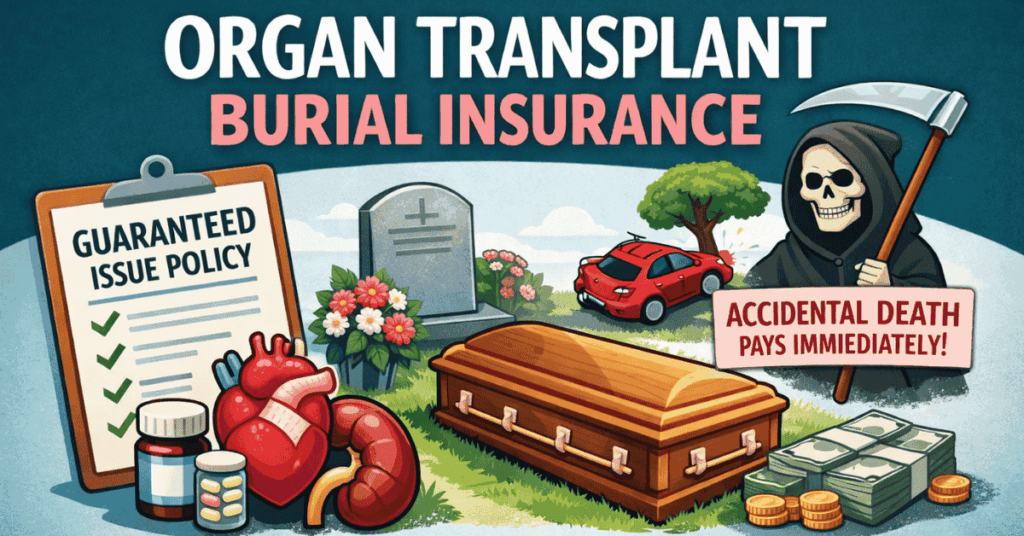
- Accidental death benefits pay out immediately: Even though a natural death has a two-year waiting period, a guaranteed issue policy pays the full benefit from the first day if an accident occurs.
I’m always on the lookout for more insurance companies that offer affordable protection for organ transplant recipients. Because of this, most people I help will have no trouble qualifying for and affording an instant-approval policy.
Organ Transplant Medical Definition & Health Risks
Insurance underwriters classify an organ transplant as a permanent high-risk condition that typically requires a mandatory two-year waiting period before most traditional policies become available. Because a transplant is a major surgery involving organ replacement, insurers must wait to ensure the body does not reject the donor organ and that the recipient’s health remains stable. While an organ transplant saves people’s lives, the body often tries to attack the new organ. This process is called rejection. If you do not manage your health well, the new organ may fail, or your body may develop dangerous infections due to a weakened immune system.
Life Insurance Companies Ask These Heart Transplant Questions
Different life insurance companies ask different questions to decide which heart transplant applicants they may approve.
- Aetna Decline – Have you ever been diagnosed with, received, or been advised to receive treatment or medication for congestive heart failure, pulmonary fibrosis, any terminal condition, or end-stage disease?
- Aetna Decline – Have you ever been diagnosed with, received, or been advised to receive treatment or medication for cerebral palsy, cystic fibrosis, muscular dystrophy, or un-operated heart defects?
- Aetna Modified – Within the past year, have you been diagnosed with, received, or been advised to receive treatment for angina (chest pain), heart attack, cardiomyopathy, or any type of heart or circulatory procedure or surgery?
- Aetna Level – Within the past 2 years, have you been diagnosed with, received, or been advised to receive treatment for angina (chest pain), heart attack, cardiomyopathy, or any type of heart or circulatory procedure or surgery?
- Aflac Decline – Have you ever been diagnosed with, received, or been advised to receive treatment or medication for congestive heart failure, pulmonary fibrosis, any terminal condition, or end-stage disease?
- Aflac Decline – Have you ever been diagnosed with, received, or been advised to receive treatment or medication for cerebral palsy, cystic fibrosis, muscular dystrophy, or un-operated heart defects?
- Aflac Modified – Within the past year, have you been diagnosed with, received, or been advised to receive treatment for angina (chest pain), heart attack, cardiomyopathy, or any type of heart or circulatory procedure or surgery?
- Aflac Standard – Within the past 2 years, have you been diagnosed with, received, or been advised to receive treatment for angina (chest pain), heart attack, cardiomyopathy, or any type of heart or circulatory procedure or surgery?
- CICA Life Level – In the past 10 years, have you opted to not seek treatment, have not taken medication, or have not followed the prescribed treatment plan following a medical diagnosis by a member of the medical profession for any one or more of the following: uncontrolled diabetes, uncontrolled high blood pressure, stroke or TIA, paralysis, congestive heart failure, heart disease, cardiomyopathy, lung disease including COPD (chronic obstructive pulmonary disease) or emphysema, liver cirrhosis or failure, kidney (renal) failure or insufficiency, or chronic kidney disease including dialysis?
- Family Benefit Life Decline – Have you ever been diagnosed by a medical professional with a terminal illness, end-stage disease, congestive heart failure, or cardiomyopathy?
- Family Benefit Life Decline – Within the past 12 months, have you been diagnosed by a medical professional for, or hospitalized for, a heart attack, stroke, transient ischemic attack (TIA), angina, aneurysm, or had cardiac or circulatory surgery of any kind to improve circulation to the heart or brain?
- Family Benefit Life Level – During the past 24 months, have you been diagnosed, treated, tested positive for, or given medical advice by a medical professional for a heart attack, stroke, transient ischemic attack (TIA), angina, aneurysm, or had cardiac or circulatory surgery of any kind such as a pacemaker, heart valve replacement, bypass, angioplasty, or stent implant to improve circulation to the heart or brain?
- Liberty Bankers Life Decline – Have you, the Proposed Insured, ever been diagnosed, treated, tested positive for, or been given medical advice by a member of the medical profession for; congestive heart failure (CHF), cardiomyopathy, memory loss, Alzheimer’s, senile dementia, dementia, heart defibrillator implant, 2 or more instances of internal cancer(s), or terminal illness (“terminal illness” means a disease or illness that is expected to result in death within 24 months)?
- Liberty Bankers Life Modified – Within the past 2 years have you, the Proposed Insured, been diagnosed, treated, tested positive for, or been given medical advice by a member of the medical profession for; angina (chest pain), any type of heart or circulatory surgery or disease, heart valve disorder, heart attack, or received a pacemaker or stent?
- Liberty Bankers Life Preferred – Have you, the Proposed Insured, by a member of the medical profession, ever been diagnosed with, or received, or been advised to receive treatment or medication for Chronic Obstructive Pulmonary Disease (COPD), chronic bronchitis, emphysema, irregular heartbeat, atrial fibrillation, peripheral vascular disease or peripheral artery disease?
- Mutual of Omaha Decline – Has the Proposed Insured ever been diagnosed by a licensed medical professional with, received treatment by a licensed medical professional for, or been advised to seek treatment by a licensed medical professional for; Alzheimer’s Disease, Dementia, Huntington’s Disease, Sickle Cell Anemia, Myelodysplastic Syndrome (MDS), Lou Gehrig’s Disease (ALS), Hydrocephalus, Muscular Dystrophy, Quadriplegia, Paraplegia, Down Syndrome, Intellectual Developmental Disorder, Congestive Heart Failure, Cirrhosis, Metastatic Cancer or recurrent Cancer of the same type?
- Mutual of Omaha Decline – In the past 12 months, has the Proposed Insured been diagnosed by a licensed medical professional as having heart disease or heart surgery of any kind?
- Mutual of Omaha Level – In the past 2 years, has the Proposed Insured been diagnosed by a licensed medical professional with, received treatment by a licensed medical professional for, or been advised to seek treatment by a licensed medical professional for; Coronary Artery Disease, Heart Attack, Coronary Artery Bypass Surgery, Angioplasty, Cardiomyopathy, irregular heart rhythm, Pacemaker or Valvular Heart Disease with surgical repair or replacement?
- Trinity Life Level – Have you ever been diagnosed by a medical professional with a terminal illness, end-stage disease, congestive heart failure, or cardiomyopathy?
- Trinity Life Decline – Within the past 12 months, have you been diagnosed by a medical professional for, or hospitalized for, a heart attack, stroke, transient ischemic attack (TIA), angina, aneurysm, or had cardiac or circulatory surgery of any kind to improve circulation to the heart or brain?
- Trinity Life Level – During the past 24 months, have you been diagnosed, treated, tested positive for, or given medical advice by a medical professional for a heart attack, stroke, transient ischemic attack (TIA), angina, aneurysm, or had cardiac or circulatory surgery of any kind such as a pacemaker, heart valve replacement, bypass, angioplasty, or stent implant to improve circulation to the heart or brain?
Organ Transplant Underwriting Basics
- Testing & Test Results: Underwriters review organ function tests, such as creatinine for the kidneys or ejection fraction for the heart. Controlled means your labs are stable, while uncontrolled means your body is showing signs of rejection.
The correct use of medications over time should reduce your mortality risk, allowing the insurance companies to offer you better coverage options.
- Why it Matters: These results confirm that the donor organ is still working, but they do not change the fact that you only qualify for a waiting-period plan.
Organ Transplant Prescription Medication Classes
- Immunosuppressants: Medications like Tacrolimus, Cyclosporine, and Mycophenolate that stop your body from attacking the new organ.
- Corticosteroids: Drugs like Prednisone are used to reduce inflammation and help prevent organ rejection.
- Anti-Infectives: Preventive medicines that protect your body while your immune system is suppressed.
Organ Transplant with Comorbidities
When multiple health issues occur simultaneously, the combined risk profile increases because the presence of other chronic conditions can complicate the recovery from an organ transplant. Insurance companies view the intersection of a transplant with diabetes, heart disease, or kidney issues as a significantly higher risk due to the increased probability of secondary medical complications. These secondary problems often occur because the anti-rejection drugs are very hard on the rest of your body. Managing these issues is vital because a single complication can lead to a hospital stay or organ failure.
In my experience, a controlled organ transplant qualifies people for guaranteed issue life insurance only, even with secondary health issues.
Most Common Organ Transplant Surgeries
Organ transplants in the United States are dominated by kidneys and livers, with hospitals performing roughly 39,000 of those 2 procedures per year, while heart, lung, pancreas, and other transplants combined account for fewer than 10,000 annually.
- Kidney
- Liver
- Heart
- Lung
- Pancreas
- Kidney–pancreas (combined)
- Intestine (small bowel)
Understanding Organ Transplant Policy Types
Carriers offer different plan categories based on an applicant’s organ transplant and long-term health stability.
- Level burial insurance provides 1st-day coverage and pays the full death benefit from day one; however, this plan is not available to transplant recipients. If you’ve had an organ transplant in the past, this will not be an option for you.
- Graded: Burial insurance limits benefits for 12 to 24 months for health-related causes of death, though most transplant cases still require guaranteed issue. If you’ve had an organ transplant in the past, this will not be an option for you.
- Guaranteed Issue: Guaranteed issue burial insurance requires no health questions but includes a 2-year waiting period before benefits are paid for health-related causes of death. I recommend Gerber Life for this.
Sample Organ Transplant Rate Snapshot for $10,000 Coverage
Monthly burial insurance costs increase as you get older because your statistical life expectancy decreases, making you a higher risk for the insurer. Rates also vary by gender because women statistically live longer than men, allowing insurance companies to offer them lower monthly premiums for the same level of coverage.
Here are some preferred rates, but your rates can vary based on which A-rated carrier is best for your situation.
GERBER LIFE INSURANCE RATES AGE 50–80
| AGE | $10,000 | $15,000 | $20,000 | $25,000 |
|---|---|---|---|---|
| 50 | F: $34 M: $44 | F: $51 M: $65 | F: $68 M: $87 | F: $84 M: $108 |
| 55 | F: $44 M: $57 | F: $65 M: $86 | F: $87 M: $114 | F: $109 M: $143 |
| 60 | F: $51 M: $63 | F: $76 M: $95 | F: $101 M: $126 | F: $126 M: $158 |
| 65 | F: $62 M: $85 | F: $93 M: $127 | F: $124 M: $169 | F: $155 M: $211 |
| 70 | F: $75 M: $99 | F: $112 M: $148 | F: $150 M: $197 | F: $187 M: $246 |
| 75 | F: $108 M: $139 | F: $161 M: $208 | F: $215 M: $278 | F: $269 M: $347 |
| 80 | F: $176 M: $247 | F: $264 M: $370 | F: $351 M: $493 | F: $439 M: $616 |
Rates may vary based on age, gender, health, and state. Click the form on this page for the lowest rates from the best carriers.
Organ Transplant Underwriting & Medication History
A prescription history assesses medical stability and allows underwriters to verify the type of transplant surgery performed by matching it to the prescribed medications. Taking anti-rejection medications consistently is a positive sign to insurers because it demonstrates strict adherence to a post-operative plan and a lower risk of organ rejection. Even if you are doing great, the history of a major organ replacement stays on your record forever.
Your prescription history is how the insurance carriers verify medical stability. Recent hospitalizations for crises result in postponement rather than permanent decline.
| Health Profile | Coverage Type | Wait Period |
|---|---|---|
| Organ Transplant History | Guaranteed Issue | 2 Years |
| On Anti-Rejection Meds | Guaranteed Issue | 2 Years |
| Active Rejection Case | Guaranteed Issue | N/A |
Real Life Organ Transplant Success Stories
Real-world examples illustrate how people with an organ transplant can get day-one protection for accidents and full coverage after two years, with $5,000 to $25,000 for burial, cremation, or final expenses.
David’s Story
David had a kidney transplant three years ago and wanted to make sure his funeral costs were covered. He knew he could not get a first-day coverage plan because of his anti-rejection medications. I helped him apply for a guaranteed issue policy with Gerber Life to start his two-year waiting period. This plan gives him peace of mind knowing the money will be there for his family. He saved time by not having to answer any difficult health questions about his surgery. David is happy that his accidental death coverage started the moment he paid his first premium.
Sarah’s Story
Sarah received a liver transplant and was worried that her hospital history would prevent her from getting any insurance. She needed a simple way to provide for her cremation and final medical bills. I assisted her in setting up a guaranteed issue plan that ignores her daily activities and recent treatments. She chose a $10,000 policy that pays 100% of the claim amount for accidents right away. By getting the policy now, she is already halfway through her waiting period for natural causes. Sarah feels much better knowing she has a plan in place from a high-quality company.
Organ Transplant Financial Ratings & Stability
Financial ratings verify a carrier’s ability to pay death claims by measuring its long-term solvency and capital reserves. A.M. Best ratings serve as an independent confirmation that an insurance company is financially stable enough to fulfill its future obligations to your beneficiaries. The BBB and NAIC help you see if a company treats its customers well and handles complaints fairly. You want a company with an A rating to ensure your family gets their money quickly.
Insurance Carrier Ratings & Comparisons
| Carrier | A.M. Best | BBB | NAIC Complaints |
|---|---|---|---|
| Aflac | A+ (Superior) | A+ | Low |
| CICA | B++ (Good) | A+ | Low |
| Colonial Penn | A (Excellent) | A+ | High (300% Above Avg) |
| Family Benefit Life | A+ (Superior) | A+ | Low |
| Guarantee Trust Life | A (Excellent) | A+ | Low |
| Senior Life | Not Rated | A+ | High (300% Above Avg) |
| Trinity Life | A+ (Superior) | A+ | Low |
Frequently Asked Questions: Organ Transplant Burial Insurance
Can organ transplant recipients qualify for burial insurance?
Transplant recipients can secure permanent burial insurance today by applying for guaranteed-issue policies that skip health questions entirely. I have sat with many people who feel discouraged after a transplant, but honestly, it just does not make sense to assume you are uninsurable just because you have a new lease on life. Because the medical community classifies organ transplants as high risk due to the potential for rejection, standard first-day coverage plans will almost always turn you down. A guaranteed issue policy bypasses those rejections and ensures your family receives a check for your funeral costs regardless of your surgical history. You do not have to beg an underwriter for approval when these plans are built to accept everyone.
What are the waiting periods for transplant-related burial insurance?
Guaranteed issue policies for transplant recipients include a standard two-year waiting period before the company pays the full death benefit for natural causes. If death occurs from an illness or rejection within the first 24 months, the insurance company typically refunds all your premiums plus 10% interest to your beneficiaries. And here is the part they do not tell you in the commercials: this refund is still better than having no plan at all because your family gets back every dollar you put in, plus a little extra. After you hit that two-year mark, the policy pays the full face amount for any cause of death. You should lock in a plan today to start that clock as soon as possible.
Do anti-rejection medications impact burial insurance qualification status?
Insurance companies conduct a quick background check on your prescriptions and treat immunosuppressants such as Tacrolimus or Cyclosporine as an automatic signal of a transplant history. Since you must take these anti-rejection drugs for life, they place you in a medical category that most standard carriers will not touch. But a guaranteed-issue policy does not consider your medicine cabinet or how many pills you take each morning. Honestly, it just does not make sense to try to hide these medications on a standard application only to get a denial letter in the mail. I skip the red tape by placing you with a carrier that asks no questions about your prescriptions.
Does burial insurance cover death after an organ transplant?
A permanent life insurance policy covers deaths following an organ transplant once you have completed the initial waiting period of the contract. Whether a future death results from organ rejection, infection, or a totally unrelated illness, the insurance company is legally required to pay the full benefit to your spouse or kids. This provides long-term financial security and ensures that your final arrangements do not become a financial burden on your loved ones. You can live with the peace of mind that your family will receive a guaranteed, tax-free payment. Lock in your rate now so your family is protected for the long haul.
What causes of death are excluded from burial insurance?
Burial insurance covers almost every natural and accidental cause of death, but it does include standard exclusions for illegal activities and early suicide. Most policies will not pay the full benefit for suicide within the first 2 years or for deaths resulting from undisclosed high-risk hobbies like skydiving. However, accidental deaths like car accidents or falls are typically covered for the full amount from day 1, even during the waiting period. This is a vital safety net that protects your family from the unexpected while you are still seasoning the policy for natural causes. You get a solid contract that tells your beneficiaries exactly what to expect, with no confusing fine print.
How much does burial insurance cost for seniors over 80?
For seniors over age 80, monthly premiums are higher because the insurance company takes on a much greater statistical risk as you continue to age. Depending on your gender and the specific carrier, a small whole-life policy can range from $140 to $250 per month. These plans are permanent, so your rate is locked in and will never increase, even if you live to 100. Honestly, it just doesn’t make sense to wait another year, because the price keeps going up every time you have a birthday. Every dollar you pay into the policy is an investment that keeps a $10,000 to $25,000 burden off your children’s shoulders.
Does a transplant history affect the cash value of a burial insurance policy?
Your medical history does not affect the cash value accumulation of a burial policy, as growth is based on your premiums rather than your health status. Like all whole life insurance plans, these policies build a small amount of cash value over time that you can actually borrow against in a financial emergency. The insurance company calculates this growth based on your policy’s face amount and the age you were when you started. It is a nice side benefit to have a little extra cushion to use if you hit a rough patch later in life. You own the policy and the value it creates, and the insurance company cannot take that away because of your transplant.
Can someone on a transplant waiting list get burial insurance?
Applicants currently on a transplant waiting list can secure a guaranteed issue plan to ensure they have a death benefit in place during the wait. Because most insurers consider a pending surgery an unstable medical event, no standard carrier will offer you immediate coverage while you are on the list. By starting a guaranteed issue policy now, you can begin working through that two-year waiting period immediately. This is a smart move because it means you might be fully covered by the time you actually receive your new organ. Do not pay a convenience tax by waiting until after the surgery; get the clock ticking today.
Why is burial insurance considered worth buying for transplant recipients?
Burial insurance is a high-value tool for transplant recipients because it provides the only guaranteed way to secure a death benefit with your specific medical history. Without this type of policy, many recipients would remain completely uninsurable and leave their families with a $10,000 funeral bill to pay out of pocket. It removes that massive financial burden from your kids and spouse and locks in your protection for the rest of your life. Honestly, it just does not make sense to leave your family’s future to chance when a guaranteed solution is available. You give your family the gift of a dignified service and a clean financial slate.
