Skin Cancer Burial Insurance
Skin cancer doesn’t automatically disqualify you from burial insurance, but applying the wrong way can cost your family thousands. These skin cancer-approved policies help people completely cover all burial or cremation costs, or provide a tax-free legacy for your loved ones.
Skin Cancer Burial Insurance Key Insights
- Cancer type dictates your risk level: Underwriters treat low-risk skin cancers like basal cell or squamous cell much more leniently than high-risk melanoma.
- Basal cell is often excluded from health questions: Many insurance companies do not even count basal cell as a “cancer” on their applications because it is usually just burned off the skin.
- Surgical removal provides a clean start: If a surgeon removes the melanoma or squamous cell growth, insurers often view you as cancer-free from the date of that surgery.
- The last treatment date starts the clock: Carriers calculate waiting periods based on the date of your last treatment round, or prescription, and not your diagnosis date.
- Melanoma requires a longer recovery window: Most standard insurance companies want you to be free of melanoma for at least 24 months before they offer you their best plans or prices.
I am always on the lookout for more insurance companies that will offer affordable protection for skin cancer. As a result, most people I rarely have trouble qualifying for and affording an instant-approval policy.
Skin Cancer Burial Insurance Medical Definition & Health Risks
Underwriters determine your final expense insurance eligibility by calculating the exact number of months that have passed since your last active cancer treatment to confirm long-term stability. Skin cancer is the growth of abnormal skin cells that can form tumors, but insurers usually treat common types like basal cell or squamous cell as minor risks that do not require a waiting period for coverage.
While common types of skin cancer stay on the surface, invasive types like melanoma can travel to your organs and become deadly if you do not treat them quickly. Poor control of aggressive skin cancer leads to high mortality risks that make insurance companies cautious.
Life Insurance Companies Ask These Skin Cancer Questions
Different life insurance companies ask different questions to decide which skin cancer applicants they may approve.
- Aetna Decline – Within the past 2 years, have you been diagnosed with, received, or been advised to receive chemotherapy or radiation for any form of cancer, excluding basal cell or squamous cell skin cancer?
- Aetna Decline – Have you ever been diagnosed with more than one occurrence of the same or a different type of cancer?
- Aflac Decline – Within the past 2 years, have you been diagnosed with, received, or been advised to receive chemotherapy or radiation for any form of cancer, excluding basal cell or squamous cell skin cancer?
- Aflac Decline – Have you ever been diagnosed with more than one occurrence of the same or a different type of cancer?
- CICA Life Level – Have you been diagnosed by a member of the medical profession with more than one occurrence of any cancer, a recurrence of any cancer, metastasis of any cancer, or currently being treated for cancer (excluding basal cell or squamous cell skin cancer)?
- Family Benefit Life Decline – Within the past 24 months, have you been diagnosed or treated by a medical professional for, or taken medication for, internal cancer, leukemia, or melanoma?
- Guarantee Trust Life Graded – Within the last 24 months, have you been diagnosed by a member of the medical profession with Cancer (excluding Stage or Grade 1 Prostate Cancer, Carcinoma in Situ and Squamous Cell or Basal Cell Carcinoma) or received treatment by a member of the medical profession (excluding checkups while in remission, routine screening and maintenance medications) with radiation therapy, chemotherapy including oral medication or immunotherapy?
- Liberty Bankers Life Decline – Have you, the Proposed Insured, ever been diagnosed, treated, tested positive for, or been given medical advice by a member of the medical profession for congestive heart failure (CHF), cardiomyopathy, memory loss, Alzheimer’s, senile dementia, dementia, heart defibrillator implant, 2 or more instances of internal cancer(s), or terminal illness (“terminal illness” means a disease or illness that is expected to result in death within 24 months)?
- Mutual of Omaha Decline – Has the Proposed Insured ever been diagnosed by a licensed medical professional with, received treatment by a licensed medical professional for, or been advised to seek treatment by a licensed medical professional for Alzheimer’s Disease, Dementia, Huntington’s Disease, Sickle Cell Anemia, Myelodysplastic Syndrome (MDS), Lou Gehrig’s Disease (ALS), Hydrocephalus, Muscular Dystrophy, Quadriplegia, Paraplegia, Down Syndrome, Intellectual Developmental Disorder, Congestive Heart Failure, Cirrhosis, Metastatic Cancer or recurrent Cancer of the same type?
- Mutual of Omaha Decline – In the past 2 years, has the Proposed Insured been diagnosed with, been treated for or advised by a licensed medical professional to receive treatment for any form of cancer (except basal or squamous cell skin cancer)?
- Mutual of Omaha Level – In the past 4 years, has the Proposed Insured been diagnosed by a licensed medical professional with, received treatment by a licensed medical professional for, or been advised to seek treatment by a licensed medical professional for Cancer, Leukemia, or any other internal cancer or melanoma (except basal or squamous cell skin cancer)?
- Trinity Life Decline – Within the past 24 months, have you been diagnosed or treated by a medical professional for, or taken medication for, internal cancer, leukemia, or melanoma?
Skin Cancer Burial Insurance Underwriting Basics
- Testing & Test Results: Insurers review the pathology report to assess the tumor’s Breslow depth (thickness) and Clark level.
- Stage 0 (in situ) or Stage 1 is low risk, while Stages 3 or 4 indicate the cancer has spread.
- Controlled vs. Uncontrolled: Controlled means the cancer was surgically removed with clear margins, and you have no new growths. Uncontrolled means you are currently doing chemo or have a pending biopsy.
The correct use of medications over time should reduce your mortality risk, allowing the insurance companies to offer you better coverage options.
Why it Matters: Test results and cancer stage indicate your likelihood of remaining healthy. Catching melanoma early often leads to lower prices, while deep or spreading cancer might force you into a plan with a 2-year waiting period.
Skin Cancer Prescription Medication Classes
- Topical Chemotherapy: Efudex, Carac, or Fluorouracil creams are used for surface growths.
- Immunotherapy: Keytruda, Opdivo, or Yervoy for advanced stages.
- Targeted Therapy: Zelboraf (Vemurafenib) or Tafinlar (Dabrafenib) is used to target specific cancer cells.
- Supportive Meds: Anti-nausea medications used during active treatment.
Skin Cancer Burial Insurance with Comorbidities
Final expense insurance carriers assess your total health risk based on all active and past medical conditions you currently manage. Skin cancer often appears alongside other problems like high blood pressure, diabetes, or thyroid issues. Underwriters look for these secondary issues because they can complicate your cancer recovery and increase your overall mortality risk.
If you have a serious condition like dementia alongside skin cancer, you will be placed in a plan with a two-year waiting period because of the dementia.
Understanding Skin Cancer Policy Types
Carriers offer different plan categories based on an applicant’s skin cancer history and long-term health stability.
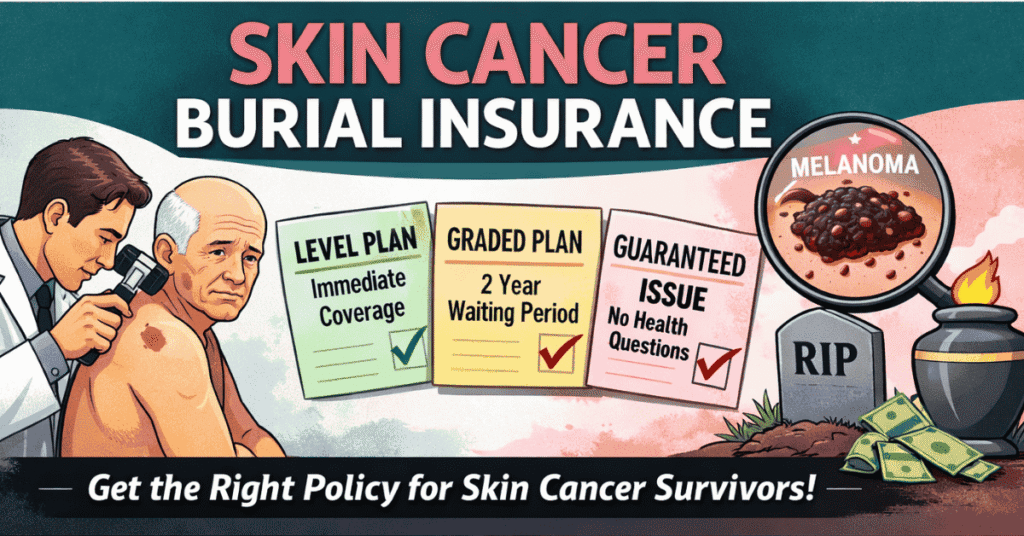
- Level: Level burial insurance offers 1st-day coverage and pays the full death benefit from day one. I recommend Trinity Life, Family Benefit, or Aflac for survivors who have been cancer-free for at least 2 years.
- Graded: Graded burial insurance limits benefits during the 12 to 24 months for health or medical-related causes of death. I recommend Guarantee Trust Life for individuals with a recent history of melanoma.
- Guaranteed Issue: Guaranteed issue burial insurance requires no health questions and includes a 2-year waiting period before benefits are paid for health- or medically related causes of death. I recommend Gerber Life for those currently undergoing active treatment.
Skin Cancer Burial Insurance Underwriting & Medication History
Insurance companies review your pharmacy records to confirm that your skin cancer is stable and not currently spreading.
Underwriting Approval Tip: If you have basal cell cancer, apply with a company that excludes it from its “cancer” questions to get the lowest pricing. Being honest about whether your melanoma was “in-situ” (on the surface) can also help you get approved for immediate coverage much faster.
Short & Long Term History: Maintenance creams for surface spots are usually ignored by underwriters. Your prescription history is how the insurance carriers verify medical stability.
Could I Get Declined?: You might be declined for standard plans if you have metastatic cancer that has spread to your internal organs. With some companies, having more than one occurrence of any cancer is a disqualifying event. Recent hospitalizations for crises trigger postponement rather than permanent decline.
| Health Profile | Coverage Type | Wait Period |
|---|---|---|
| Basal Cell (Treated) | Level | None |
| Melanoma (2+ Yrs) | Level | None |
| Active Treatment | Guaranteed Issue | 2 Years |
Real Life Skin Cancer Burial Insurance Success Stories
Real-world examples illustrate how people with skin cancer can get day-one protection with $10,000 to $25,000 to cover burial and funeral expenses.
David’s Story
David was worried about his history of squamous cell skin cancer when he looked for a $15,000 policy. He had a few spots removed over the last 3 years, but he was currently cancer-free. Since his type was low-risk and fully treated, I helped him get a level plan with Trinity Life. This plan gave his family immediate coverage for his funeral costs without any waiting period. He ended up saving 20% compared to the no-question plans he saw on TV.
Linda’s Story
Linda survived melanoma 4 years ago and wanted to make sure her cremation costs were covered. Because she had been clear of treatment for more than 2 years, she qualified for a first-day coverage plan. We placed her with Family Benefit Life, which offered her a locked-in rate that will never increase. This gave her the peace of mind that her daughter wouldn’t have to pay for her final bills out of pocket.
Skin Cancer Insurance Rates & Approvals
TRINITY LIFE & FAMILY BENEFIT INSURANCE RATES AGE 50–85
| AGE | $10,000 | $15,000 | $20,000 | $25,000 |
|---|---|---|---|---|
| 50 | F: $21 M: $27 | F: $31 M: $39 | F: $40 M: $52 | F: $50 M: $64 |
| 55 | F: $26 M: $32 | F: $38 M: $47 | F: $49 M: $62 | F: $61 M: $78 |
| 60 | F: $32 M: $41 | F: $47 M: $61 | F: $62 M: $80 | F: $77 M: $100 |
| 65 | F: $41 M: $53 | F: $60 M: $79 | F: $79 M: $104 | F: $99 M: $130 |
| 70 | F: $52 M: $69 | F: $76 M: $102 | F: $101 M: $135 | F: $126 M: $169 |
| 75 | F: $71 M: $96 | F: $106 M: $143 | F: $140 M: $190 | F: $175 M: $237 |
| 80 | F: $104 M: $145 | F: $155 M: $217 | F: $207 M: $288 | F: $258 M: $360 |
| 85 | F: $155 M: $192 | F: $231 M: $287 | F: $307 M: $382 | F: $384 M: $477 |
Request a quote on this page, or visit my main Cancer Burial Insurance Page for rates and more information.
Frequently Asked Questions: Skin Cancer Burial Insurance
Does basal cell carcinoma affect burial insurance eligibility?
Basal cell carcinoma typically does not affect an applicant’s eligibility for preferred burial insurance rates. Because this form of skin cancer is slow-growing and rarely spreads to other parts of the body, most insurance underwriters view it as a minor health issue. As long as the lesion has been successfully removed and you are not currently undergoing systemic treatment like chemotherapy, you will likely qualify for immediate, first-day coverage at the lowest possible price.
Can I get first-day burial insurance coverage with a history of squamous cell carcinoma?
Seniors with a history of squamous cell carcinoma can usually qualify for first-day coverage once the cancer has been surgically removed. Unlike internal cancers that require a “remission period” of two to five years, most final expense companies treat squamous cell as a non-issue as long as it is localized to the skin. If your pathology report shows clean margins and no further treatment is required, you should be able to skip the mandatory two-year waiting period.
How does a melanoma diagnosis impact burial insurance?
Melanoma impacts burial insurance eligibility more significantly than other skin cancers due to its potential to metastasize. If you were diagnosed with melanoma within the last 24 months, many carriers will offer a “Graded” or “Modified” plan that includes a waiting period. However, if your melanoma was “in-situ” (Stage 0) or Stage 1 and has been removed for more than two years, you can often qualify for a “Level” plan that provides full protection from day one.
Is there a burial insurance waiting period for skin cancer survivors?
A waiting period is generally not required for survivors of non-melanoma skin cancers like basal or squamous cell carcinoma. Most burial insurance applications specifically exclude these types of skin cancer when asking if you have “ever been diagnosed with cancer.” For melanoma survivors, the waiting period depends on the time since your last treatment; once you are two years post-surgery or post-treatment, many insurers will waive the waiting period entirely.
Can I qualify for burial insurance if I have multiple skin cancer spots?
Multiple occurrences of basal or squamous cell carcinoma do not typically disqualify an applicant from immediate burial insurance. Even if you have had several spots removed over the years, insurers generally view this as a manageable skin condition rather than a life-threatening illness. As long as your dermatologist is simply removing localized spots and you are not receiving internal radiation or chemotherapy, your eligibility for a first-day payout remains very high.
Does burial insurance pay out for death caused by skin cancer?
Life insurance policies pay the full death benefit if the insured passes away from complications related to skin cancer. This includes cases where a melanoma may have spread to internal organs or caused other systemic failures. As long as the policyholder was honest on the initial application and has moved past the standard two-year contestability period, the insurance company is legally required to pay the claim in full.
Does a history of skin cancer increase my burial insurance monthly premiums?
A history of common skin cancers, like basal or squamous cell, rarely increases your monthly burial insurance premiums. Because these conditions have very high survival rates and do not significantly impact life expectancy, most seniors qualify for “Standard” or “Preferred” rates. Only a history of advanced-stage melanoma or metastatic skin cancer would likely lead to higher “substandard” rates or the need for a more expensive guaranteed issue policy.
Is actinic keratosis considered a “cancer” by burial insurance companies?
Actinic keratosis is viewed as a “pre-cancerous” condition rather than an active cancer diagnosis by insurance underwriters. Because these are sun-damaged spots that have not yet become malignant, they do not trigger the “cancer” questions on a final expense application. You can honestly answer “No” to cancer questions if you only have a history of actinic keratosis, which allows you to secure immediate coverage at the most competitive rates.
Can I get burial insurance if I use chemotherapy creams for skin cancer?
The use of topical chemotherapy creams (such as Efudex or Fluorouracil) is often considered a localized treatment and will not affect insurance eligibility. Unlike systemic chemotherapy, which affects the whole body, these creams only treat the skin surface. This type of cancer treatment will be carrier-dependent and also factor in any other health problems you may have at the time of insurance application.
Why is an independent burial insurance broker important for skin cancer applicants?
An independent broker can navigate the different “look-back” periods of various insurance companies to find the best fit for your history. While one carrier might see the word “melanoma” and automatically impose a waiting period, another may be more lenient if the diagnosis was several years ago. A broker can check multiple A-rated companies simultaneously to ensure you get immediate protection and don’t overpay for your coverage.
