Testicular Cancer Burial Insurance
Testicular cancer doesn’t automatically disqualify you from burial insurance, but applying the wrong way can cost your family thousands. These testicular cancer approved policies I help people with pay out quickly to cover burial or cremation costs, or provide a tax-free legacy for your loved ones.
Key Testicular Cancer Burial Insurance Insights
- Some companies offer a loophole for the cured: If your doctor has officially declared you cured and you are currently treatment-free, CICA Life may offer you first-day coverage immediately, regardless of how recent your diagnosis was.
- Germ cell tumors respond help with 1st-day coverage: Most testicular cancers are germ cell tumors, which insurers view as highly treatable and lower-risk than other, more aggressive cancers.
- The two-year rule is the standard for top rates: Most insurance carriers require you to be 24 months past your last treatment or surgery to qualify for level benefits with no waiting period.
- Pending tests will trigger an automatic delay: If you have an upcoming CT scan or a follow-up appointment to check for recurrence, your insurer will postpone your application until they receive the final “all-clear” results.
- Guaranteed-issue is a reliable fallback: If you are currently undergoing chemotherapy or radiation, a guaranteed-issue plan like Gerber Life is the best way to secure coverage while you recover.
I am constantly searching for insurance carriers that provide low-cost protection for families dealing with testicular cancer. Because of this, most people I help will have no trouble qualifying for and affording an instant approval policy.
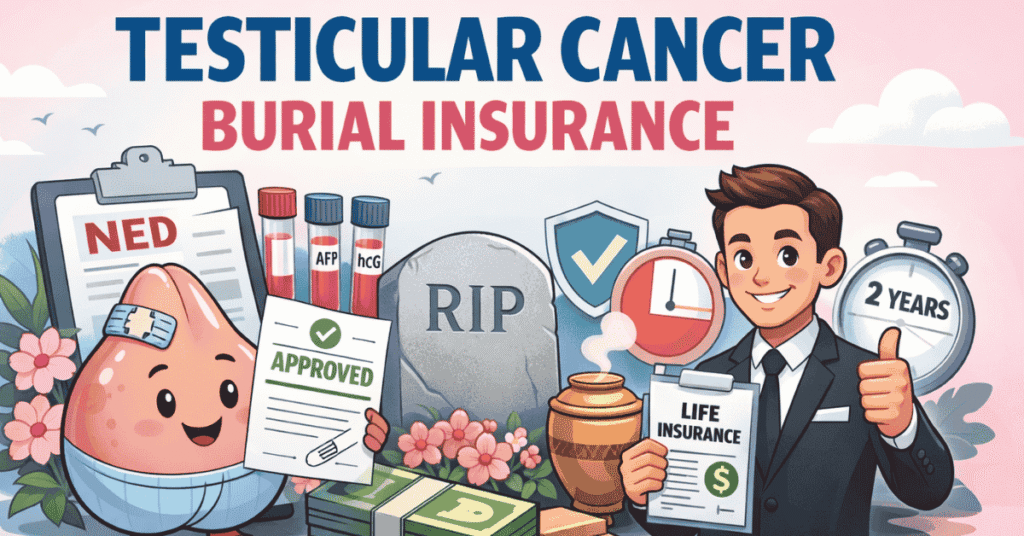
Testicular Cancer Burial Insurance Medical Definition & Health Risks
Insurance underwriters classify the risk of testicular cancer based on how long it has been since your last surgery or treatment ended. Testicular cancer is a disease where cancer cells grow in the tissues of the testicles, which can sometimes spread to the lymph nodes or other organs. Poor control or a lack of follow-up care can lead to the cancer returning or spreading (metastasis), which significantly increases the risk of a life insurance claim.
Life Insurance Companies Ask These Testicular Cancer Questions
Different life insurance companies ask different questions to decide which testicular cancer applicants they may approve.
- Aetna Decline – Within the past 2 years, have you been diagnosed with, received, or been advised to receive chemotherapy or radiation for any form of cancer, excluding basal cell or squamous cell skin cancer?
- Aetna Decline – Have you ever been diagnosed with more than one occurrence of the same or a different type of cancer?
- Aflac Decline – Within the past 2 years, have you been diagnosed with, received, or been advised to receive chemotherapy or radiation for any form of cancer, excluding basal cell or squamous cell skin cancer?
- Aflac Decline – Have you ever been diagnosed with more than one occurrence of the same or a different type of cancer?
- CICA Life Level – Have you been diagnosed by a member of the medical profession with more than one occurrence of any cancer, a recurrence of any cancer, metastasis of any cancer, or currently being treated for cancer (excluding basal cell or squamous cell skin cancer)?
- Family Benefit Life Decline – Within the past 24 months, have you been diagnosed or treated by a medical professional for, or taken medication for, internal cancer, leukemia, or melanoma?
- Guarantee Trust Life Graded – Within the last 24 months, have you been diagnosed by a member of the medical profession with Cancer (excluding Stage or Grade 1 Prostate Cancer, Carcinoma in Situ and Squamous Cell or Basal Cell Carcinoma) or received treatment by a member of the medical profession (excluding checkups while in remission, routine screening and maintenance medications) with radiation therapy, chemotherapy including oral medication or immunotherapy?
- Liberty Bankers Life Decline – Have you, the Proposed Insured, ever been diagnosed, treated, tested positive for, or been given medical advice by a member of the medical profession for congestive heart failure (CHF), cardiomyopathy, memory loss, Alzheimer’s, senile dementia, dementia, heart defibrillator implant, 2 or more instances of internal cancer(s), or terminal illness (“terminal illness” means a disease or illness that is expected to result in death within 24 months)?
- Mutual of Omaha Decline – Has the Proposed Insured ever been diagnosed by a licensed medical professional with, received treatment by a licensed medical professional for, or been advised to seek treatment by a licensed medical professional for Alzheimer’s Disease, Dementia, Huntington’s Disease, Sickle Cell Anemia, Myelodysplastic Syndrome (MDS), Lou Gehrig’s Disease (ALS), Hydrocephalus, Muscular Dystrophy, Quadriplegia, Paraplegia, Down Syndrome, Intellectual Developmental Disorder, Congestive Heart Failure, Cirrhosis, Metastatic Cancer or recurrent Cancer of the same type?
- Mutual of Omaha Decline – In the past 2 years, has the Proposed Insured been diagnosed with, been treated for or advised by a licensed medical professional to receive treatment for any form of cancer (except basal or squamous cell skin cancer)?
- Mutual of Omaha Level – In the past 4 years, has the Proposed Insured been diagnosed by a licensed medical professional with, received treatment by a licensed medical professional for, or been advised to seek treatment by a licensed medical professional for Cancer, Leukemia, or any other internal cancer or melanoma (except basal or squamous cell skin cancer)?
- Trinity Life Decline – Within the past 24 months, have you been diagnosed or treated by a medical professional for, or taken medication for, internal cancer, leukemia, or melanoma?
Testicular Cancer Underwriting Basics
- Tumor Marker Levels: Underwriters look for normal levels of Alpha-fetoprotein (AFP) and Human Chorionic Gonadotropin (hCG) in your blood tests to prove the cancer is gone.
- Cancer Staging: Stage 1 cases localized to the testicle are much easier to insure for first-day coverage than Stage 2 or 3 cases that have spread to other areas.
- Pathology Type: Carriers prefer to see “Seminoma” tumors because they grow more slowly and are less likely to spread than “Non-seminoma” types.
The correct use of medications over time should reduce your mortality risk, allowing the insurance companies to offer you better coverage options.
Why it Matters: Your test results and the time since your last treatment indicate to the insurance company the likelihood of cancer recurrence, which helps determine your final price.
Testicular Cancer Burial Insurance Prescription Medication Classes
- Chemotherapy Agents: Cisplatin, Etoposide (VP-16), and Bleomycin are often used together in “BEP” therapy to kill any remaining cancer cells.
- Hormone Replacement: Testosterone injections or patches (AndroGel) are used if the remaining testicle does not produce enough hormones after an orchiectomy.
- Anti-Nausea Drugs: Ondansetron (Zofran) is commonly prescribed during active chemotherapy cycles to manage side effects.
Testicular Cancer Burial Insurance With Comorbidities
The presence of multiple health issues at the same time increases the total insurance risk because they can make it harder for your body to recover from cancer treatments. If you have testicular cancer along with other conditions like congestive heart failure or COPD, the insurance company will prioritize the cancer as the topmost concern. However, having lung issues after taking Bleomycin can also make some carriers more cautious about their life expectancy. If you have several major health problems at once, a guaranteed-issue plan is usually the most realistic option to ensure your family is protected.
A past testicular cancer diagnosis doesn’t mean you can’t get quality burial insurance right now, even with secondary health issues.
Other Common Health Issues With Testicular Cancer
Chemotherapy and radiation used to treat testicular cancer can cause late-stage side effects that insurance companies track to determine your long-term health.
- Cardiovascular Disease: Testicular cancer survivors have a significantly higher risk of developing high blood pressure, high cholesterol, and heart disease. Insurers check for these because aggressive chemotherapy can cause permanent damage to your blood vessels and heart muscle.
- Metabolic Syndrome: Many survivors struggle with weight gain, insulin resistance, or diabetes following their treatment. Carriers view metabolic syndrome as a major risk factor for early death and will review your blood sugar and BMI results.
- Peripheral Neuropathy: Some chemotherapy drugs cause a lasting “pins and needles” feeling or numbness in your fingers and toes. Underwriters care about this because severe nerve damage can lead to balance issues and dangerous falls as you age.
- Kidney Dysfunction: High doses of platinum-based chemotherapy can lead to chronic kidney disease or reduced organ function over time. Life insurance companies review your lab results to confirm your kidneys are still filtering waste properly.
- Pulmonary Fibrosis: Certain medications used for testicular cancer can cause scarring in the lung tissue that makes breathing difficult. Carriers will ask whether you have shortness of breath or have ever required supplemental oxygen.
- Secondary Cancers: Survivors have a higher statistical chance of developing a second cancer in the bladder, kidneys, or colon later in life. Underwriters will review your history of regular screenings to confirm that no new health threats have appeared.
A past testicular cancer diagnosis doesn’t mean you can’t get quality burial insurance right now, even with secondary health issues.
Understanding Testicular Cancer Burial Insurance Policy Types
Carriers offer different plan categories based on an applicant’s testicular cancer stage and length of remission.
- Level: Level burial insurance offers 1st-day coverage and pays the full death benefit from day one. I recommend CICA Life for those recently cured, or Aflac, Aetna, Trinity Life, and Family Benefit Life for those two years past treatment.
- Graded: Graded burial insurance limits benefits during the 12 to 24 months for health or medical-related causes of death. This is often used if you have had a recent minor flare-up or are in a specific recovery window. I recommend Guaranteed Trust Life for these situations.
- Guaranteed Issue: Guaranteed issue burial insurance requires no health questions and includes a 2-year waiting period before benefits are paid for health- or medically related causes of death. Gerber Life is my top recommendation for anyone currently in treatment.
Sample Testicular Cancer Rate Snapshot for $10,000 Coverage
Monthly premiums for burial insurance policies increase as you get older because the statistical risk of death rises every year. Rates vary by age and gender because women statistically live longer than men, allowing insurance companies to offer them lower monthly premiums.
Here are some preferred rates, but your rates can vary based on which A-rated carrier is best for your situation.
CICA LIFE LEVEL INSURANCE RATES AGE 50–85
| AGE | $10,000 | $15,000 | $20,000 | $25,000 |
|---|---|---|---|---|
| 50 | F: $31 M: $33 | F: $47 M: $50 | F: $62 M: $67 | F: $78 M: $84 |
| 55 | F: $38 M: $43 | F: $57 M: $64 | F: $77 M: $86 | |
| 60 | F: $49 M: $55 | F: $73 M: $82 | F: $98 M: $110 | |
| 65 | F: $62 M: $72 | F: $93 M: $108 | F: $124 M: $144 | |
| 70 | F: $83 M: $102 | F: $125 M: $153 | F: $167 M: $205 | |
| 75 | F: $118 M: $145 | |||
| 80 | F: $152 M: $207 | |||
| 85 | F: $213 M: $294 |
Rates may vary based on age, gender, health, and state. Click the form on this page for the lowest rates from the best carriers.
Testicular Cancer Burial Insurance Underwriting & Medication History
Your prescription history helps insurance carriers verify that your cancer is in remission and that you are not currently undergoing active treatment. One of the biggest insider tips is to wait until all your post-surgery tests are finished before applying, as a “pending” test will cause an automatic postponement. If you are only taking testosterone replacement, this is usually seen as a positive sign of a stable recovery rather than a risk. Another secret is that moving past the 24-month mark from your last chemo dose can often drop your monthly premium by 30% or more.
Your prescription history is how insurance carriers verify medical stability by confirming whether you have stopped taking chemotherapy drugs. Recent hospitalizations for crises trigger postponement rather than permanent decline. If you were recently in the hospital for a surgery like an orchiectomy, most insurance companies will want you to wait at least 3 to 6 months before they approve your policy.
| Health Profile | Coverage Type | Wait Period |
|---|---|---|
| 2+ Years Cancer Free | Level | None |
| Cured (Less than 2 years) | Level (CICA) | None |
| Active Treatment | Guaranteed Issue | 2 Years |
Real Life Testicular Cancer Burial Insurance Success Stories
Real-world examples illustrate how people with testicular cancer can get day-one protection with anywhere from $5,000 to $25,000 for funeral expenses.
Mark’s Story
Mark was diagnosed with Stage 1 testicular cancer and had surgery to remove the tumor 18 months ago. He was concerned he wouldn’t qualify for first-day coverage because he hadn’t yet reached the full two-year mark. I helped him apply with CICA Life because they are much more lenient with survivors who have been declared cured. Mark was approved for $20,000 in level coverage with no waiting period. This saved him over $40 per month compared to a graded plan.
David’s Story
David finished his last round of chemotherapy for a germ cell tumor nearly three years ago and has had clean scans ever since. He wanted a $10,000 policy to make sure his wife wouldn’t have to pay for his cremation out of her own pocket. Because he was beyond the 24-month window, we were able to shop with Aetna and Trinity Life to find the lowest price. He received instant approval for first-day coverage in the best possible rate class. David now has peace of mind knowing his final bills are fully covered.
Testicular Cancer Financial Ratings & Stability (Table 3)
Financial ratings verify a carrier’s ability to pay death claims by demonstrating sufficient capital to meet all future obligations. A.M. Best gives out letter grades like A or A- to show that an insurance company is financially healthy and will be around to pay your family when the time comes. The Better Business Bureau tracks how well a company treats its customers and how quickly they resolve service issues. We also review the NAIC index to ensure the company has not had a history of ignoring or delaying legitimate death claims.
Insurance Carrier Ratings & Comparisons
| Carrier | A.M. Best | BBB | NAIC Complaints |
|---|---|---|---|
| Aflac | A+ (Superior) | A+ | Low |
| CICA | B++ (Good) | A+ | Low |
| Colonial Penn | A (Excellent) | A+ | High (300% Above Avg) |
| Family Benefit Life | A+ (Superior) | A+ | Low |
| Guarantee Trust Life | A (Excellent) | A+ | Low |
| Senior Life | Not Rated | A+ | High (300% Above Avg) |
| Trinity Life | A+ (Superior) | A+ | Low |
Frequently Asked Questions: Testicular Cancer Burial Insurance
Can I get burial insurance with active testicular cancer?
You can get a burial insurance policy while undergoing active treatment for testicular cancer by choosing a “Guaranteed Issue” plan. Because these policies skip all medical exams and health questions, a current diagnosis or chemotherapy schedule will not prevent you from obtaining coverage. While these plans typically feature a two-year waiting period for non-accidental deaths, they ensure that every applicant can provide financial protection for their family regardless of their current health status.
Is testicular cancer considered a terminal illness for burial insurance?
Insurance companies do not classify testicular cancer as a terminal illness unless a physician provides a written prognosis of 12 to 24 months or less to live. Since testicular cancer has one of the highest cure rates among all cancer types, it is generally treated as a manageable medical history rather than a life-limiting event. This distinction is vital because it allows survivors to avoid high-cost “terminal risk” plans and instead qualify for standard whole life insurance with first-day benefits.
Can I be denied burial insurance for a history of orchiectomy?
Insurance providers do not deny coverage for a history of orchiectomy because the surgical removal of a testicle is viewed as a definitive and successful treatment for localized cancer. In many cases, if the surgery was the only treatment required and occurred more than 12-24 months ago, you can qualify for the lowest possible premiums. Underwriters see a successful orchiectomy as a risk-reducing event that makes you a more favorable candidate for a standard “Level” benefit policy.
Does chemotherapy like Cisplatin affect burial insurance eligibility?
Insurance companies treat active chemotherapy as a signal to move an applicant into a “Guaranteed Issue” or “Graded” policy category. Once you have completed your last round of platinum-based chemo and are declared “No Evidence of Disease” (NED), you begin the countdown toward qualifying for first-day coverage. Many carriers will offer you their best rates once you are 24 months past your last treatment, provided your follow-up scans remain clear.
Can I get burial insurance if testicular cancer has spread to the lymph nodes?
You can still qualify for burial insurance even if the cancer spread to localized lymph nodes, with guaranteed issue whole life insurance. These plans still provide a vital safety net, ensuring your family receives a refund of all premiums plus interest if you pass away during the initial two-year waiting period.
Why should I use an independent broker for testicular cancer coverage?
An independent broker is essential because they can select insurance companies whose underwriting is most lenient toward past germ cell tumors. While most major carriers are fair, a few may have broad “cancer” questions that could lead to an unnecessary waiting period if your diagnosis was recent. A broker acts as your advocate, ensuring your application is placed with a carrier that offers first-day coverage and the most competitive pricing for your age.
Does a history of testicular cancer increase insurance premiums?
A history of testicular cancer does not increase your monthly insurance premiums once you have reached the two-year cured milestone. Since the long-term mortality risk for early-stage testicular cancer survivors is negligible, you will pay the same rates as an applicant with perfect health. This makes burial insurance an affordable and certain option for survivors who want to ensure their families aren’t burdened by funeral costs.
