Quick Answer
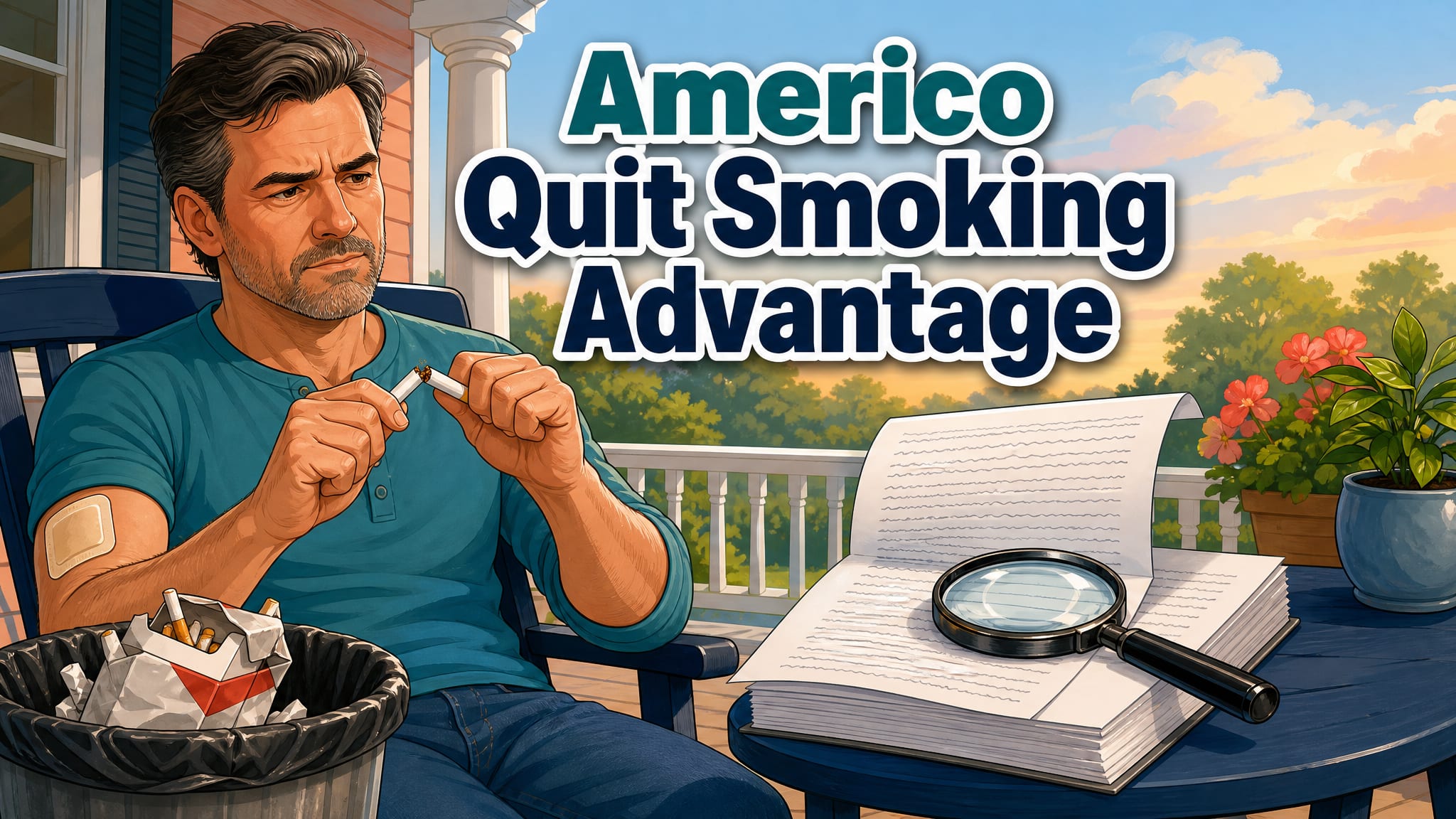
Americo’s Quit Smoking Advantage gives smokers non-smoker rates on select final expense policies for the first three years. By the third policy anniversary, you must prove you’ve been nicotine-free for at least 12 straight months with a cotinine test from an Americo-approved lab. If you miss the deadline or fail the test, Americo cuts your death benefit starting in year four, by up to 30% in some cases, while your premium stays the same. Keeping your original death benefit means calling before the deadline and paying a premium up to 30% higher.
Here’s What This Means for You:
- You get non-smoker rates upfront, but they’re temporary and conditional
- You must prove you quit or lose coverage later
- Missing the deadline can cut your death benefit up to 30%
- Your premium stays the same even if your coverage drops
- Most people don’t meet the strict requirements and lose value
GET MY QUOTEor call 888-862-9456
What Americo’s quit smoking advantage actually is
Americo sells this plan as if it’s a reward for smokers who want to quit. The marketing sounds helpful, but it rarely proves useful in the long run.
| Policy Detail | How Americo Advertises It | What Actually Happens |
|---|---|---|
| Program Pitch | Reward for smokers who plan to quit | Temporary discount that flips after 3 years |
| Intro Rate | Non-smoker pricing for first 3 years | Only applies if you later pass nicotine verification |
| Proof Requirement | Simple “verification” after 3 years | Must take an Americo-approved cotinine test and submit before deadline |
| If You Miss or Fail the Test | Not clearly stated in marketing | Death benefit cut up to 30%, premiums stay the same |
| Accidental Death Benefit | Included for added protection | Also reduced if verification fails |
| Alternate Option | Option to keep full coverage | Must request before deadline and pay up to 30% higher premium |
| Policy Type | Marketed as “Simplified Issue” | Behaves more like a graded or conditional plan |
| Result for Most Policyholders | Better rates for motivated quitters | Reduced coverage and higher long-term cost for most customers |
| Who Truly Benefits | The customer | Americo, not the policyholder |
For the first three years, smokers are offered non-smoker rates on select final expense policies.
But there’s a catch hiding in the fine print.
By the third policy anniversary, you must prove you’ve been nicotine-free for at least 12 straight months. That proof must come from a cotinine (nicotine) test conducted by an Americo-approved lab and submitted before the company’s deadline.
Miss the window, fail the test, or simply forget to send the proof, and Americo automatically cuts your death benefit starting in year four. Your premium remains unchanged, but your coverage will be reduced by up to 30% in some cases. In many cases, your accidental death benefit also gets reduced.
There’s one other option, but it’s not much better.
You can call Americo before the deadline and ask to retain your original death benefit, but they’ll require you to pay a premium that is up to 30% higher to do so. Most people are unaware that this is necessary until after their coverage has already been downgraded.
That means thousands of Americo customers end up stuck paying full price for reduced protection. The policy doesn’t seem built to help smokers quit. It seems built to keep Americo profitable when they don’t stop smoking.
Americo’s company structure and history
Americo Financial Life and Annuity Insurance Company is part of Americo Life, Inc., a privately held group based in Kansas City, Missouri.
They sell life insurance, annuities, and mortgage-protection products. On paper, Americo holds an A (Excellent) rating from A.M. Best, which measures financial strength rather than consumer fairness.
That rating means Americo can pay its bills, not that it treats policyholders well.
According to complaint data from the National Association of Insurance Commissioners (NAIC), Americo’s ratio often exceeds the national average, indicating a higher number of complaints per policy sold. Here are their results:
Americo’s NAIC (National Association of Insurance Commissioners) complaint index indicates a higher number of complaints than expected for its market share. For example, one report from the Indiana Department of Insurance shows Americo with a complaint index of 5.08.
The NAIC complaint index compares a company’s number of complaints to the market average: an index of (1.0) is average, above (1.0) is more than average, and below (1.0) is less than average.
Americo’s score of (5.08) is over five times the number of complaints expected for its market size. This score indicates a higher-than-average number of customer complaints.
Because it’s privately owned, Americo answers to shareholders, not policyholders. Mutual companies, such as Mutual of Omaha, reinvest profits to enhance member benefits. Americo keeps profits in-house. That difference matters when you’re paying premiums for 10, 20, or 30 years.
Compared to top-tier final-expense providers like Aetna, Trinity Life, or Family Benefit Life, Americo doesn’t appear to be the best fit for most seniors.
How the “quit smoking advantage” plan really works
Americo calls this program an “advantage” for smokers, but the advantage seems only to go one way… toward Americo.
Here’s what really happens.
For the first three years, smokers get non-smoker rates on certain final expense policies. It sounds like a deal, but that short-term discount is built on strict conditions most people will never meet.
By the third policy anniversary, you must prove you’ve been completely nicotine-free for 12 straight months. That means no smoking, vaping, patches, or nicotine gum. You must provide Americo with proof before their deadline, or they will treat you as if you never qualified in the first place.
If you miss the deadline or can’t prove you quit, Americo will cut your death benefit in the fourth year. Your premium stays the same. They shrink your coverage but continue to charge you full price. Even the accidental death benefit can be reduced.
You do have one option, though: you can call Americo before that deadline and ask to keep your original death benefit, but they’ll RAISE YOUR PREMIUM.
It’s a pay-more-or-lose-more setup. Hence, the description of a “total turd policy!”
The earliest you can try to prove you’ve quit is after your first policy anniversary, but only if you’ve already been nicotine-free for a full year. Most people never get that far.
| Policy Detail | What Americo Promises | What Actually Happens |
|---|---|---|
| Rate Type | Non-smoker rates for smokers | Rates are temporary and conditional |
| Qualification Period | Keep low rates for first 3 years | Must stay nicotine-free for 12 months before year 3 |
| Proof Requirement | Just verify you quit | Must submit evidence before the 3-year deadline or lose benefit |
| Failure to Verify | No clear warning in marketing | Death benefit is reduced in year 4 while premium stays the same |
| Alternative Option | Keep benefit as-is | Only if you agree to a higher premium |
| Accidental Death Benefit | Included for protection | Can also be reduced if you fail nicotine test |
| Reclassification Timing | Anytime during the policy | Earliest attempt allowed after year 1 with 12 months nicotine-free |
| Initial Policy Status | Issued as non-smoker plan | Actually issued as smoker classification with temporary discount |
| End Result | “Quit Smoking Advantage” saves money | Benefit shrinks or premium increases: a lose-lose setup |
The policy is issued as a smoker classification, even though Americo gives you non-smoker rates upfront. It’s a baited hook: they reel you in with low pricing, then watch the benefit shrink when you don’t meet their conditions.
Why it’s one of the worst final expense policies on the market
The Quit Smoking Advantage sounds innovative until you compare it to the basics of good insurance. A real policy gives you 100% certainty. This one creates 100% uncertainty for a full three years.
Every policyholder starts at non-smoker pricing, which means you pay less than you would immediately. That lower rate is supposed to be permanent, but for most people it becomes temporary.
Many feel that Americo created a process that appears to be a reward but functions as a penalty.
Waiting periods, fine print, and underwriting risks
Americo labels this plan as “simplified issue,” but the fine print often tells a different story.
A simplified issue policy typically has no medical exam and offers instant coverage from the first day, provided you qualify.
The Quit Smoking Advantage adds extra layers that work against that simplicity.
The underwriting language allows Americo to delay or deny benefits under specific clauses related to smoking. Even though they call it a simplified issue policy, it behaves like a hybrid between a graded-benefit and guaranteed-issue plan.
That’s not what most seniors expect when they’re told they have “day one protection.”
| Feature | Americo “Quit Smoking Advantage” | Aetna / Trinity / Family Benefit Life |
|---|---|---|
| Policy Type | Labeled “Simplified Issue,” acts like hybrid | True Simplified Issue Whole Life |
| Medical Exam | None | None |
| Health Questions | Yes, plus additional smoking verification clauses | Simple yes/no health questions |
| Waiting Period | Possible delay under certain smoking provisions | None – pays from day one |
| Future Testing or Proof Required | Yes – must verify nicotine-free status | No – approval based on current health |
| Full First-Day Coverage? | Not guaranteed; may be reduced or delayed | Yes, immediate full benefit upon issue |
| Policy Transparency | Complex, requires reading multiple clauses | Simple, direct, and explained upfront |
| Overall Value | Confusing and restrictive | Clear and reliable protection |
Other carriers are more direct. Aetna, Trinity, and Family Benefit Life, which the Final Expense Guy uses, issue policies that pay full benefits from the first day, as long as you can answer a few health questions honestly.
Those companies don’t need complicated programs because they’ve built underwriting that works in real life, not theory.
Americo’s policy appears to rely on confusion to increase sales and generate more revenue.
What regulators and consumer watchdogs say
According to the National Association of Insurance Commissioners (NAIC), Americo’s complaint ratio has often been higher than the national average. That means more policyholders report problems for every policy sold.
Common grievances include unclear billing cycles, lost payments, and delays in claims processing. Many complaints describe the same frustration: Americo’s customer service blames the client for missing paperwork, even when the company never provided it.
The Better Business Bureau (BBB) also reveals patterns of unresolved complaints associated with misleading marketing and policy cancellations. While Americo’s financial rating from A.M. Best remains “A (Excellent),” that rating only measures the company’s ability to pay its debts. It does not measure whether customers are treated fairly or truthfully.
State insurance departments, including the Missouri Department of Commerce and Insurance, keep public complaint records that show Americo has faced multiple allegations of misrepresentation in sales practices. Those are not small misunderstandings. They are signs of a pattern where the company benefits when the customer is confused.
Always verify these sources yourself. Start with NAIC data and your state’s complaint database. Financial strength is only one side of the story. The other side is integrity, and that can’t be scored with a letter grade.
Americo’s history of consumer complaints and misleading marketing
Many seniors would say that Americo’s sales approach depends on optimistic language and selective detail.
The company highlights its “unique smoker-friendly advantage” in brochures and on agent training materials, but may not highlight the rules that make that advantage nearly impossible for most clients to claim.
Many policyholders report discovering the limitations only after they receive their policy packet. Others find out years later when they try to convert to non-smoker rates and are told the eligibility period has expired. These aren’t isolated stories.
According to NAIC data, Americo consistently generates more complaints per policy than larger, more transparent carriers. The most common issues include billing errors, long delays for claim payments, and misleading quotes during the sales process.
The Better Business Bureau lists similar feedback, with customers describing the product as confusing and the company as unresponsive once problems begin.
Sales incentives appear to add another layer to the problem.
Americo’s commission structure encourages agents to sell high-premium plans because the smoker rate raises the policy’s face value. This can provide the company with a financial incentive to promote the “Quit Smoking Advantage”, even when it is not in the client’s best interest.
Who this policy actually benefits (and who it hurts)
Many consumers would say the Quit Smoking Advantage plan benefits only one group: Americo.
It gives the appearance of rewarding healthy habits while making it difficult for most clients ever to escape higher premiums.
For Americo, the model ideally generates greater profit because smoker rates mean larger premiums and fewer payout obligations.
When policyholders fail to qualify for reclassification, the company keeps those payments indefinitely.
Seniors on fixed incomes often underpay for three years and then face higher rates or reduced coverage.
Consumer protection: how to spot gimmick policies like this
You can avoid 90 percent of bad insurance policies by recognizing the patterns.
Gimmicks always follow the same formula. They promise flexibility, reward, or special eligibility, but every benefit depends on something you have to do later. That’s the first red flag.
The second is language that sounds generous but often means nothing.
Words like advantage, benefit, option, and preferred status are often marketing lingo meant to distract. They’re used when the fundamental feature wouldn’t sound appealing if stated directly.
Any plan that requires you to retest, requalify, or submit new paperwork in the future should raise immediate concern.
A real simplified-issue whole life policy doesn’t work that way. Once you’re approved and the first premium is paid, the benefit is locked for life. No more tests. No fine print.
Both the Federal Trade Commission (FTC) and the National Association of Insurance Commissioners (NAIC) have issued warnings about misleading life insurance marketing.
They highlight vague ads that hide conditions in small print or rely on the buyer’s misunderstanding of words like “guaranteed,” “advantage,” or “instant approval.”
Many seniors would say Americo’s “Quit Smoking Advantage” seems to fit that description.
Before buying any policy, ask for a copy of the full contract and look for these five things:
- Does it say “full benefit from day one”?
- Does it list specific medical questions, or does it use vague qualifiers?
- Is there any mention of future testing or conversion?
- Is the premium fixed for life?
- Is the agent independent, with at least ten years of experience?
If any of those answers are unclear, walk away. There are too many transparent, consumer-first policies available to settle for one that hides its rules.
First-day coverage vs. Americo’s gimmicks
The easiest way to see how bad the Quit Smoking Advantage really is is to compare it to the kind of coverage most people actually want.
First-day coverage means what it says: your policy pays the full death benefit from the very first day it takes effect. No testing. No waiting. No excuses.
Roughly 97% of applicants qualify for first-day coverage with the Final Expense Guitar if they answer basic health questions truthfully. These are called simplified-issue whole life policies. They’re designed to give permanent protection with no retesting or future underwriting.
Americo’s plan is complex, conditional, and more expensive for almost every other company.
The difference becomes clear when you line up the details side by side.
| Company | Coverage Type | Waiting Period | Future Testing Required | Premium Stability | First-Day Full Benefit? |
|---|---|---|---|---|---|
| Americo | Quit Smoking Advantage | Up to 2 years (conditional) | Yes | May change after reclassification | No |
| Mutual of Omaha | Living Promise Whole Life | None | No | Fixed for life | Yes |
| Aetna | Protection Series Whole Life | None | No | Fixed for life | Yes |
| Trinity Life | Immediate Benefit Whole Life | None | No | Fixed for life | Yes |
| Family Benefit Life | Simplified Issue Whole Life | None | No | Fixed for life | Yes |
Every company listed above offers simpler and stronger protection without hidden conditions. You qualify once, and your rate never changes. Americo makes you qualify twice and keeps your money longer.
Better alternatives to Americo’s quit smoking advantage
If you smoke or have recently quit, there are far better ways to get coverage without being punished for trying to improve your health. The strongest companies in the final expense market all offer smoker and non-smoker plans with no requalification period.
The Aetna Protection Series is known for fair pricing for smokers, stable premiums, and straightforward policy terms.
Trinity Life and Family Benefit Life both provide true first-day coverage with relaxed underwriting. These carriers specialize in helping seniors and middle-income families find lifetime protection that never increases in cost.
Each of these companies follows a simple rule: once you qualify, your rate is locked for life. There are no future tests, no “advantage” programs, and no fine-print conditions that penalize you for being human.
Independent agents, such as the Final Expense Guy, who work with these carriers, can shop multiple options to match your exact health profile and budget. You deserve a policy that guarantees stability, not one that gambles with it.
Final verdict: Americo’s quit smoking advantage is a bad deal
Americo’s Quit Smoking Advantage is a perfect example of a product that sounds helpful but punishes the very people it claims to reward.
From the inflated smoker premiums after 3 years to the difficult qualification questions, this plan seems to benefit the insurance company more than the insured.
The few policyholders who manage to meet every condition still don’t end up with an excellent policy after three years.
There is no reason to buy a complex policy like this when clear, first-day coverage is available with companies like Aetna, Trinity Life, and Family Benefit Life that offer true lifetime protection without requalification traps.
With better companies, you qualify once. You’re covered forever. That’s what insurance is supposed to be.
If you already have an Americo policy, don’t panic, but don’t ignore it either. Review your paperwork carefully and talk with an independent agent who can compare better options.
If you’ve been misled, file a complaint and take back control of your coverage before it’s too late.
Call 888-862-9456 or visit FEXGUY.com to see what real first-day coverage looks like. I’ll show you how simple, honest insurance should work and why plans like this never deserve your trust.
Frequently asked questions: Americo life insurance
Is Americo a real life insurance company?
Yes. Americo Financial Life and Annuity Insurance Company is a legitimate insurer based in Kansas City, Missouri. They’ve been operating for more than 100 years and hold licenses in nearly all 50 states. Americo is privately owned, not part of a large, publicly traded group.
Is Americo a reputable insurance company?
Yes. Americo consistently maintains an A (Excellent) rating from A.M. Best, the industry’s primary financial-strength rating agency (source: ambest.com. That means they’re financially sound and able to pay claims.
What kind of insurance does Americo sell?
Americo offers whole life, term life, and final expense policies, as well as indexed and fixed annuities. Their Eagle Premier line is one of the most popular final expense products for seniors aged 50–85.
What are the benefits of an Americo policy?
Most Americo final-expense plans include first-day coverage, simplified underwriting (no exam), and optional riders such as accidental-death or children’s term riders.
Who owns Americo Life Insurance?
Americo Life, Inc. is privately held by Americo Holding Inc., not by Fidelity or any religious organization. Despite recurring internet rumors, the LDS Church does not own Americo.
Who is the owner of Americo?
Americo is owned by Americo Life, Inc., an independent U.S. insurance group headquartered in Kansas City.
What is the rating of Americo Insurance Company?
Americo’s A (Excellent) financial-strength rating from A.M. Best reflects strong capitalization and a steady record of claim payments.
What is Americo known for?
They’re best known for Eagle Premier final-expense coverage, flexible underwriting for moderate health conditions, and stable legacy-planning products.
Is Americo one of the top insurance companies?
Americo is smaller than national giants like Mutual of Omaha or State Farm, but within the final-expense category, it ranks among the top 20 carriers nationwide.
What is the phone number for Americo Life Insurance Company?
You can reach Americo’s customer service at 800-231-0801 (Mon–Fri 8 a.m.–5 p.m. CST).
How do I contact Americo customer service?
Call the number above or visit www.americo.com
to log in, check your policy status, update beneficiaries, or request a claim form.
How do I find out if an old Americo policy is still active?
Contact the company directly with the policy number or the insured’s name. They can confirm whether it’s active or if benefits have already been paid.