Quick Answer
Yes, you can get burial insurance with a history of alcohol or drug abuse, but timing and recovery matter. If abuse is recent or ongoing, you’ll likely be limited to guaranteed issue burial insurance with higher costs and a waiting period. Most companies look for about 2 years (24 months) of sobriety before approving better policies, although exact lookback questions vary by company. With 1 to 2 years of sobriety, it depends on timing and the company: some offer graded coverage, while guaranteed issue may still be the realistic option.
Here’s What This Means for You:
- Recent alcohol or drug abuse usually leads to declines or waiting periods
- Most companies want at least 2 to 3 years of sobriety
- Guaranteed issue plans cost more and delay full payout for 2 years
- Applying without a strategy can trigger declines that hurt future approvals
- Stable recovery can still qualify for first-day coverage with the right carrier
GET MY QUOTEor call 888-862-9456
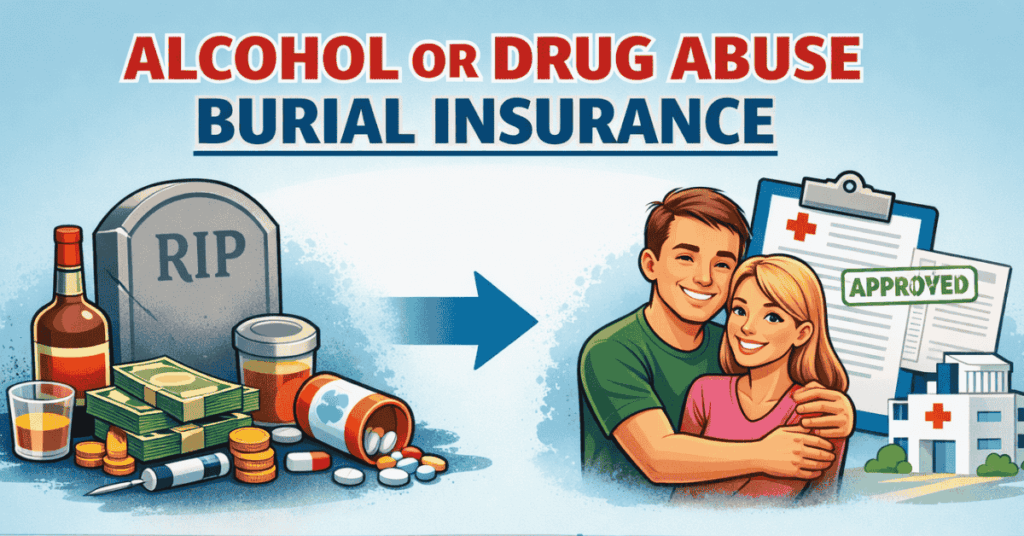
Alcohol or drug abuse burial insurance key insights
- Active substance use prevents some approvals: Insurance companies will not offer traditional 1st-day coverage to anyone currently abusing drugs or alcohol because of the high risk of fatal accidents and organ damage.
- Sobriety windows define plan eligibility: Applicants must remain clean and sober for at least 24 months before most carriers will consider them for first-day coverage.
- Pending medical tests will cause delays or denials: You should wait for all current heart or liver test results to come back before applying to avoid being forced into an expensive waiting-period plan.
- Hospitalizations or treatment centers impact your options: Inpatient treatment or emergency room visits for substance abuse in the last two years will usually limit you to a guaranteed issue policy.
- Daily living assistance triggers waiting periods: If substance use has damaged your body so much that you need help with bathing or dressing, you will be restricted to a two-year waiting period.
I’m always on the lookout for more insurance companies that will offer affordable protection for alcohol or drug abuse recovery. Because of this, most people I help will have no trouble qualifying for and affording an instant-approval policy.
Alcohol or drug abuse medical definition & health risks
Insurance underwriters classify the risk level of substance abuse based on the duration of an applicant’s sobriety and their overall lifestyle stability since treatment. Because alcohol and drug abuse can cause significant long-term damage to physical health and safety, insurers typically require a minimum period of recovery before offering standard coverage rates. These issues can cause permanent damage to your liver, heart, and brain. Insurers worry about these risks because they often lead to early death from organ failure or dangerous accidents.
Alcohol & drug abuse underwriting basics
- Testing & Test Results: Underwriters review liver enzyme levels, such as GGT, ALT, and AST, to assess organ function. They also review driving records for any DUI or DWI convictions in the past 2 years.
The correct use of medications over time should reduce your mortality risk, allowing the insurance companies to offer you better coverage options.
- Why it Matters: Test results and driving records prove whether your recovery is stable. Better results help you qualify for lower-priced plans that start on day one.
Alcohol & drug abuse prescription medication classes
- Recovery Support: Medications like Antabuse or Naltrexone to help maintain sobriety from alcohol.
- Opioid Treatment: Drugs such as Suboxone or Methadone are used to manage recovery from drug use.
- Liver Support: Prescription vitamins or medications used to treat liver impairment caused by past use.
- Mental Health: Antidepressants or anti-anxiety meds are used to treat the underlying causes of addiction.
Alcohol & drug abuse with comorbidities
Multiple health issues occurring simultaneously increase total insurance risk by placing additional strain on your internal organs and complicating the recovery process. When substance use is combined with liver disease, depression, or high blood pressure, underwriters see a higher probability of health complications that could lead to an earlier claim payout. These issues make it harder for the body to heal and stay healthy over time. Insurers look at all these problems together to see if you are a safe person to insure.
In my experience, controlled alcohol or drug abuse recovery qualifies people for immediate level burial insurance coverage, even with secondary health issues.
Other common health issues with alcohol & drug abuse
Alcohol abuse and drug abuse disrupt normal brain chemistry and damage vital organs over time, which impairs judgment, metabolism, cardiovascular function, and immune response, and can affect underwriting and policy selection when these related complications are present.
- Liver disease – Toxic exposure damages liver cells and leads to fatty liver, hepatitis, cirrhosis, or liver failure.
- Cardiovascular problems – Substance use increases the risk of high blood pressure, arrhythmias, heart attack, and stroke.
- Cognitive impairment – Long-term use affects memory, focus, and decision-making ability.
- Mental health disorders – Depression, anxiety, psychosis, and mood instability frequently worsen with use.
- Increased injury risk – Impaired coordination and judgment raise accident and trauma risk.
- Withdrawal complications – Sudden cessation can cause seizures, hallucinations, or life-threatening instability.
- Immune suppression – Chronic use weakens immune defenses and increases infection frequency.
- Gastrointestinal damage – Substance use causes ulcers, pancreatitis, bleeding, and digestive dysfunction.
- Work and social impairment – Attendance issues, job loss, and relationship strain are common.
- Elevated mortality risk – Long-term abuse significantly increases the risk of early death from disease or overdose.
Understanding alcohol or drug abuse policy types
Carriers offer different plan categories based on an applicant’s alcohol or drug abuse history and long-term health stability.
- Level: No insurance company will approve you for this if you were abusing alcohol or drugs in the last 24 months. If you have been clean for two years, you can qualify through Trinity Life, Family Benefit Life, or Aflac.
- Graded: Graded burial insurance limits benefits during the first two years for medical-related causes of death through Guaranteed Trust Life.
- Guaranteed Issue: Guaranteed issue burial insurance requires no health questions but includes a two-year waiting period through Gerber Life.
Sample alcohol or drug abuse rate snapshot for $10,000 coverage
Monthly burial insurance costs increase as you get older because your statistical life expectancy decreases, making you a higher risk for the insurer. Rates also vary by gender because women statistically live longer than men, allowing insurance companies to offer them lower monthly premiums for the same level of coverage.
Here are some preferred rates, but your rates can vary based on which A-rated carrier is best for your situation.
Trinity Life & Family Benefit insurance rates age 50–85
| AGE | $10,000 | $15,000 | $20,000 | $25,000 |
|---|---|---|---|---|
| 50 | F: $21 M: $27 | F: $31 M: $39 | F: $40 M: $52 | F: $50 M: $64 |
| 55 | F: $26 M: $32 | F: $38 M: $47 | F: $49 M: $62 | F: $61 M: $78 |
| 60 | F: $32 M: $41 | F: $47 M: $61 | F: $62 M: $80 | F: $77 M: $100 |
| 65 | F: $41 M: $53 | F: $60 M: $79 | F: $79 M: $104 | F: $99 M: $130 |
| 70 | F: $52 M: $69 | F: $76 M: $102 | F: $101 M: $135 | F: $126 M: $169 |
| 75 | F: $71 M: $96 | F: $106 M: $143 | F: $140 M: $190 | F: $175 M: $237 |
| 80 | F: $104 M: $145 | F: $155 M: $217 | F: $207 M: $288 | F: $258 M: $360 |
| 85 | F: $155 M: $192 | F: $231 M: $287 | F: $307 M: $382 | F: $384 M: $477 |
Rates may vary based on age, gender, health, and state.
Alcohol & drug abuse underwriting & medication history
The insurance carrier identifies medical stability by reviewing your prescription history to verify you are no longer using high-risk substances and to confirm you are maintaining sobriety. Managing your recovery with a doctor’s professional guidance is viewed positively by underwriters, as it demonstrates a commitment to long-term health and risk reduction. They look at your pharmacy records to make sure you are not filling prescriptions for heavy painkillers or other drugs of abuse. Consistent use of recovery medications shows that you take your health seriously.
Your prescription history is how the insurance carriers verify medical stability. Recent hospitalizations for crises trigger postponement rather than permanent decline.
| Health Profile | Coverage Type | Wait Period |
|---|---|---|
| 2+ Years Sober | Level with many companies | None |
| 1-2 Years Sober | Depends on timing and carrier: Graded with some companies, or Guaranteed Issue | 12-24 Months (Graded) or 2 Years (Guaranteed Issue) |
| Current Use | Guaranteed Issue | 2 Years |
Real life alcohol or drug abuse success stories
Real-world examples illustrate how people with an alcohol or drug abuse history can get day-one protection with anywhere from $5,000 to $25,000 for burial, cremation, funeral expenses, final expenses, leave money for loved ones, pay off last bills, or a combination of these.
Michael’s story
Michael struggled with alcohol abuse for many years but celebrated his third year of sobriety last month. He wanted to find a policy to pay for his cremation so his son wouldn’t have to worry about the cost. Because he had been sober for over 24 months and had no other major health issues, I helped him get a plan with Trinity Life. He was approved for $10,000 in first-day coverage at a very affordable rate. This plan gives him peace of mind knowing his final expenses are handled.
Sarah’s story
Sarah went through a difficult period with prescription drugs and completed an inpatient treatment program 14 months ago. She knew she couldn’t get a standard plan yet, but wanted to start her coverage as soon as possible. I navigated her history and found a graded plan through Guaranteed Trust Life. Even though she has a short waiting period, she is already building value in her policy. She is saving money every month and will have full protection for her family very soon.
Alcohol or drug abuse financial ratings & stability
Financial ratings verify a carrier’s ability to pay death claims by measuring its long-term solvency and capital reserves. A.M. Best ratings serve as an independent confirmation that an insurance company is financially stable enough to fulfill its future obligations to your beneficiaries. A high BBB rating indicates that the company treats its customers fairly and responds to customer inquiries promptly. You should always choose a company with strong ratings to ensure your family is protected.
Insurance carrier ratings & comparisons
| Carrier | A.M. Best | BBB | NAIC Complaints |
|---|---|---|---|
| Aflac | A+ (Superior) | A+ | Low |
| CICA | B++ (Good) | A+ | Low |
| Colonial Penn | A (Excellent) | A+ | High (300% Above Avg) |
| Family Benefit Life | A+ (Superior) | A+ | Low |
| Guarantee Trust Life | A (Excellent) | A+ | Low |
| Senior Life | Not Rated | A+ | High (300% Above Avg) |
| Trinity Life | A+ (Superior) | A+ | Low |
Frequently asked questions: alcohol or drug abuse burial insurance
Does drug use disqualify you from burial insurance?
Substance use history limits your initial policy choices, but it does not make you uninsurable because most specialized carriers offer guaranteed acceptance plans that ignore your medical history entirely. I have sat with many people who felt they could never get coverage because of their past, but honestly, it just does not make sense to leave your family unprotected. While active addiction prevents you from qualifying for standard first-day coverage, guaranteed issue plans ensure that every applicant can eventually secure a death benefit. These plans skip the health questions so you can lock in a price today. You give your family a financial safety net regardless of the challenges you have faced.
Will burial insurance pay out for a drug overdose?
Insurance companies pay for overdose deaths depending on the policy type and whether you have passed the initial two-year waiting period. If you have a guaranteed issue policy that has been active for more than 2 years, the company must pay the full benefit to your beneficiaries for any natural or accidental cause. But here is the part they do not tell you in the commercials: during the first 2 years, most policies will only refund your premiums plus interest if the death is ruled a suicide. Once you move past that contestability window, the contract is a solid guarantee for your family. I help you understand the timing so your loved ones get the check they need without any surprises.
Does burial insurance cover death from alcoholism?
Active policies cover alcohol-related deaths after the contestability period ends, as long as you were honest on your initial paperwork. Whether a medical examiner lists the cause as liver cirrhosis or an alcohol-related accident, the insurance company cannot deny a claim once the policy has been active for at least 2 years. For newer policies, the insurer may investigate to ensure you disclosed your drinking habits correctly when you signed up. Honestly, it just doesn’t make sense to hide the truth during the application, because it puts the entire payout at risk. I make sure we find a carrier that accepts your history so your family receives their tax-free payment without a fight.
Is there burial insurance for people in active drug abuse recovery?
Recovery status determines your premium rates and waiting periods, but I can often find level benefit plans for applicants who have been sober for more than 24 months. If you have stayed clean for over 2 years, you can often qualify for immediate coverage with no waiting period. But if you are in the early stages of recovery or currently in a treatment program, you will typically be steered toward a guaranteed issue plan to lock in your approval. You do not have to pay a convenience tax for the rest of your life. We start with the best plan you qualify for today, and you can always look for a better rate once you hit new milestones in your sobriety.
Can alcoholism be listed as a primary cause of death in burial insurance?
Medical examiners list alcoholism on death certificates when the condition causes organ failure, and the insurance company will pay the claim if you disclosed the condition during the application process. When an underwriter sees chronic alcoholism or liver failure on a claim form, they verify your original answers from the day you signed up. Honesty during sign-up is the most important factor in ensuring your family receives its payout without legal complications. And since I use a quick background check on your prescriptions to help verify your stability, we can make sure the carrier knows exactly what they are covering. This keeps the process clean and guarantees the money is there for your funeral.
Do burial insurance companies test for drug use during the application?
Burial insurance applications skip the medical exam and lab tests because these plans use simplified issue underwriting instead of invasive physicals. Unlike traditional term life insurance that requires blood and urine samples, this process relies on your answers to health questions and a digital review of your records. Honestly, it just does not make sense to deal with needles and strangers in your house when I can get you an approval in minutes. This streamlined approach gets your coverage in place today without the corporate hurdles of a standard life insurance policy. Your family gets protection, and you get a simple, private experience.
What deaths are not covered by burial insurance?
Standard exclusions like suicide or deaths resulting from a felony apply during the first 2 years of a policy, but the plan covers almost everything else once that period expires. Most burial plans will not pay the full death benefit if the insured dies from these specific events within the initial 24-month window. Once this period ends, the policy becomes “incontestable,” and the company must pay for almost any cause of death, including substance-related issues. This is why you must lock in your policy as soon as possible to get that clock ticking. Every day you wait is another day your family lacks the full protection of a permanent contract.
Can burial insurance be denied for undisclosed drug use?
Misrepresentation on an application leads to denied claims if the insurance company discovers that an applicant failed to disclose a recent history of drug abuse or hospitalizations. If a death occurs during the contestability period, the company will investigate your medical records to see if you were truthful. If they find you lied about your history, they will typically refund the premiums to the family but will refuse to pay the full death benefit. You should never risk your family’s future by trying to “beat the system” on a health questionnaire. I help you find the right carrier that accepts your history honestly, so the claim is a sure thing.
Is burial insurance worth buying for a recovering addict?
Burial insurance provides a guaranteed financial safety net for high-risk individuals by ensuring that children or spouses do not inherit the high costs of a funeral. For those in recovery, these policies offer a way to take responsibility and protect their families from a financial crisis during their time of grief. It is a permanent solution that builds cash value and guarantees a payout no matter how long you live. Honestly, it just does not make sense to leave your final expenses to chance when a small monthly payment can handle everything. You give your family the gift of a dignified service and a clean slate.
What is considered a drug abuse stability window for burial insurance companies?
Insurers define stability as 24 months of continuous sobriety, and reaching this two-year milestone is a major turning point for your monthly insurance rates. Once you have passed 2 years without a relapse, hospitalization, or DUI, many top-rated companies will move you into a level plan that offers lower costs and immediate coverage. This 2-year window is the industry standard for moving from high-risk categories into preferred pricing. I perform a quick background check on your prescriptions to verify your dates and help you get the best deal available. You save money for your family by proving your long-term commitment to your health.