Quick Answer
Getting burial insurance with liver disease depends on how serious your condition is and how well it’s controlled. Insurers look at your diagnosis, liver test results, medications, and whether your condition is stable or getting worse. If it’s mild or managed, you may still qualify for first-day coverage. If it’s severe or recent, you’ll likely be pushed into a guaranteed issue plan with higher costs and a 2-year waiting period.
Here’s What This Means for You:
- Liver disease can raise your rates or limit your coverage options
- Severe cases like cirrhosis often force 2-year waiting period plans
- Many agents push guaranteed issue without checking first-day options
- Applying with unstable health can lead to denial or higher pricing
- Not disclosing liver issues can void your policy later
GET MY QUOTEor call 888-862-9456
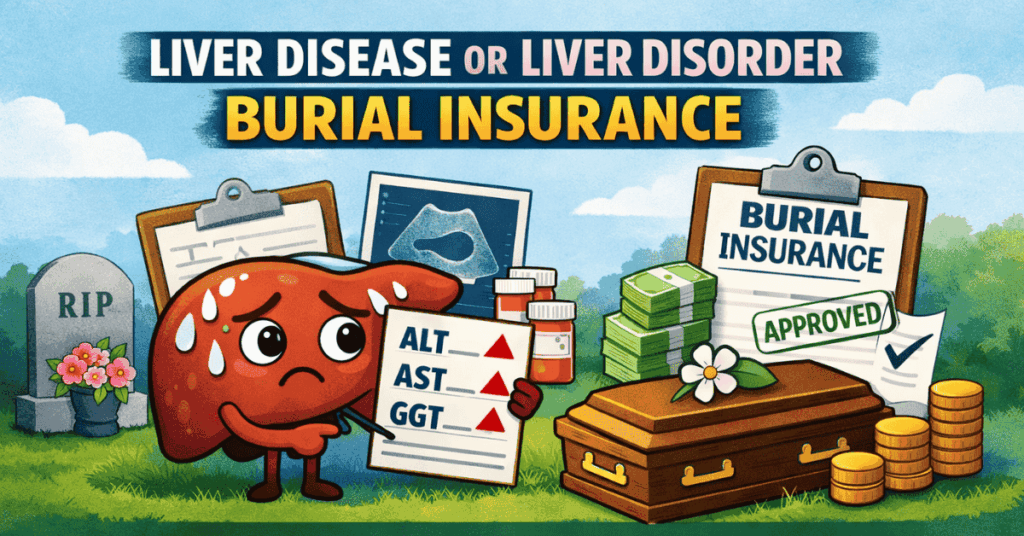
Liver disease or liver disorder burial insurance key insights
- First-day coverage is possible: Some insurance carriers will not offer immediate benefits if you currently have active liver function issues or a recent diagnosis, but there is one 1st-day coverage option if you qualify, and if it’s offered in your state.
- Liver stability determines the best plan options: Insurance companies prioritize whether your liver condition is currently stable or progressing toward liver failure.
- Pending tests cause automatic delays: You should never submit an application while you have medical tests or procedures pending because underwriters will deny coverage unless it’s a guaranteed issue plan with a 2-year wait.
- Progressive liver disease requires action: Liver issues tend to get worse over time and can eventually affect your kidneys, making it important to get a policy now while you still qualify.
- Daily living needs change eligibility: If your liver disorder is severe enough that you need help with bathing, eating, or dressing, you will only qualify for a guaranteed issue plan.
I’m always on the lookout for more insurance companies that will offer affordable protection for Liver Disease or Disorder. Because of this, most people I help will have no trouble qualifying for and affording an instant approval policy.
Liver disease or liver disorder medical definition & health risks
Insurers classify the risk of liver disease by evaluating your specific diagnosis alongside laboratory results, such as ALT and AST enzyme levels. Because conditions like hepatitis or cirrhosis prevent your liver from effectively cleaning your blood, underwriters prioritize evidence of medical stability, such as a “sustained virologic response” or a stable FibroScan score.
When your liver fails, it cannot remove toxins from your body, leading to serious health problems. Insurers worry about these issues because they can quickly become life-threatening without a transplant or intense care.
Liver disease or disorder underwriting basics
- Testing & Test Results: Underwriters look for high levels of enzymes like ALT, AST, and GGT in your medical records. They also check for mild versus severe scarring on liver ultrasounds or biopsies. The correct use of medications over time should reduce your mortality risk, allowing the insurance companies to offer you better coverage options.
- Why it Matters: Test results tell the insurance company if your liver is currently failing. Stable results help you get better prices and avoid the long wait times found in most basic plans.
Liver disease or disorder prescription medication classes
- Antivirals: Drugs like Harvoni or Epclusa are used to treat and cure Hepatitis C.
- Diuretics: Water pills like Spironolactone are used to reduce fluid buildup in the belly.
- Ammonia Reducers: Medications like Lactulose that help clear toxins when the liver is struggling.
- Immune Suppressants: Drugs used if the liver issue is caused by an autoimmune disorder or a past transplant.
Liver disease or disorder with comorbidities
Insurers evaluate how overlapping health conditions influence total insurance risk by placing excessive stress on all your major organs. If you have liver disease paired with kidney issues, COPD, or diabetes, your body has a harder time staying healthy, which often results in higher premiums or waiting periods. Underwriters also look at any secondary problems to see if your health is declining quickly.
Combining liver problems with heart disease often makes an applicant a higher risk for insurance companies. In my experience, controlled liver disease or disorder qualifies people for immediate level burial insurance coverage, even with secondary health issues.
Common liver diseases
Fatty Liver Disease
- Nonalcoholic fatty liver disease from insulin resistance, obesity, and diabetes
- Alcoholic fatty liver disease from regular alcohol use
Hepatitis
- Hepatitis A is a short-term viral infection
- Hepatitis B is a chronic or acute viral infection
- Hepatitis C is usually chronic and progressive
Alcohol-Related Liver Disease
- Fatty liver
- Alcoholic hepatitis
- Cirrhosis
Liver Fibrosis
- Early scarring
- Often reversible if caught early
Cirrhosis
- Permanent liver scarring
- End stage of many liver diseases
Autoimmune Liver Diseases
- Autoimmune hepatitis
- Primary biliary cholangitis
- Primary sclerosing cholangitis
Genetic & Metabolic Liver Diseases
- Hemochromatosis
- Wilson disease
- Alpha-1 antitrypsin deficiency
Liver Cancer
- Hepatocellular carcinoma
- Usually develops after cirrhosis
Other common health issues with liver disease or disorder
Liver disease or disorder compromises the liver’s ability to detoxify blood, regulate circulation, and support organ systems, which can trigger cascading failures in the brain, kidneys, heart, and gastrointestinal tract and can affect underwriting and policy selection when these related issues are present.
- Hepatic encephalopathy – Toxin buildup impairs brain function, causing confusion, personality changes, and loss of consciousness.
- Ascites – Severe fluid accumulation in the abdomen signals advanced liver failure and impairs breathing and mobility.
- Esophageal varices – Enlarged veins in the esophagus can rupture and cause sudden, life-threatening internal bleeding.
- Kidney failure – Altered blood flow and toxin overload can lead to hepatorenal syndrome and rapid kidney shutdown.
- Sepsis risk – Immune dysfunction increases the risk of overwhelming infections, which can be fatal.
- Severe bleeding disorders – Loss of clotting factor production raises the risk of uncontrolled bleeding from minor injuries.
- Cardiac strain – Circulatory imbalance and chronic inflammation increase the risk of heart failure and arrhythmias.
- Severe malnutrition – Impaired bile and protein metabolism leads to muscle wasting and organ weakness.
- Portal hypertension – Elevated pressure in the liver’s blood vessels damages surrounding organs and worsens bleeding risk.
- Liver failure progression – Advanced dysfunction may require transplant evaluation and carries a high mortality risk.
Understanding liver disease or liver disorder policy types
Carriers offer different plan categories based on an applicant’s Liver Disease or Disorder and long-term health stability.
- Level: Level burial insurance offers 1st-day coverage and pays the full death benefit from day one through certain insurance companies.
- Graded: Graded burial insurance limits benefits during the 12 to 24 months for health or medical-related causes of death through Guarantee Trust Life.
- Guaranteed Issue: Guaranteed issue burial insurance requires no health questions but includes a 2-year waiting period before it pays out for health-related causes of death through Gerber Life.
Sample liver disease or liver disorder rate snapshot for $10,000 coverage
Insurers use age-based pricing to determine burial insurance premiums because mortality risk increases as applicants get older, making coverage more expensive the longer you wait to apply. Since women typically have longer life expectancies than men, they often benefit from premiums that can be up to 30% lower for identical coverage amounts.
Here are some preferred rates, but your rates can vary based on which A-rated carrier is best for your situation.
Trinity Life & Family Benefit insurance rates age 50–85
| AGE | $10,000 | $15,000 | $20,000 | $25,000 |
|---|---|---|---|---|
| 50 | F: $21 M: $27 | F: $31 M: $39 | F: $40 M: $52 | F: $50 M: $64 |
| 55 | F: $26 M: $32 | F: $38 M: $47 | F: $49 M: $62 | F: $61 M: $78 |
| 60 | F: $32 M: $41 | F: $47 M: $61 | F: $62 M: $80 | F: $77 M: $100 |
| 65 | F: $41 M: $53 | F: $60 M: $79 | F: $79 M: $104 | F: $99 M: $130 |
| 70 | F: $52 M: $69 | F: $76 M: $102 | F: $101 M: $135 | F: $126 M: $169 |
| 75 | F: $71 M: $96 | F: $106 M: $143 | F: $140 M: $190 | F: $175 M: $237 |
| 80 | F: $104 M: $145 | F: $155 M: $217 | F: $207 M: $288 | F: $258 M: $360 |
| 85 | F: $155 M: $192 | F: $231 M: $287 | F: $307 M: $382 | F: $384 M: $477 |
Rates may vary based on age, gender, health, and state.
Liver disease or disorder underwriting & medication history
Insurers use prescription history to verify medical stability by checking that you are consistently taking medications to keep your liver functioning properly. Regular doctor visits further support your application because they provide documented evidence that a medical professional is actively monitoring your health and managing any potential risks. If your pharmacy records show you take your liver meds every day, it shows your condition is under control. Underwriters especially like to see that you have completed treatment for viral issues like Hepatitis C, as a cure significantly lowers your risk.
Your prescription history is how the insurance carriers verify medical stability. Recent hospitalizations for crises trigger postponement rather than permanent decline.
| Health Profile | Coverage Type | Wait Period |
|---|---|---|
| Mild Fatty Liver | Level | None |
| Chronic Hepatitis | Graded | 12-24 Months |
| Active Cirrhosis | Guaranteed Issue | 2 Years |
Real life liver disease or disorder success stories
Real-world examples illustrate how people with Liver Disease or Disorder can get day-one protection with anywhere from $5,000 to $25,000 for burial, cremation, funeral expenses, final expenses, leave money for loved ones, pay off last bills, or a combination of these.
Robert’s story:
Robert was diagnosed with fatty liver disease about 4 years ago, and worried about his family’s future. He had no other major health issues, and his liver enzymes remained in the normal range. I helped him apply with one insurance company to get the best possible rate for his age. He was approved for $15,000 in first-day coverage and now has peace of mind. This plan allowed him to designate funds specifically for his funeral and a small gift for his grandkids. He saved over 30% compared to the waiting-period plans he saw advertised on TV.
Martha’s story:
Martha has lived with chronic Hepatitis B for several years and takes regular maintenance medication. She originally thought she could only get a plan with a long waiting period because of her condition. I reviewed her stability over the last 24 months and found a strong fit with Family Benefit Life. She qualified for an immediate $10,000 level benefit plan without any delays or medical exams. She used the savings to pay off a small credit card balance while keeping her life insurance active. Martha feels much more comfortable knowing her burial costs are fully covered from day one.
Liver disease or disorder financial ratings & stability
Insurers use financial ratings to verify a carrier’s ability to pay death claims by measuring total cash reserves and long-term solvency. The A.M. Best rating serves as a critical score because it specifically evaluates an insurance company’s balance sheet strength and its historical record of meeting policyholder obligations.
A high rating means the company is strong and will be there to pay your family when you pass away. You should also check the BBB to see how they handle customer service and claims for other families.
Insurance carrier ratings & comparisons
| Carrier | A.M. Best | BBB | NAIC Complaints |
|---|---|---|---|
| Aflac | A+ (Superior) | A+ | Low |
| CICA | B++ (Good) | A+ | Low |
| Colonial Penn | A (Excellent) | A+ | High (300% Above Avg) |
| Family Benefit Life | A+ (Superior) | A+ | Low |
| Guarantee Trust Life | A (Excellent) | A+ | Low |
| Senior Life | Not Rated | A+ | High (300% Above Avg) |
| Trinity Life | A+ (Superior) | A+ | Low |
Frequently asked questions: liver disease or disorder burial insurance
Can people with liver disease qualify for burial insurance?
Specialized final expense companies approve applicants with liver disease every single day because they categorize your risk based on the specific type and stability of your condition. I have sat with many folks who assume a liver diagnosis makes them uninsurable, but honestly, it just does not make sense to walk away from protection. If you have a stable condition like fatty liver or resolved hepatitis, you can often qualify for immediate coverage at standard rates. However, if your condition has progressed to advanced cirrhosis, you will likely be steered toward a guaranteed issue policy. These plans ensure your family gets a check regardless of your medical charts, so you never have to worry about a “Big Name” company turning you down.
Do liver function tests impact burial insurance rates?
Underwriters perform a quick background check on your medical history to see if your liver enzymes, such as ALT, AST, or bilirubin, have remained stable over the last 12 to 24 months. If your labs show active inflammation or high damage markers, a carrier might charge you a “convenience tax” in the form of higher premiums or a waiting period. But here is the part they do not tell you in the commercials: stable results are the best evidence you have for securing a level plan with first-day protection. By working with an independent agent, we can find the specific carrier that is most lenient with your lab numbers. Every dollar we save on your rate is another dollar that stays with your spouse or kids.
Is first-day burial insurance coverage available for people with cirrhosis?
Immediate first-day coverage is a realistic option for people with stable cirrhosis if the diagnosis occurred more than 2 years ago and you have avoided recent hospitalizations. Many specialized final expense carriers will provide full benefits from day 1, provided you have demonstrated long-term stability. But if your diagnosis is brand new or you are currently sitting on a transplant list, you will likely have to start with a waiting-period plan. Honestly, it just does not make sense to wait until your health gets worse to apply. Locking in a policy now starts the clock on your protection, so your family is not left holding the bag for a $15,000 funeral bill.
How do burial insurance waiting periods apply to liver transplant recipients?
Transplant recipients must use guaranteed issue policies that include a standard two-year waiting period because insurers view the long-term use of anti-rejection meds as a permanent high risk. Because the risk of organ rejection is always a factor, no standard carrier is going to offer you immediate coverage. But a guaranteed issue policy ensures your family receives the full payout once that initial 24-month window has passed. And here is the kicker: if you pass away from an accident during that time, most policies still pay the full amount immediately. You should get this protection in place today so you can put that two-year wait behind you as quickly as possible.
Does burial insurance pay out for deaths related to liver failure?
A permanent life insurance policy pays out for deaths caused by liver failure or any other natural cause once the policy is active and past the initial contestability period. Whether the cause is listed as liver failure, internal bleeding, or an infection, the insurance company cannot deny the claim as long as you were honest on your application. I always tell my clients that honesty is the best policy because it ensures the check is a sure thing for your beneficiaries. Your family receives a tax-free payment to cover your final arrangements, without any legal hassle or corporate red tape. You give them a clean financial slate during one of the hardest times of their lives.
Is liver disease considered a terminal illness for burial insurance?
Insurance companies only classify liver disease as terminal if a doctor provides a written statement estimating a life expectancy of 12 to 24 months or less.
While chronic liver disease is a serious long-term issue, it is not considered terminal in its early or middle stages. This means you can still qualify for many standard burial insurance products that are much cheaper than the “no questions asked” plans. Honestly, it just does not make sense to pay for a high-risk plan if your doctor says you have years of life ahead of you. I help you navigate these definitions so you get the most coverage for the lowest possible monthly price.
Can I get burial insurance while taking anti-rejection meds?
You can secure burial insurance while taking anti-rejection meds like Tacrolimus or Cyclosporine, but you will need to use a guaranteed issue policy that asks no health questions.
These medications tell an underwriter that a major organ transplant has occurred, which usually disqualifies you from first-day coverage. But a guaranteed issue plan ensures you are never turned away based on your pharmacy history. You do not have to jump through hoops or deal with invasive medical exams to get approved. I match you with a carrier that accepts everyone, ensuring your family has a guaranteed safety net for the future.
Does a history of hepatitis affect burial insurance premiums?
Your hepatitis history influences your monthly cost, but those who have completed treatment and have clear labs can often qualify for the lowest preferred rates. If you have beaten Hepatitis C and your liver shows no major scarring, many carriers will treat you just like someone who never had the virus. But if you have chronic Hepatitis B, you might pay slightly higher premiums while still securing full coverage without a medical exam. I run a quick background check on your prescriptions to see which companies offer the best deals. This keeps your monthly budget predictable while providing your family with the maximum payout possible.
What causes of death are excluded from liver disorder burial insurance policies?
Standard burial policies only exclude specific causes like suicide or deaths resulting from a felony during the first 2 years of the contract. Once you pass that initial 24-month window, the policy becomes “incontestable,” meaning the company must pay for almost any cause of death, including complications from your liver disorder. But here is the catch: if you intentionally lie about your medical history or alcohol use on the application, they could void the policy during those first 2 years. I make sure your application is bulletproof so your family gets the check without any complications. You want a contract that is as solid as your commitment to your family.
Why is burial insurance worth buying for liver patients?
Burial insurance is a high-value tool for liver patients because it provides a guaranteed financial legacy for those with unpredictable health futures. Because liver disease can change quickly, having a permanent policy in place ensures your family will not have to scramble for $10,000 to $20,000 when the time comes. It locks in your rate today so the price never goes up, no matter how your health changes down the road. Honestly, it just does not make sense to leave your final expenses to chance. You provide your loved ones with the gift of a dignified service and the cash they need to move forward without debt.