Quick Answer
Yes. Most burial insurance and whole life companies will still approve you, but they look at how often you use marijuana, how you use it, and why. Some insurers may treat you like a non-smoker, while others classify you as a smoker, which can double your cost. If you use it for minor issues and have a stable history, you can often qualify for a level plan that pays in full from the first payment.
Here’s What This Means for You:
- Marijuana use usually won’t disqualify you, but details affect your rate
- Frequent use can get you classified as a smoker with higher premiums
- Some companies don’t care, others will charge more or decline
- Many people overpay by applying with the wrong company first
- Not disclosing marijuana use can void your policy later
GET MY QUOTEor call 888-862-9456
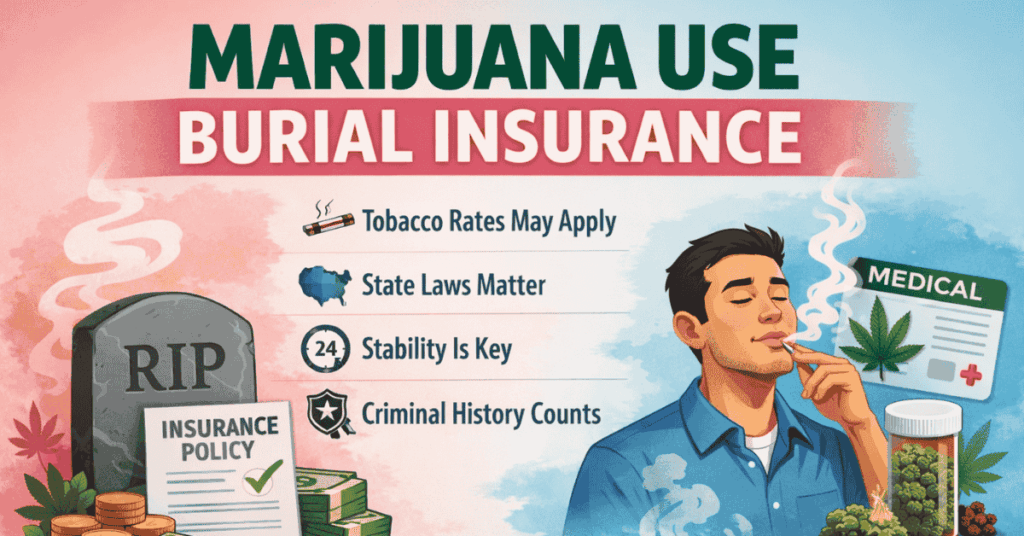
Marijuana use burial insurance key insights
- Tobacco rates often apply to users: Most insurance companies simply assign a higher tobacco premium to anyone who has used marijuana or nicotine products within the last 12 months.
- State legality affects drug disclosures: If marijuana is legal in your state, you can truthfully answer “NO” to questions about illegal drug use on most insurance applications.
- Treatment for heavy use may apply: If your marijuana use was intense enough to require therapy or medical intervention, underwriters want to see at least 24 months of stability.
- Criminal history impacts policy approval: Convictions related to the distribution of substances or other serious crimes can block you from getting the best burial insurance rates.
- Method of use changes risk profiles: While many carriers group all smokers together, some may offer better plans for edible users if they have no other respiratory issues.
I’m always on the lookout for more insurance companies that will offer affordable protection for marijuana users. Because of this, most people I help will have no trouble qualifying for and affording an instant-approval policy.
Marijuana use medical definition & health risks
Insurance underwriters classify the risk level of marijuana use by evaluating the frequency of consumption and whether it is legal under state or local legal regulations. Because marijuana can be used for both medical and recreational purposes, insurers assess usage patterns to determine if it impacts the applicant’s overall physical health or safety. While many states have legalized it, insurers still evaluate how it affects your heart and lungs. Poor control or heavy use can sometimes lead to mental health struggles or respiratory issues that concern insurance companies.
Marijuana use underwriting basics
- Testing & Test Results: Underwriters check for nicotine or THC in your system if a test is required, though most burial plans use database checks instead. They care if your use is tied to a serious underlying medical condition.
The correct use of medications over time should reduce your mortality risk, allowing the insurance companies to offer you better coverage options.
- Why it Matters: Your usage frequency determines if you pay the non-tobacco rate or the much higher smoker rate. This choice can double your monthly premium over time.
Marijuana prescription medication classes
- Medical Cannabis: Prescribed for chronic pain, glaucoma, or nausea related to other treatments.
- Synthetic Cannabinoids: FDA-approved drugs like Marinol are used for appetite loss or severe nausea.
- Anxiety Meds: Often used alongside medical marijuana to manage stress or sleep disorders.
- Respiratory Maintenance: Inhalers like Albuterol if smoking has caused any breathing irritation or COPD.
Marijuana use with comorbidities
Multiple health issues occurring simultaneously influence total insurance risk by complicating the underlying stability of your lungs and heart. When marijuana use is combined with conditions like diabetes, high blood pressure, or COPD, underwriters evaluate each factor independently to determine how the cumulative strain affects your overall life expectancy. They want to make sure your heart and lungs are strong enough for a long life. Managing these secondary issues is the best way to keep your insurance costs low.
In my experience, controlled marijuana use qualifies people for immediate level burial insurance coverage, even with secondary health issues.
Other common health issues with marijuana use
Marijuana use affects brain signaling, cardiovascular response, and respiratory function, which can impair cognition, coordination, and heart rate regulation, and can affect underwriting and policy selection when these related issues are present.
- Cognitive impairment – Slowed reaction time, reduced attention, and memory issues affect daily tasks and work performance.
- Impaired coordination – Altered motor control increases accident and injury risk.
- Anxiety and panic symptoms – THC can trigger paranoia, panic attacks, and emotional instability.
- Mood changes – Chronic use may worsen depression, motivation loss, or emotional blunting.
- Respiratory irritation – Smoking marijuana inflames the airways and can cause chronic cough or bronchitis symptoms.
- Heart rate changes – Increased heart rate and blood pressure fluctuations strain the cardiovascular system.
- Reduced motivation – Ongoing use can lower drive, consistency, and productivity.
- Sleep disruption – Use may interfere with normal sleep cycles and restorative rest.
- Dependency risk – Regular use can lead to cannabis use disorder with withdrawal symptoms.
- Work and driving limitations – Impaired judgment and reaction time increase safety and reliability concerns.
Understanding marijuana use policy types
Carriers offer different plan categories based on an applicant’s marijuana use and long-term health stability.
- Level: This plan offers 1st-day coverage and pays the full benefit immediately through companies like Trinity Life, Family Benefit Life, and Aflac.
- Graded: Graded burial insurance limits benefits during the first 24 months for health-related causes of death through Guaranteed Trust Life.
- Guaranteed Issue: Guaranteed issue burial insurance requires no health questions but includes a 2-year waiting period through Gerber Life.
Sample marijuana use rate snapshot for $10,000 coverage
Monthly burial insurance costs increase as you get older because your statistical life expectancy decreases, making you a higher risk for the insurer. Rates also vary by gender because women statistically live longer than men, allowing insurance companies to offer them lower monthly premiums for the same level of coverage.
Here are some preferred rates, but your rates can vary based on which A-rated carrier is best for your situation.
Trinity Life & Family Benefit insurance rates age 50–85
| AGE | $10,000 | $15,000 | $20,000 | $25,000 |
|---|---|---|---|---|
| 50 | F: $21 M: $27 | F: $31 M: $39 | F: $40 M: $52 | F: $50 M: $64 |
| 55 | F: $26 M: $32 | F: $38 M: $47 | F: $49 M: $62 | F: $61 M: $78 |
| 60 | F: $32 M: $41 | F: $47 M: $61 | F: $62 M: $80 | F: $77 M: $100 |
| 65 | F: $41 M: $53 | F: $60 M: $79 | F: $79 M: $104 | F: $99 M: $130 |
| 70 | F: $52 M: $69 | F: $76 M: $102 | F: $101 M: $135 | F: $126 M: $169 |
| 75 | F: $71 M: $96 | F: $106 M: $143 | F: $140 M: $190 | F: $175 M: $237 |
| 80 | F: $104 M: $145 | F: $155 M: $217 | F: $207 M: $288 | F: $258 M: $360 |
| 85 | F: $155 M: $192 | F: $231 M: $287 | F: $307 M: $382 | F: $384 M: $477 |
Rates may vary based on age, gender, health, and state.
Marijuana use underwriting & medication history
The insurance carrier identifies medical stability by reviewing your prescription history to determine whether substances are being used for medically supervised treatment or recreational purposes. Being transparent about your usage and following your state’s specific laws is a smart move during the application process to ensure your coverage is issued accurately. If marijuana is legal where you live, you can often avoid the “illegal drug” label that causes automatic declines. Consistently following your doctor’s advice for other conditions shows the insurer that you are a responsible applicant.
Your prescription history is how the insurance carriers verify medical stability. Recent hospitalizations for crises trigger postponement rather than permanent decline.
| Health Profile | Coverage Type | Wait Period |
|---|---|---|
| Recreational (Legal State) | Level | None |
| Medical (With significant health Issues) | Level to Guaranteed Issue | 0-24 Months |
| Heavy Abuse History | Level or Graded | 0-24 Months |
Real life marijuana use success stories
Real-world examples illustrate how people with marijuana use can get day-one protection with anywhere from $5,000 to $25,000 for burial, cremation, funeral expenses, final expenses, leave money for loved ones, pay off last bills, or a combination of these.
David’s story
David uses marijuana recreationally a few times a week in a state where it is fully legal. He was worried that he would be declined or forced into a 2-year waiting period. I helped him apply with Family Benefit Life, where he disclosed his usage as a tobacco user. He received instant approval for a $15,000 first-day coverage plan. This policy allowed him to arrange for his funeral costs without any stress for his family. He only pays a few dollars more per month than a non-smoker would.
Karen’s story
Karen uses medical marijuana to help with chronic back pain and minor anxiety. She was concerned that her medical history would make her insurance too expensive to afford. I found her a level coverage plan with Trinity Life that accepted her health profile. She qualified for $10,000 in immediate benefits to cover her cremation and final medical bills. She felt relieved that her medical choices did not prevent her from protecting her children’s future.
Marijuana use financial ratings & stability
Financial ratings verify a carrier’s ability to pay death claims by demonstrating that they maintain significant capital reserves to cover future liabilities. A.M. Best assigns letter grades that serve as a benchmark for an insurance company’s financial health and its long-term reliability for policyholders. The BBB rating tells you if the company treats its customers with respect and pays claims on time. You should always look for a company with high scores to make sure your money is safe for the long run.
Insurance carrier ratings & comparisons
| Carrier | A.M. Best | BBB | NAIC Complaints |
|---|---|---|---|
| Aflac | A+ (Superior) | A+ | Low |
| CICA | B++ (Good) | A+ | Low |
| Colonial Penn | A (Excellent) | A+ | High (300% Above Avg) |
| Family Benefit Life | A+ (Superior) | A+ | Low |
| Guarantee Trust Life | A (Excellent) | A+ | Low |
| Senior Life | Not Rated | A+ | High (300% Above Avg) |
| Trinity Life | A+ (Superior) | A+ | Low |
Frequently asked questions: marijuana use and burial insurance
Can individuals who use marijuana qualify for burial insurance?
Specialized burial insurance companies approve marijuana users every single day because these plans are built for seniors with all kinds of lifestyle habits. I have sat with plenty of folks who think their evening gummy or medicinal vape makes them uninsurable, but honestly, it just does not make sense to go unprotected when most carriers see this as a minor issue. While traditional life insurance might require a medical exam and blood tests, burial insurance uses simplified questions that focus on your major health history. Most applicants qualify easily, though the specific plan you get often depends more on the health condition you are treating than the marijuana itself. You do not have to settle for a “bad deal” just because you use a plant that is legal in most states.
Does marijuana use lead to higher smoker burial insurance rates?
Your monthly premium depends entirely on how often you use marijuana and whether you are inhaling smoke or consuming edibles. Many burial insurance carriers will offer you their best non-smoker rates if you only use marijuana occasionally or strictly stick to edibles and oils. But here is the part they do not tell you in the commercials: if you smoke or vape daily, most companies will dump you into the “smoker” category, which can easily double your monthly cost. You should not have to pay a “convenience tax” for smoking if you can qualify for non-smoker rates with a different company. I run a quick background check on your habits to identify the carriers most lenient with your usage.
Do burial insurance companies check for medical marijuana cards?
Insurers perform a quick background check on your prescription history and medical records to see if a doctor has authorized you for cannabis use. While the physical card in your wallet is not always their main focus, the insurance companies look at your pharmacy reports and the “Medical Information Bureau” to see what you are treating. The underwriter will investigate the underlying reason for your use, like chronic pain or anxiety, to determine if you are a stable risk. Honestly, it just does not make sense to hide your card when the insurance company already has a digital trail of your medical history. I help you disclose this correctly so your policy is bulletproof from day 1.
Is first-day coverage burial insurance available for marijuana users?
Immediate first-day coverage is widely available for marijuana users as long as you are using it for minor issues like insomnia or mild aches and pains. If you have a stable history with no recent hospitalizations or “drug abuse” flags on your record, you can often qualify for a level benefit plan that pays out in full from the very first payment. This ensures your family receives the full $10,000 or $20,000 payout regardless of when you pass away. You should never accept a 2-year waiting period for recreational or light medical marijuana use. I shop your case around to find the “marijuana-friendly” companies that give you full protection today.
Does a history of drug abuse impact marijuana burial insurance eligibility?
A recent history of treatment for addiction or “harder” drugs will almost always trigger a mandatory 24-month waiting period for a standard burial policy. If your medical records show you were in an inpatient or outpatient program within the last 2 years, you will likely be restricted to a guaranteed issue policy. These plans ensure your approval is locked in, but your family will only receive a refund of premiums plus interest if you pass away from natural causes during the first 2 years. Honestly, it just does not make sense to lie about your recovery when a guaranteed plan is a sure thing. Once you hit that 2-year sobriety milestone, we can often move you into a better plan with immediate coverage.
Can I be denied burial insurance for using cannabis?
It is almost impossible to be denied burial insurance for marijuana use alone because guaranteed acceptance plans are available to everyone between the ages of 50 and 85.
Even if a traditional carrier turns you down because of heavy use or a serious underlying illness, these guaranteed plans do not ask a single health or lifestyle question. This means you cannot be turned away because of your habits, health, or history. You should not let a past rejection stop you from protecting your family today. I find the plan that guarantees you a seat at the table so your spouse is never stuck with the bill for your final arrangements.
Does edible marijuana consumption affect burial insurance rates differently?
The method of how you consume marijuana is the biggest factor in whether you pay a low non-smoker rate or a high smoker price. Since insurance underwriters primarily worry about the lung and heart risks of inhaling smoke, many carriers are much more lenient toward users who only take gummies, tinctures, or pills. Disclosing that you do not “smoke” can often save you 50% or more on your monthly premiums. This keeps more money in your pocket while still providing the same $15,000 check for your family. Honestly, it just does not make sense to pay smoker prices if you are not actually putting smoke into your lungs.
How does the reason for medical marijuana use affect burial insurance approval?
The insurance company cares much more about the disease you are treating than the fact that you use medical marijuana to treat it. If you are using it for a serious condition like active cancer or a recent stroke, those major health events will dictate your plan type and price. But if your underlying illness is something manageable like back pain or glaucoma, you can still qualify for affordable, immediate-approval coverage. I look at your entire health profile to ensure we match you with a company that understands your specific situation. This prevents you from being unfairly “rated” for a condition that is already under control.
Why is it important to disclose marijuana use on the burial insurance application?
Honesty on your application is the only way to protect your beneficiaries from having their claim denied during the two-year “contestability period.” During the first 2 years of a policy, the insurance company has the right to investigate your medical records after you pass away to see if you were truthful. If they find you claimed to be a non-smoker but were actually a daily marijuana smoker, they can void the policy and refuse to pay the death benefit. Honestly, it just does not make sense to save a few dollars a month if it puts your family’s $10,000 safety net at risk. I make sure your application is 100% accurate, so the check is a guarantee for your kids.
What happens to burial insurance if I am a daily marijuana user?
Daily marijuana users are often viewed as higher-risk candidates, but that does not mean you are stuck with a bad policy or a high price. Depending on the company, daily use might result in a “smoker” rating, but some marijuana-friendly carriers still offer standard non-smoker rates to daily users if it is for a minor medical reason. Working with an independent agent allows you to skip the “tobacco trap” that most big-name companies set for you. I perform a quick background check on your options to find the few companies that do not penalize you for your daily routine. This ensures your family gets the most protection for the lowest possible cost.