How Life Insurance Height & Weight Build Charts Work
 last updated on April 14, 2026
Here’s the Bottom Line:
• A build chart can raise your price or get you declined
• Your height and weight directly impact your life insurance approval
• Being overweight doesn’t mean being denied, but it often means a higher cost
• Different companies have very different weight limits and flexibility
• Applying blindly can push you into worse pricing or waiting periods
• Some burial insurance plans are more forgiving than traditional policies
A life insurance build chart is a height-and-weight guideline used by insurance companies to determine your risk level and pricing. It compares your build to what they consider a healthy range, which directly affects whether you qualify and how much you pay. Burial insurance and simplified-issue whole life policies are usually more lenient, while term life policies are stricter. The key is this: one company might approve you at a good rate, while another charges more or declines you completely. That’s where most people mess up.
Complete my quote request form on this page to get matched correctly and avoid overpaying.
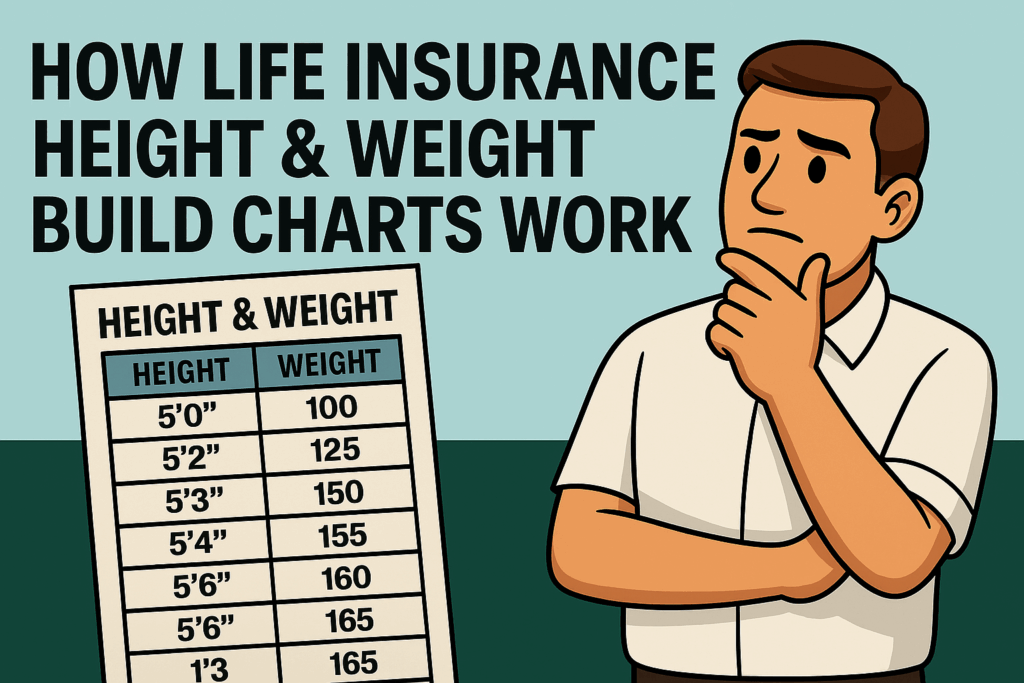
HOW HEIGHT & WEIGHT AFFECT YOUR PREMIUM CLASS
Your height and weight place you into a risk class that directly controls how much you pay for the same coverage.
Different companies may use slightly different terminology, but they all basically mean the same thing.
At the top are “Preferred” classes, which are reserved for people within a narrow weight range for their height.
The next level down is “Standard,” where most healthy adults qualify.
Below that are “Substandard” or “Modified” classes, which typically include applicants whose weight or health conditions fall outside standard limits.
A 5’8″ applicant who weighs 165 pounds might qualify for Preferred rates.
The same person at 215 pounds may still get approved but at Standard rates with slightly higher premiums due to a higher “table rating”.
Beyond that range, the policy might still be available through a graded or guaranteed issue plan.
Because build often interacts with other health factors like blood pressure or diabetes, one small change in weight can shift an application into a higher-risk category.
That’s why an experienced agent reviews both build and health history before matching a client to a company.
The lower the risk class, the lower the rate, but weight alone rarely tells the full story.
Insurers use these tables and ratings as a guideline, not a punishment.
The key is to let the Final Expense Guy match your current build to a company whose chart fits your frame rather than trying to fit yourself into one company’s chart.
COMMON COMPLAINTS WITH LIFE INSURANCE BUILD CHARTS
Below are some of the most common complaints or concerns about “build charts”:
Charts Are Not Easily Accessible To The Public
Most insurers do not publicly provide their build charts. Until an applicant submits an application or sees the results of his or her medical exam, they do not know where the limits are. This can be a shock.
An applicant often does not know they will be penalized until either they apply to the insurer or have an agent (sometimes new or poorly trained, but usually just uneducated) tell them they can apply to a preferred class, only to find out they are marginally just above or below the weight.
BMI/Weight Misclassifies Muscular Or Abnormal Body Compositions
When relying on a BMI or height-weight chart, there is a potential misclassification if an applicant has a muscular build, a low percentage of body fat, and is generally healthy and at an appropriate height.
Some people worry about if BMI and/or charts will discriminate against muscular individuals and not against fat healthy individuals. Someone who lifts weights, runs, or even has lots of muscle mass can occasionally fall into an “overweight” or “obese” rating, even though they are not overweight.
Frustratingly, these build charts do not take into account muscle composition; they only take into account pounds.
Weight History May Be Considered
If applicants have a weight history, some insurers factor in your weight history.
If you have lost weight in the last 12-24 months, some companies will factor in any recent weight loss. If you lost 100 lbs in the previous 12 months, some companies may add 50 pounds of that onto your current weight, since they know that many people do eventually put some lost weight back on.
Charts Vary Significantly When Submitted
What one insurer considers “standard,” another will consider “substandard,” or even declines, which means an exchange with a knowledgeable broker/insurance agent is essential. Many consumers find that one insurer may decline them and another insurer approves, but at significantly different costs.
Being Underweight Also Assists
It’s not just being “too heavy” either. If you’re too light for your height, many insurers would also consider this part of a medical history risk. Being petite can also impact your future life insurance with some companies!
Underwriting Policies Differ Tremendously
Some companies have lenient guidelines, but other companies have guidelines and reject or heavily rate if the applicant is over or under specific weight restrictions. Some people are shocked by their lab results that classify them as “high risk.”
When you work with a broker like the Final Expense Guy, you set yourself up for the best rates and the greatest amount of coverage.
UNDERSTANDING LIFE INSURANCE TABLE RATINGS
A table rating means you’re approved for coverage but charged more because the insurer views your risk as higher than average.
It’s not a denial. You’re approved, but your premium increases according to how far you fall outside the company’s Standard range.
Most companies use a 16-table system, marked as Table 1 through Table 16 or Table A through Table P.
Each step equals a 25% increase over the Standard premium.
A Table 2 rating means you’ll pay roughly 50% more, Table 4 doubles the price, and so on up to Table 16, which is about 400% above Standard.
The reason for a table rating can vary, such as weight above the approved chart, blood pressure, diabetes, a history of heart disease, or other manageable health issues. The company accepts the risk but charges more to offset the expected impact on life expectancy.
Here’s a simple reference table showing how those ratings translate into real-world premium adjustments.
Not all companies use every table. Some cap at Table 8, while others extend to 16 for complex cases. The higher the table, the higher the cost, but it’s still far better than being declined entirely.
Final expense policies usually skip table ratings. They use fixed categories instead, such as Preferred, Standard, and Modified, which makes them more straightforward for seniors or applicants with moderate health issues.
If you’re assigned a table rating, a good broker can often find a company that would approve you at a lower table or even Standard, just by comparing underwriting tolerance across carriers.
Build, age, and history all weigh differently depending on the insurer.
That’s the advantage of working with an independent broker like the Final Expense Guy instead of a call center quoting one company’s strict chart. You don’t have to fit their table. You just need the right table for you.
🔍 The Agent Who Quoted Preferred
Local agent quote, Preferred class implied, Dan believed his weight wouldn’t change the outcome.
Dan, 54, sat through a kitchen-table pitch where the agent quoted Preferred rates without checking build, then submitted the app the same night.
The missing piece was the table rating applied after underwriting, which stacked his build with blood pressure and quietly shifted him upward.
I pulled the underwriting notes, explained how the table was assigned, and re-matched him to a carrier that read his profile differently.
The result was a $20,000 policy that pays immediately for burial and final expenses once approved.
WHY INSURERS USE BUILD CHARTS
Insurance companies using build charts for life insurance is a decades-old practice.
The insurance companies created these charts because they know that certain health factors, like being underweight or overweight, can influence mortality rates.
Being too far above or below average is almost always indicative of problems associated with specific health problems.
More companies are now offering “simplified issue” or “no medical exam” guidelines, which often do not include strict build charts or provide more flexibility (at a higher price or other qualifications). Many insurance applicants prefer these options, especially in situations where build charts result in policies that are too costly or would result in a decline.
There are options for almost every height and weight. When you check with the Final Expense Guy, he’ll make sure you get the best deal.
PROS & CONS OF LIFE INSURANCE BUILD CHARTS
From the insurer’s perspective, using a height and weight chart adds consistency and predictability to the underwriting process. They standardize risk assessment so that those with similar health risks are underwritten in a similar way.
This provides a way for insurance companies to price fairly (from their standpoint) and limits arbitrary decisions.
From the insured’s perspective, this can be frustrating if they are over or under the build chart limits and are then charged more, or possibly declined for coverage.
A person may be subject to a rate class penalty because they are “over” a chart cutoff by just a couple of pounds, even though all other health metrics are well within normal ranges. This may feel unjust.
Also, using BMI or weight classifications can be misleading as charts don’t typically differentiate between fat, muscle, bone density, or body composition.
As an extreme example, a weight lifter or athlete could be rated in a lower class for having more muscle.
If you are underweight or overweight, you need a broker like the Final Expense Guy who will shop your application with many different insurance companies so you can get the lowesnt rate and best coverage.
TYPICAL LIFE INSURANCE HEIGHT & WEIGHT CHART EXAMPLE
Sample build charts show how small weight differences can shift you between rate classes depending on the insurer.
This example uses general industry averages and does not represent any single insurer. Actual numbers vary by company, age, and policy type.
These ranges demonstrate why working with the right company is crucial. If you’re slightly outside one carrier’s “Standard” column, another may still classify you as “Preferred.”
Mutual of Omaha, for example, often allows broader weight tolerance for seniors.
Prosperity Life tends to be more forgiving for men with higher BMI, while Aetna’s build table leans tighter.
The takeaway is simple: don’t assume one rejection means you’re uninsurable. It just means you’re talking to the wrong company.
WHEN YOUR WEIGHT PUTS YOU IN A DIFFERENT PLAN TYPE
If your weight falls outside standard limits, insurers often move you into graded or guaranteed plans instead of declining you.
For whole life insurance for seniors, there are three common categories for people who don’t meet the Preferred or Standard insurance build charts.
Level or First-Day Coverage Plans:
These plans pay 100% of the benefit starting from the exact moment you make your first premium payment.
This is the best coverage available, and it does get you the lowest rates.
Graded or Modified Benefit Plans:
Graded plans pay a percentage of the death benefit during the first two years. If death occurs in year one, the beneficiary may receive only 30 to40% of the benefit. In the second year they may pay out 50 to 70% of the benefit. After the second year passes, the policy pays in full.
These refund all premiums plus interest if death occurs within the first two years. The full death benefit becomes available afterward.
Guaranteed Issue Plans:
These plans have no medical questions at all, and anyone can qualify regardless of build, but they always include a two-year waiting period and higher premiums.
Most people don’t realize how many options exist between “approved” and “declined.”
Independent brokers specialize in finding carriers that stretch their insurance build charts far enough to qualify someone for first-day coverage. It’s common for one company to decline an applicant while another approves them instantly.
Build is only one factor.
Other issues, such as diabetes, blood pressure, and mobility, are reviewed alongside it.
Someone moderately overweight but otherwise healthy can usually still get first-day coverage through a simplified issue plan.
The key is never to accept a graded or guaranteed issue policy until a broker checks every carrier’s chart. 97% of the people who apply at the Final Expense Guy qualify for 1st-day coverage and the lowest rates.
💡 The No-Questions Shortcut
TV ad call, no health questions implied, Louise believed waiting periods were optional.
Louise, 72, called a TV ad promising fast approval and no exams, and the rep pushed a plan that skipped questions and rushed payment.
The trap was a graded benefit that delayed full payout, which the rep hadn’t explained while focusing on speed.
I reviewed her build, medications, and stability, then showed how a simplified issue plan could show day 1 coverage.
She chose a $25,000 whole life policy that pays immediately to cover cremation and final bills.
WHEN YOUR WEIGHT PUTS YOU IN A DIFFERENT PLAN TYPE (TERM LIFE INSURANCE)
In term life insurance, weight affects pricing tiers rather than whether the policy type changes.
Instead, it moves you between risk classes, and those classes directly control what you pay. This is how table ratings work for term policies.
When you apply for term coverage, the insurer looks at your height, weight, and overall health to decide which class you fit into.
Every step away from the Standard chart increases your cost. The difference between classes isn’t about coverage approval, but about the price you’ll pay for the same death benefit.
Here’s what that usually looks like:
- Preferred Plus or Preferred: This is the top tier. It’s for people who meet tight height and weight limits and have no health issues. Very few applicants qualify here. These policies have the lowest possible rates.
- Standard or Regular: This is where most healthy adults qualify. You might be slightly over the “ideal” build but still within the insurer’s range for normal risk.
- Substandard or Table-Rated Classes: This is where build becomes a pricing factor. Instead of denying you, the insurer approves your policy but applies a table rating.
Each table level adds about 25% to your premium.
A Table 2 rating is roughly 50% higher than Standard, and a Table 8 rating is about double. Table ratings can go as high as 16, depending on the company’s underwriting guidelines. - Decline: If your build falls completely outside the insurer’s tolerance, or if your weight combines with serious health issues, the application can be declined. That doesn’t mean you’re out of options. It just means you need a company with broader charts or a simplified issue policy designed for seniors or higher-risk applicants.
Even slight differences in weight can result in hundreds of dollars of additional cost over the policy’s life. That’s why it’s critical to compare multiple companies instead of relying on a single quote engine that only assumes a Preferred rate.
Independent brokers such as the Final Expense guy know which insurers allow wider build ranges and which ones tighten their charts for larger coverage amounts.
They can often move someone from a Table 4 rating to a Standard rating just by choosing the right company.
If your weight, or BMI, has been steady and your health otherwise good, you can usually qualify for affordable term coverage without being penalized. The key is applying with the insurer whose chart matches you, not trying to squeeze into one that doesn’t.
WHY HEIGHT & WEIGHT MATTER MORE FOR TERM THAN FINAL EXPENSE
Higher death benefits make term insurance far stricter about build than final expense policies.
Term coverage is designed for large death benefits, typically ranging from hundreds of thousands to millions of dollars.
Because the payout is higher, underwriting is understandably tighter.
Building charts for term policies is precise, and even a few pounds over the limit can change the risk class or trigger a request for a full medical exam.
Final expense insurance works differently.
These policies are smaller, designed to cover burial and funeral costs, and are issued to older adults. Insurers recognize that most applicants won’t meet textbook BMI standards, so they adjust their criteria accordingly.
They focus more on overall health stability and medical history than on a specific weight number.
Here’s a comparison of how term and final expense plans treat build during underwriting.
This difference is why so many seniors succeed with final expense policies after being denied term coverage.
Term insurance looks for “ideal” builds. Final expense plans look for practical ones. If your weight has been steady and your health otherwise normal, a simplified issue whole life plan is often the best option.
When you apply through a broker like the Final Expense Guy, they can target the companies most likely to approve you for first-day coverage without an exam.
WHY EVERY COMPANY’S BUILD CHART IS DIFFERENT
Each life insurance company sets its own height and weight limits based on its internal risk data, not an industry standard.
No two insurers use the same build chart.
Each company designs its own based on decades of internal mortality data. That’s why your weight might be acceptable for one company but over the limit for another.
Some carriers, such as Aetna and Guarantee Trust, tend to be more lenient, especially for seniors or individuals over the age of 60. Others, such as Mutual of Omaha or Americo, may have more restrictive height and weight charts.
Older applicants are often allowed higher weight ranges since risk from build naturally levels off after age 65. Younger applicants applying for longer-term policies may be scrutinized more closely.
What most people don’t realize is that online quote engines rarely consider these important details.
Most online quotes, or commission-hungry life insurance agents, will quote you as a “Preferred” build. They then say, “There’s been a problem with your application,” and try to upsell you into a more expensive policy.
That’s why it pays to work with an independent agent like the Final Expense Guy who understands insurance build charts across multiple carriers.
A quality broker can identify which companies will approve your exact height and weight for first-day coverage with or without a medical exam.
⚠️ The Postcard That Looked Universal
Carrier postcard • wording implied broad acceptance • Maria believed her height and weight wouldn’t matter.
Maria, 67, brought in a glossy postcard that said coverage was available regardless of build and age, and she’d called the number listed after seeing neighbors mention it.
The hidden issue was the fine print that tied approval to one carrier’s narrow chart, which treated her steady weight as outside range even with normal vitals.
I reviewed the postcard language and her medical notes, then showed how another carrier allowed wider tolerance for seniors with stable records.
She left with a $15,000 whole life policy that pays immediately to cover funeral and final bills from day 1.
WHY “BMI” DOESN’T TELL THE WHOLE STORY
BMI gives insurers a rough risk signal, but it often misrepresents actual health and long-term mortality.
It was created as a population statistic, not a medical diagnostic tool. Insurance companies still reference BMI because it correlates roughly with mortality risk, but it’s far from perfect.
A muscular person might have a BMI of 30 and be labeled “obese” even if their blood pressure, cholesterol, and heart health are excellent.
On the other hand, a person with low muscle mass and a thin build could have a “healthy” BMI yet poor cardiovascular fitness.
That’s why many insurers supplement BMI with additional context. They may ask whether you exercise, whether you’ve had recent medical exams, or whether your doctor has recorded any related health concerns.
In simplified issue final expense plans, BMI still matters, but it’s treated more flexibly. The focus is on whether your weight has caused related conditions, not on the number itself. A stable weight with normal blood work is often acceptable, even if it falls outside the normal range.
In term life insurance, BMI matters much more because the coverage amounts are larger and the underwriting is stricter.
The insurer isn’t just looking at whether your weight has caused health issues; they’re measuring how closely your build aligns with long-term mortality data. A healthy BMI can mean the difference between a Preferred or Standard rate class.
Still, if your lab work, blood pressure, and medical history are stable, many carriers will overlook a few extra pounds as long as the rest of your profile shows low risk.
Underwriters also consider gender and age when interpreting your build. A 70-year-old woman who is slightly overweight poses far less long-term risk than a 35-year-old man who is twice his recommended BMI.
When BMI and build numbers don’t match your actual health picture, that’s when a broker’s experience matters most. They know which insurers read those charts like rigid formulas and which look at the whole person.
HOW AGE AND GENDER IMPACT HEIGHT & WEIGHT REQUIREMENTS
Age and gender influence how much weight insurers consider acceptable at a given height.
Many insurance companies have more lenient weight requirements as you get older. This is because many people experience weight gain as they age.
Also, men typically have higher muscle mass and bone density, so their weight thresholds are usually higher than those of women of the same height.
Women, on the other hand, may be offered more favorable rates within lower BMI ranges because their long-term mortality data is stronger in many age brackets.
RED FLAGS WHEN AGENTS IGNORE BUILD CHART RULES
Agents who quote rates without checking build details often cause pricing surprises or coverage delays.
Call centers are the worst offenders.
They often quote prices based on the lowest possible rate class, then quietly switch your application to a more expensive and higher table-rated plan once underwriting comes back from the insurance company.
Some agents claim they “work with over 30 companies” and can get anyone approved. This is almost always a lie.
They may have access to over 30 companies, but are they actually contracted and approved to do business with these companies?
The answer is “no”, so go find another agent if your agent says this and can’t prove that they are contracted with over 30 companies. Little lies lead to big lies, so don’t tolerate this behavior at all.
This misrepresentation is dishonest, and it’s how clients end up with overpriced or delayed coverage. The truth is, experienced brokers know exactly which few companies are best for each body type, age, and health situation.
WHAT TO EXPECT MOVING FORWARD
There is a trend towards “simplified underwriting”.
There is growing availability for simplified issue and final expense insurance that is less strict or even has no height & weight chart limits. These can make for a solid backup option for anyone who struggles with strict build charts.
Insurance companies are also adapting and using alternative criteria, such as Body Mass Index (BMI), waist circumference, or laboratory data, instead of relying solely on weights measured on a scale.
Some of these options are more appropriate than others for people whose height or weight would otherwise exclude them from coverage. It’s to your advantage to let the Final Expense Guy do the shopping for you.
WHAT IF YOU DON’T MEET THE CHART REQUIREMENTS?
Here are several strategies if you’re a bit out of the required “build chart” specifications:
Improve Your Health Metrics
If it’s medically safe, lose weight, reduce blood pressure, improve cholesterol, and improve blood sugar control. Even if you only have modest improvements, that may push you into a better rate class.
Wait And Stabilize Your Weight
Sometimes the underwriters want your weight to be stable for a few months. If you’ve recently lost weight, your medical history still counts. Sometimes waiting until your weight stabilizes can be beneficial before you apply.
Consider More Than One Insurance Company
Charts vary greatly in detail between carriers. Some are more forgiving. The Final Expense Guy can direct you to more forgiving or more favorable build charts, which can lead to better rates.
Consider Final Expense or Burial Insurance
These types of policies often have less strict build charts or may not have them at all.
Consider Guaranteed Issue or Simplified Issue Coverage
Companies offering guaranteed-issue polices don’t have any medical exams or ask any health questions. A simplified issue may not have all the medical requirements as a fully underwritten policy.
Fully Disclose Your Health History
Always be honest and upfront on your application. The underwriters will check your records for health or medical impairments. If they find out you have omitted specific details, it’s not going to benefit your application for coverage.
Seek Out Expert Or Broker Help
Any broker or agent who knows the insurance market can get you set up with a company with more forgiving build charts or better underwriting. The Final Expense Guy is an example of someone who can help anyone with weight/build challenges find better rates and competent help.
You don’t have to decide on this today, but the Final Expense Guy recommends you at least look into your best options, and then decide what to do from there.
WHAT TO DO IF YOU WERE DECLINED FOR BUILD
A build-based decline usually means the application went to the wrong company, not that coverage is unavailable.
It usually means your agent submitted your application to a company whose chart was too narrow for your body type.
The first step is to request a reason for the denial. Some insurance companies provide this, others do not.
Every insurer keeps internal notes that show exactly why an application was rejected. If the only reason listed is “build exceeds limits,” that’s valuable information for your next application.
Once you have that information, your broker can compare your height and weight to those of other companies’ charts. You might find that another carrier will approve you instantly, even though another did not.
Never reapply to the same company after a denial. Each new submission triggers the creation of another record in the Medical Information Bureau (MIB), which can slow down future approvals.
Instead, let a competent broker like the Final Expense Guy match your application to a carrier that’s more lenient before resubmitting.
If your weight has been stable and your vitals are normal, those notes can support your next application. Underwriters often make more favorable decisions when they see medical stability, even at higher weights.
If your build is combined with other conditions, such as diabetes or high blood pressure, a broker may recommend a simplified issue plan.
These policies skip medical exams and use short questionnaires instead of full underwriting. Many accept wider build ranges without downgrading to a graded benefit.
A decline due to your build is fixable. It just takes the right match between you and the insurer that evaluates your build realistically.
WHICH COMPANIES ARE MORE FLEXIBLE ON INSURANCE BUILD CHARTS
Some insurers allow wider height and weight ranges because they focus on older ages or smaller policies.
Some carriers are lenient because they focus on older applicants or smaller face amounts, while others are strict because they target younger, higher-value policies.
Insurance companies like Mutual of Omaha, Aetna, and Prosperity Life tend to allow more flexibility. They understand that most clients are in their 50s, 60s, or 70s, and weight naturally fluctuates with age. In contrast, companies that sell large term life policies, such as Americo or AIG, may apply stricter guidelines.
HOW TO QUALIFY FOR FIRST-DAY COVERAGE EVEN IF YOU’RE OVERWEIGHT
Stable health and the right carrier choice often matter more than hitting an ideal weight number
Insurers look at patterns, not perfection. If your weight is stable and your doctor hasn’t noted complications, there’s usually a carrier that will approve you.
An experienced life insurance broker begins by identifying companies with a wider range of build options. They’ll also check whether your other health factors balance the chart.
For example, if your blood pressure and cholesterol levels are normal, a positive family history can offset a few extra pounds.
Simplified issue plans are the most forgiving. These policies don’t require a medical exam and typically approve clients within minutes. They use yes-or-no health questions instead of full lab results, so weight plays a minor role.
Fully underwritten plans are the most stringent type of life insurance. They require a medical exam, blood tests, and sometimes even a doctor’s report. The company studies every aspect of your health, including your build, lab results, and medical history, to determine your risk level.
Because the payout amounts are higher, weight matters more in this case than it does with simplified issue coverage. If you meet the company’s build chart requirements and your health numbers are solid, you’ll receive the best available rates.
The process takes longer, but it’s designed for precision. And that precision can save you money when your numbers fall inside their ideal range.
The best strategy is to work with someone who already knows which carriers are most flexible. They can place you directly with the right company, eliminating the need to submit multiple applications and risk a denial that appears on your record.
The weight number itself doesn’t disqualify you. The issue is finding the insurer whose chart matches your build and age.
SUGGESTIONS FOR GETTING THE LOWEST LIFE INSURANCE RATES
Here are a few suggestions to get working on if you know you’ll want some life insurance in the future:
- Start managing your cholesterol, blood pressure, and blood sugar levels even if you’re slightly over ideal weight. Don’t worry about getting off your medications, as these are a non-issue as long as you go with the right company the first time.
- Slowly and safely lose weight. New medical or health issues can occur from crash dieting, and the insurance company will often review your weight over the last 1-2 years, so crash dieting doesn’t fool the life insurance companies.
- Stop smoking. Non-smokers get much lower rates than smokers…because it helps you live longer. The insurance companies will often ask you how long you have smoked and how long it’s been since you quit.
- Also, be aware that many people put on weight after quitting smoking, so you may be better off applying at smoking rates rather than overweight rates.
HOW TO READ YOUR LIFE INSURANCE APPLICATION’S BUILD SECTION
The build section records your physical measurements and determines how underwriting classifies your risk.
It usually appears in the first few questions under “Medical Information” or “Physical Measurements.”
You’ll see fields for height, weight, and sometimes waist size or body mass index. These answers are used to compare you against the company’s internal build chart. Agents must fill in those numbers accurately, and any discrepancy can delay the underwriting process.
If the application asks for a weight range, always use your current number, not what you expect it to be.
Underwriters verify your height and weight through prescription histories, medical records, or previous insurance exams. Guessing or rounding down can create inconsistencies that slow down approval or cause denials.
In fully underwritten policies, a paramedical examiner measures you directly during the in-person exam.
For simplified issue or final expense policies, you simply state your numbers, and the company checks them against database records.
When reviewing your policy documents after approval, look for a section labeled “Risk Class” or “Build Category.” That’s where the insurer lists the class you were approved under, such as Preferred, Standard, or Modified.
If the build section was a concern, it may be noted in the underwriting notes or comments.
Understanding what this section means helps you catch mistakes and verify that your agent applied to the right company. Too often, people are misclassified simply because their agent didn’t double-check how their build fit the chart.
If something looks off, ask your broker to re-shop your coverage with a carrier that has a wider range, or even better, locate a more experienced broker. Build-related declines and misclassifications are easy to fix for a competent life insurance agent, so don’t settle for a lousy or inexperienced agent.
WHO REGULATES LIFE INSURANCE UNDERWRITING STANDARDS
Insurance regulators oversee fairness and solvency but allow companies to set their own build rules.
No federal or state law sets a universal height and weight requirement for life insurance. Each company creates its own internal standards based on years of claims data, mortality studies, and actuarial research.
What is regulated are the business practices surrounding those decisions.
The National Association of Insurance Commissioners (NAIC) oversees national standards for financial solvency and consumer protection. Every state insurance department enforces those rules to make sure companies act fairly and remain financially stable.
Underwriting guidelines, including insurance build charts, fall under what regulators refer to as “proprietary risk evaluation.” Insurers are allowed to determine their own acceptance criteria as long as those criteria are applied consistently and don’t discriminate based on race, gender, or disability.
Organizations like A.M. Best rate companies based on their financial strength, rather than underwriting flexibility. That means an A+ rating shows the company can pay claims but says nothing about whether their build chart is lenient or strict.
Below is a quick reference of who regulates what in the life insurance industry.
| Organization | Primary Role | Focus Area |
|---|---|---|
| NAIC | Develops national regulatory standards | Consumer protection, insurer solvency |
| State Insurance Departments | Enforces state-specific rules and licensing | Market conduct, complaint resolution |
| A.M. Best | Evaluates financial strength and claim-paying ability | Insurer stability |
| Better Business Bureau (BBB) | Tracks consumer complaints and reputation | Public trust and service quality |
FREQUENTLY ASKED QUESTIONS: LIFE INSURANCE HEIGHT & WEIGHT BUILD CHARTS
How do height and weight affect life insurance approval and pricing?
Insurers use build charts to assign you a risk class. A few pounds can move you from Preferred to Standard or into a higher-cost category. Different companies use different charts, so one denial doesn’t mean you’re uninsurable. The smartest move is comparing carriers before applying. That’s where working with the Final Expense Guy saves you from overpriced quotes.
Can you get life insurance if you’re overweight or obese?
Many overweight applicants still qualify for life insurance. The key is matching your build to a company with wider guidelines. Fully underwritten policies are stricter, while simplified issue and final expense plans are far more forgiving. Applying blindly can trigger higher costs or denials. The Final Expense Guy shops carriers that approve first-day coverage despite weight.
Which life insurance companies are most lenient on height and weight?
Carrier build limits vary widely by company and policy type. Leniency varies by age, policy type, and coverage amount. Some insurers allow wider build ranges for seniors or smaller policies, while others tighten limits aggressively. Online quotes rarely reflect these differences. An independent broker already knows which companies fit your build. That’s how the Final Expense Guy avoids trial-and-error applications.
Does BMI matter more than height and weight for life insurance?
BMI gives insurers a rough risk signal. Insurers know BMI mislabels muscular or older applicants. Many companies weigh build alongside medical history and stability. Simplified issue plans rely less on BMI than term policies. A broker helps place your application where BMI won’t hurt you.
Can weight alone cause a life insurance denial?
A build chart mismatch can trigger a denial. That doesn’t mean coverage isn’t available elsewhere. Many declines are chart-specific, not health-based. Reapplying correctly fixes most build denials. The Final Expense Guy handles that before your record gets cluttered.
Is final expense insurance easier to qualify for with weight issues?
Final expense policies usually allow wider build ranges. These policies are designed for older adults and smaller coverage amounts. Insurers focus on health stability, not perfect build numbers. Many applicants qualify for first-day coverage even when term policies decline them. That’s why Final Expense Guy options work so often.
Do life insurance build charts differ between companies?
Insurers set their own build charts. There’s no industry standard. One company’s Standard is another company’s decline. That’s why single-company quotes are dangerous. A broker compares charts before submitting your application.
Should you lose weight before applying for life insurance?
Waiting to apply can leave you uninsured if your health changes. Waiting can backfire if health changes. Coverage today protects your family immediately. The Final Expense Guy helps lock something in now, then improves it later if possible.
What happens if you’re underweight for life insurance charts?
Low weight can raise underwriting concerns. It may signal underlying health concerns. Some companies penalize low weight more than moderate excess weight. Choosing the wrong carrier leads to higher costs. A broker avoids those traps.
Can a broker help lower life insurance rates despite build issues?
A broker can cut costs by placing you with a better-fitting company. Table ratings and downgrades are company-specific. Switching carriers can remove them entirely. Call centers won’t do this. The Final Expense Guy does it every day.
Are online life insurance quotes accurate for height and weight?
Most instant quotes start from the best-case rate class. That’s why prices change after underwriting. It’s a bait-and-switch most buyers don’t expect. Accurate quotes require knowing the carrier’s chart first. That’s the difference with the Final Expense Guy.
What’s the best life insurance option if you don’t meet build charts?
Simplified issue and final expense plans fit many people outside strict charts. They avoid strict charts and medical exams. Many offer immediate coverage. Guaranteed issue should be the last option, not the first. A broker checks everything before settling.
INDUSTRY SOURCES AND DATA REFERENCES
Credible actuarial and regulatory sources help separate real underwriting rules from sales fluff.
Experienced agents use the following sources to verify insurer strength, underwriting guidelines, and mortality statistics.
A.M. Best: The leading independent agency that rates the financial strength of insurance companies.
National Association of Insurance Commissioners (NAIC): Oversees state-level regulation and consumer protection.
Centers for Disease Control and Prevention (CDC): Publishes national data on BMI and mortality trends used in actuarial research.
Social Security Administration (SSA): Maintains U.S. life expectancy and actuarial tables used by many insurers to calculate long-term risk.
Better Business Bureau (BBB): Tracks consumer complaints and service history for insurance companies.
Using verified sources protects consumers from sales pitches disguised as “official data.” A broker who references real actuarial and regulatory information can immediately spot misleading claims.
Life insurance companies use a weight and height chart to help assess risk and set premiums. Generally, individuals with a healthy weight are likely to pay lower premiums than those who are overweight or obese.
